
AI transformation inside most companies is a mess right now, even though every board deck somehow says it’s going great.
Look one level down and you get a very different picture:
- Engineering: Shipping more code, then spending more time checking what AI broke.
- Sales development: Automating outreach while buyers get better at ignoring it.
- Marketing: Producing more content than anyone could possibly consume.
- HR: Using AI to write applications and then using AI to reject them.
- Customer service: Celebrating deflection while the customer still wants their refund.
I sell AI Employees, so I’m standing in the middle of this too. And honestly, I freaking love what’s happening. A lot of the traditional organization probably does need to be rebuilt.
But we’ve gotten way too comfortable using AI activity as proof of AI return.
So we surveyed leaders at 220 companies and asked something much harder: Where did you expect AI to make money, and where is it actually making or saving money?
The gap between those two answers is where things get interesting.
Where AI Is Actually Paying Off
For this research, “AI saved me a few hours” wasn’t enough. We were looking for actual financial impact: lower spending, hires companies no longer needed to make, or additional gross profit after accounting for the cost of the AI, implementation, oversight, and mistakes.
Almost every company can point to something AI made faster. Far fewer can point to where that speed actually changed the economics of the business.
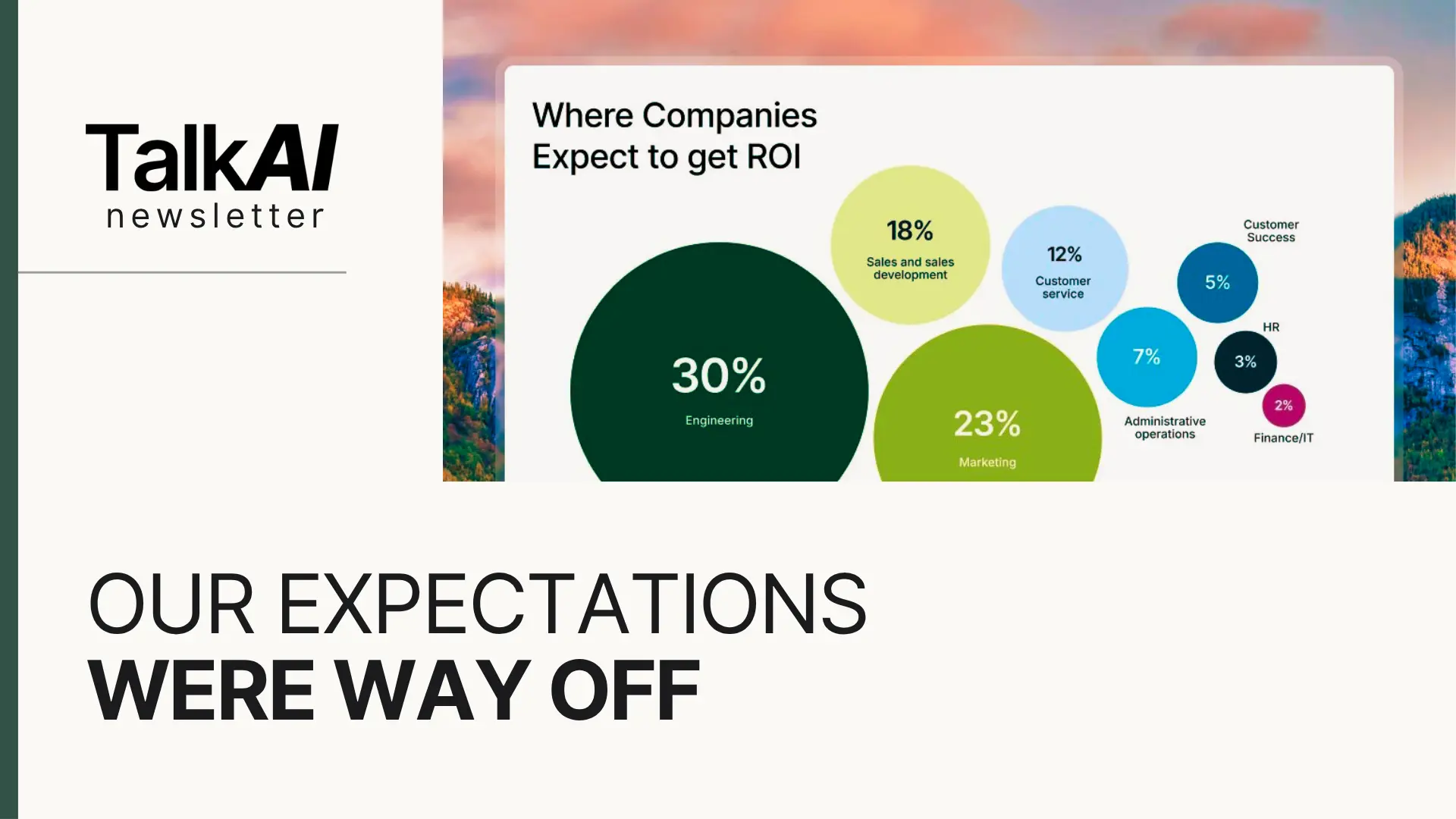
Engineering came out on top for both expected and actual ROI. That makes sense. Engineering teams are large, the labor is expensive, and AI can now handle a meaningful chunk of the work. But producing more code isn’t the return. If the same team can ship what the company needs with less spend or without hiring, that’s where the value shows up.
Customer service was the surprise. It ranked fourth in expectations but second in actual returns. Only 12% expected it to lead on ROI, but 23% said it ended up being their biggest financial win.
The reason is pretty straightforward. The calls and tickets already exist, and companies are already paying people to handle them. If AI takes over enough of that work to lower the cost without hurting service, you can actually see the result in the budget.
That’s different from celebrating “deflection” because fewer customers reached an agent. If the customer gave up and still wants their refund, you didn’t save anything worth celebrating.
Sales and sales development ranked third on both lists. The trap here is mistaking activity for return. More outreach, faster follow-up, and higher volume all look productive, but they don’t matter much if pipeline quality and cost stay the same.
The real win is when AI helps the team create better opportunities more efficiently.
Customer success also performed better than companies expected, coming in fourth in actual returns after ranking sixth in expectations. If AI can help a CS team onboard customers, answer repeat questions, and cover smaller accounts without adding the next CSM, while retention and service hold up, the savings are real.
That’s what the winners have in common. They start where the cost is already obvious, then use AI to take that cost down.
The Boring Work Might Be Easier to Justify
Administrative operations ranked fifth on both lists, with HR moving from seventh in expectations to sixth in actual returns.
Neither one sounds particularly exciting compared with an autonomous salesperson or an AI engineer. But order entry, document processing, calendar management, interview scheduling, candidate screening, onboarding paperwork, and routine employee questions all consume paid labor every day.
If AI can reliably take enough of that work off the table to reduce outsourcing, agency fees, or the need for another hire, the math is pretty easy to understand.
Finance and IT support ranked eighth on both lists. AI can absolutely help with invoices, reconciliations, password resets, and routine tickets, but there’s another lesson hiding there: a useful automation isn’t automatically a large financial opportunity.
If only one or two people were doing the work to begin with, there’s a limit to how much company-wide ROI you can create.
That matters because companies tend to chase the use cases that look impressive instead of asking where there’s actually enough cost or revenue sitting underneath the work to matter.
Marketing Has the Biggest Reality Gap
Twenty-three percent of leaders expected marketing to deliver their biggest AI return. Only 5% said it was actually producing their biggest financial win.
That doesn’t surprise me.
AI can make a marketing team incredibly busy. It can produce posts, emails, ads, decks, landing pages, campaign ideas, and variations of all of them faster than any team could before.
The output is obvious, so the productivity feels obvious too. But buyers don’t owe you money because you made more stuff.
If acquisition costs haven’t dropped, agency spending hasn’t fallen, and gross profit hasn’t moved, then the company hasn’t created much financial value. It just built a faster content factory.
That’s the difference between AI making work easier and AI making the business better.
If the Numbers Don’t Change, Where’s the Return?
This research has made me much more skeptical of how companies talk about AI adoption.
I don’t really care how many people used Claude this week or how many workflows got automated. I want to know how much work AI actually took over and what changed financially because of it.
Show me the hire you didn’t need to make, the contractor spend that disappeared, the support cost that came down, or the gross profit that went up.
Everybody feels more productive right now. Great.
Where did the money go?
That’s the question I’d want on every AI transformation deck right now. Not how many employees are using AI, how many prompts were sent, or how many workflows were automated.
If the numbers don’t move, I’m not sure we should be calling it ROI.