
People are much better at spotting BS than companies seem to think.
You can give an AI a human name. You can polish bad writing until it sounds profound. You can call an unstructured sales call “conversational.”
People still know when something is off.
The problem is not the technology, the content, or the sales process. It is the assumption that presentation can replace honesty and clarity.
It can’t. When people have to figure out what is really happening, find the point themselves, or assemble your story for you, you have already lost them.
Let’s get into it.
Your AI Should Admit It Is AI
Should an AI salesperson or customer service rep tell people it is AI?
My answer is yes. Always.
I recently had a support conversation where the “agent” had a name, a photo, and kept talking like a real person.
- The responses came back instantly.
- Every sentence was strangely polished.
- It dodged simple questions while repeating the same empathy over and over.
So I finally asked, “Are you an AI?”
It replied, “I’m part of the customer experience team.” That was the moment I almost lost my sh*t. I was not annoyed that it was AI. I was mad that the company thought I was stupid enough not to notice.
Not because AI is bad, but because hiding it is stupid.
The moment a customer realizes they have been talking to a machine that was pretending to be a person, you have turned a technology win into a trust problem.
And they will figure it out.
The AI responds too fast, it never gets tired, it remembers everything. It is available at 2:13 in the morning.
Eventually someone asks the wrong question, the mask slips, and the customer stops thinking, “That was helpful.” Now they are thinking, “Why did this company lie to me?”
Some teams refuse to disclose because they are scared customers will not engage with AI. That is usually a crappy product hiding behind a “transparency strategy.”
If the AI is useful, customers will use it. I promise, I see it every day.
If it resolves the issue, remembers the conversation, books the meeting, updates the account, and gets the customer what they need, most people will not care that it is AI.
They care that it works.
Disclosure does not need to be some giant warning label.
“Hi, I’m Miles, Atonom’s AI support employee. I can help resolve your issue or bring in a human anytime.”
Done.
You do not need to disclose every time AI helps a human write an email, summarize a call, or find an answer. But when AI is directly interacting with a customer as the representative of your company, hiding what it is crosses the line.
We are getting into how CX leaders are actually using AI at AICX on August 19.
Trust compounds over time, but so does deception. So just disclose the AI and then make it good enough that nobody cares.
AI is not the only thing pretending to be human.
LinkedIn has been rewarding fake authenticity for years.
LinkedIn Built the Slop Machine
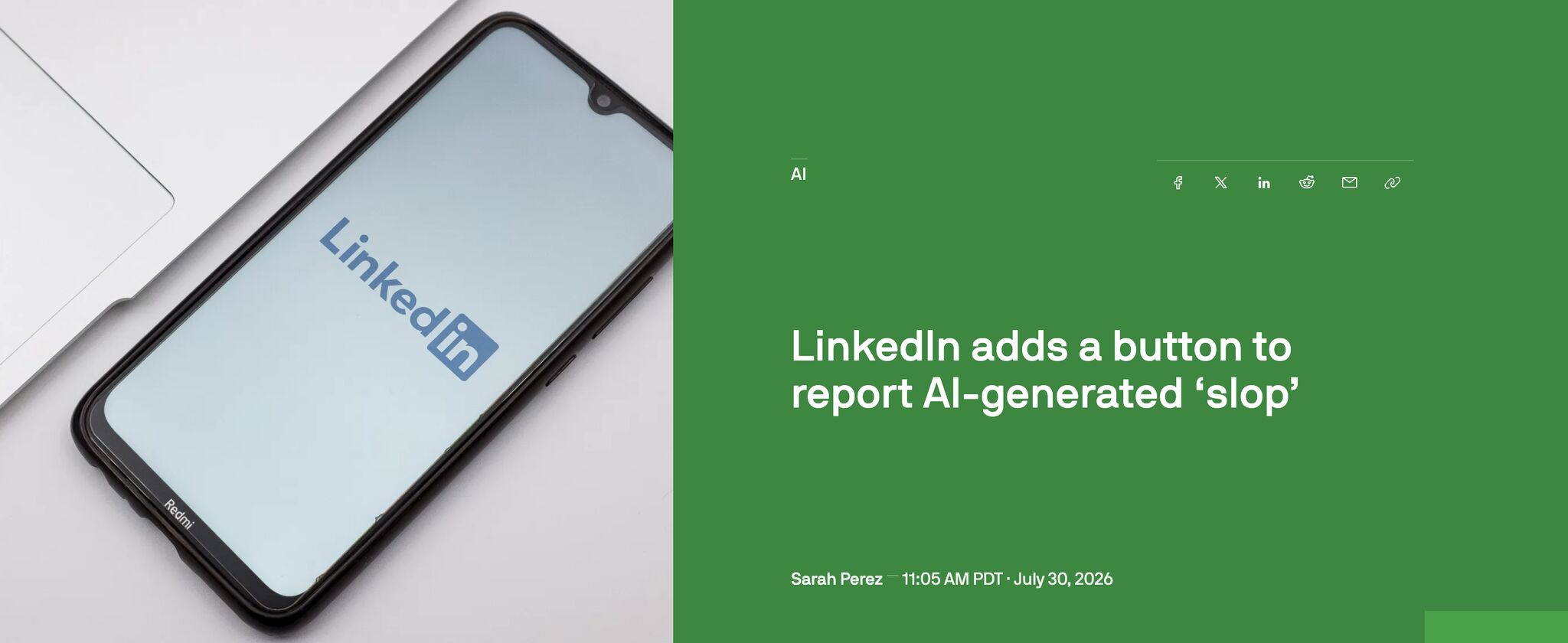
LinkedIn spent years teaching people to write like soulless corporate dipshits. Now it has added a button to report them for sounding like soulless corporate dipshits.
Come on, man.
LinkedIn rewarded fake vulnerability, stupid hooks, and grown adults begging people to comment “PDF” so they could juice the algorithm.
Then it added AI writing tools and made the problem worse. Now LinkedIn wants to act like users created the mess.
I am not buying it.
LinkedIn built the incentive system. It rewarded the garbage. Now it wants credit for adding a report button. Nope. Not under my watch.
LinkedIn needs to fix the algorithm and stop blaming the people who learned how to game it.
Salespeople have the opposite problem. They confuse being unprepared with being authentic.
You Are Not Good Enough to Wing It
Please, for the love of sales, use slides on your first call.
You suck at winging it.
Salespeople love to brag about this like it is some kind of superpower:
- “I just let the conversation tell me where it wants to go.”
- “I ask a few questions, show the product, and see where it goes.”
- “I do not want to overprepare and sound robotic.”
Call it organic or conversational if you want. Most of the time, it is confusing as hell.
Your questions barely connect. You jump from discovery to demo to pricing and back again. Then you click around a product that is already confusing and expect the buyer to assemble the story in their own head.
It is not happening.
They will smile, say it was interesting, and disappear.
Slides are not there to turn you into a corporate robot. They are there to force you to organize your thinking.
- Here is the problem.
- Here is why it matters.
- Here is how we solve it.
- Here is the proof.
- Here is what happens next.
That structure helps the buyer follow you.
Great salespeople do not avoid structure. They make a structured call feel natural.
Organize your thoughts. Put visuals around them. Give the buyer a story they can actually follow.
The Reality Check
The more technology learns to imitate people, the more valuable it becomes to actually sound like one.
We are heading into a world where every email is polished, every support agent is available, and every presentation can be built in seconds. That sounds efficient. It also means polish is about to become worthless.
Authenticity does not mean refusing to use AI or showing up unprepared. It means being honest about what people are interacting with, having something real to say, and respecting them enough to make the story clear.
Technology can make you faster. It can make you sound smarter. It can help you scale almost anything.
It cannot make people trust you.
And in a world where almost everything can be generated, trust may be the only thing that still has to be earned.