
Most sales teams are asking the wrong question about AI.
They ask, “How can we get our reps to use it?” Then they buy a copilot, celebrate that someone wrote an email in 30 seconds, and call it transformation.
That email might save a rep a few minutes. Great. But if you want a meaningful return, look for work that is currently going undone, deals that are being lost, or headcount you would otherwise need to add.
I don’t have every answer. I work on this every day, and we’re figuring shit out with customers as we go. But we’ve started to see a practical progression in sales. You can begin with a narrow job, prove it makes money, and give AI more responsibility from there.
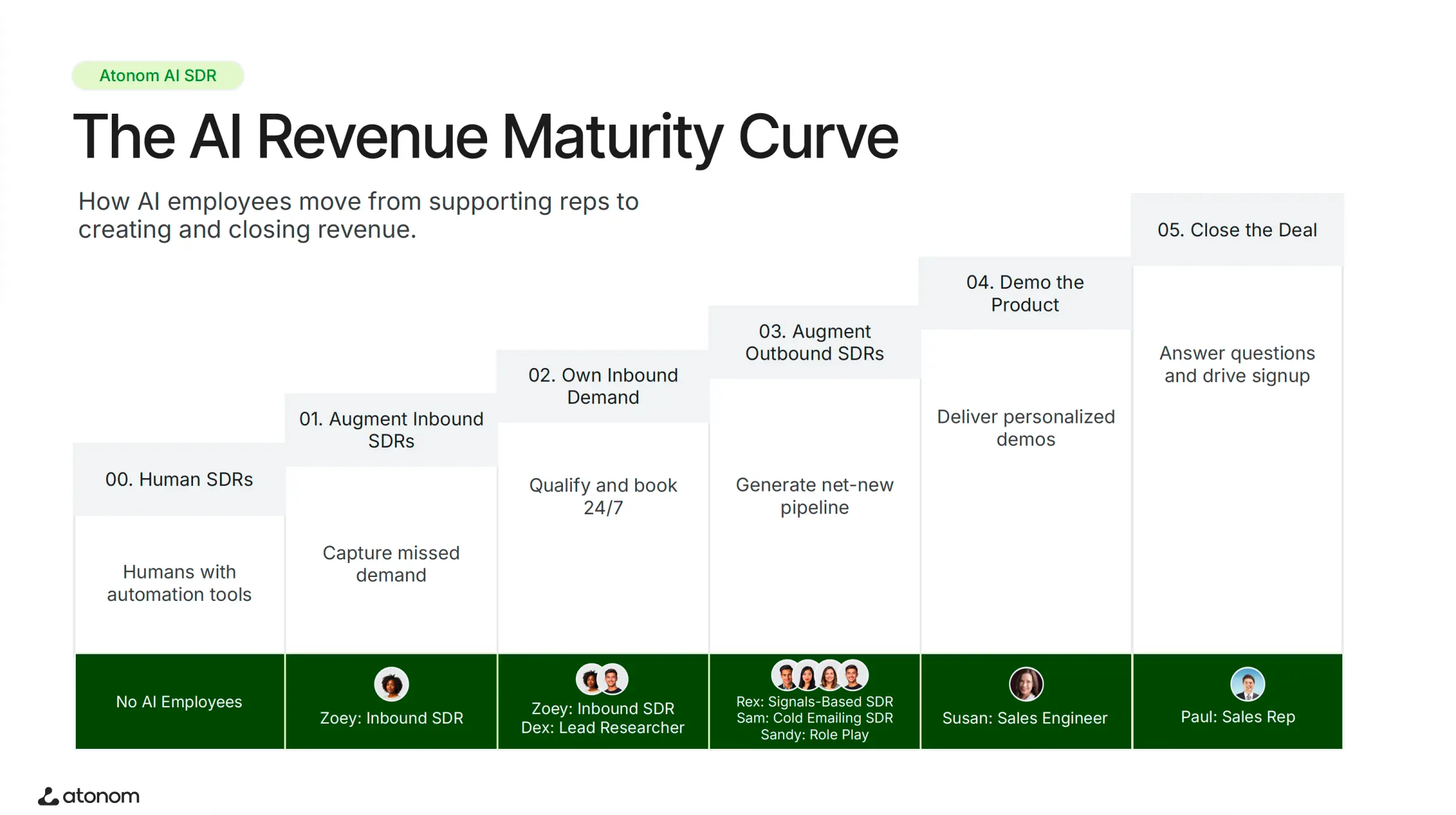
1. Stop letting inbound leads sleep overnight
This is the easiest place I’ve found to start.
A prospect fills out a form at 8:43 p.m. Your SDR team starts work at 8 a.m. By then, the prospect has probably submitted another form, talked to someone else, or moved on with their life.
So we put an AI SDR on after hours inbound. Its job is narrow: respond, qualify the lead, and book a meeting for a human SDR. The SDR then takes it from there.
Is it a little wimpy? Sure. The AI isn’t closing deals or replacing the team. It’s covering the hours when nobody is there, getting to the buyer while their interest is fresh, and giving the SDR a better conversation to walk into.
In one customer case study, the human-plus-AI process produced 14% more closed-won deals than the AI-only process.
Notice what I said: closed-won deals. I didn’t say it created a bunch more SQLs. With an AI qualification step followed by human qualification, you could even end up with fewer SQLs. The point is to get to buyers faster and have humans spend their time on better opportunities. If more of those opportunities close, that’s the number I care about.
2. Let the AI SDR own a portion of inbound
Once the narrow version works, take off the training wheels.
Give the AI SDR a portion of inbound demand. Let it respond, qualify, handle the initial conversation, and book qualified buyers directly with an AE. The human SDR no longer has to sit between the lead and the person who can run the deal.
The test is straightforward: can you maintain the lead-to-meeting rate and the quality of those meetings?
If you can, you’ve changed the economics of the team. You can handle more inbound volume without hiring an SDR every time demand grows. Buyers get a faster path to sales, and your people can focus on work that needs them.
That’s a real business case. “Our reps used AI to draft 400 emails” isn’t.
3. Augment outbound before you hand it over
Outbound is harder. It’s also where people get stupid with AI fast.
Don’t start by asking an AI employee to spray 50,000 strangers with emails and hope the calendar fills up. Start with jobs that improve the human team.
Use AI to research accounts and surface leads worth a rep’s time. Use it for role play, so a rep can practice a difficult buyer conversation and get a scorecard before doing it live.
Then move into signal based outbound. Your team already has tools collecting signals: a leadership change, a hiring pattern, a product launch, a customer event. The problem is that you can’t work every signal well.
Give the strongest ones to your best human reps. Give the next tier to an AI SDR that can follow up and carry a conversation. Now you’re acting on more of the opportunities you already know about.
We’re also running a higher volume motion with an AI employee named Sam. Sam sends thousands of cold emails a month and handles the replies through email or phone when appropriate. We’re gearing up for roughly 1,200 replies a month, with a target of booking meetings from 25% of those replies.
That’s a target as we scale the motion, not a result I’m claiming we’ve already hit. The opportunity is clear, though: if AI can work the volume and respond when someone engages, your team can spend more time on conversations that have a pulse.
4. Give buyers a real product demo
The next step is an AI sales engineer that can give a personalized demo.
I don’t mean a video with the prospect’s first name pasted into it. I don’t mean a click-through tour where the buyer does all the work. I mean a conversation where a buyer can describe what they need, see the relevant parts of the product, ask questions, and book time with sales when they’re ready.
Think about what happens on most B2B sites today. Someone is interested enough to visit your product page, but their choices are to watch a generic video or request a demo and wait. An AI sales engineer can meet them in that moment.
5. Help the buyer get to a decision
Eventually, an AI sales rep can do more than generate a meeting. Its job is to help an interested buyer get to close.
Paul, one of the AI employees we’re working on, can answer questions, help someone understand the offer, and guide them through signup. If they’re ready, Paul can send a link by text or walk them through the process.
This fits a high volume SMB or midmarket motion where buyers have questions but shouldn’t need a committee and three calendar invites to make a decision.
If you’re selling a jumbo jet to the king of Saudi Arabia, I would keep your human sales team. AI isn’t taking that deal from first conversation to signature anytime soon.
Start where the money is leaking
This is the progression I’m seeing: cover missed inbound demand, give AI a share of inbound, expand outbound coverage, deliver demos, and then help buyers close.
You don’t have to do all five. Most companies shouldn’t try.
Find the point in your sales process where buyers are waiting, good opportunities are being ignored, or growth requires another hire. Give AI a specific job there. Measure meetings, deal quality, closed revenue, and cost against the process you have today.
Start with the work that makes or loses money. Earn the right to expand from there.