
Another wild week in tech and the pattern is getting hard to ignore. The foundations are shifting fast. SaaS growth is collapsing while AI startups scale faster than anyone imagined. Apple is facing a leadership test in the age of agents. Google and Microsoft are building the operating systems for the AI workforce. Adobe is scrambling to own the signals behind creative work. The labor market is quietly rewiring itself.
Let’s start with the part everyone keeps tiptoeing around. The core engine of the last twenty years is teetering.
SaaS Isn’t Slowing, It’s Getting Eaten Alive
Aventis Advisors's growth chart tells the story. From 36% growth to 12%, with forecasts sinking toward 11%.
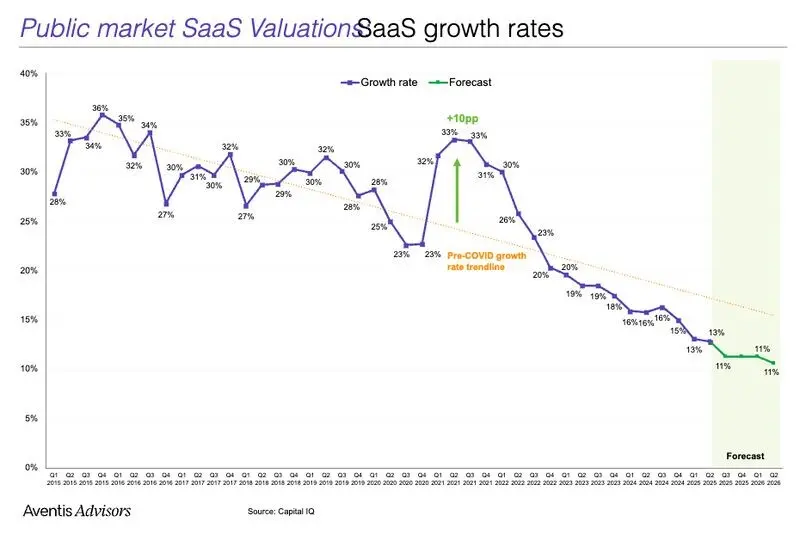
This trend is pretty clear. SaaS is becoming a utility. Durable, necessary, but no longer where the real upside lives. But instead a part of the infrastructure ... with similar value multiples.
Its simple, AI is cannibalizing the workflows SaaS was built to monetize.
Key trends operators are seeing:
- SaaS used to sell “workflows.” AI sells “outcomes” (OaaS). Agents do the work inside the tool, so the tool stops being the product. The labor becomes the product.
- Budgets (and investors) are leaving SaaS and flowing to digital labor. CFOs aren’t buying more seats. They’re buying fewer humans. AI fits. SaaS doesn’t.
- Feature parity killed differentiation. Entire categories are indistinguishable. CRM, CX, marketing automation … all the same. AI exposes how thin the moats always were.
- Enterprises hit peak-SaaS years ago. Now they’re consolidating and cutting 20 to 40 percent of their stack. AI accelerates that purge.
- AI startups are growing at speeds SaaS can’t touch. When companies hit nine figures in months, not years, investor expectations reset. SaaS looks slow, expensive, and operationally bloated.
- Value is moving down the stack. The action is in compute, data, agents, and orchestration. SaaS is becoming a UI layer that AI sits on, not the engine driving the work.
The growth-rate collapse isn’t a mystery, it’s more of a transfer of value. SaaS is maturing into a stable, cash-flow asset class with a focus on profitability, not growth. AI is becoming the new growth engine of the enterprise.
That means founders have a choice, build on SaaS and optimize it like infrastructure, or build AI agents that replace the workflows SaaS was built to capture. One path gives you stable multiples, the other gives you growth.
And SaaS isn’t the only part of the old tech economy hitting the wall. Even the giants that defined the last era are running into the same shift.
Apple’s Next Battle Isn’t Hardware, It’s Agents
Everyone’s treating Tim Cook’s succession a routine baton pass. It isn’t. Tim Cook industrialized Apple. $350B to $4T market cap. One in five people on the planet uses an iPhone.
However, Bloomberg reports sources inside Apple say there is a "feeling among Apple’s senior decision makers that something needs to change" ... "that Apple risks becoming the next Nokia or BlackBerry if it doesn’t pivot quickly".
The report implies that Apple may have made a "misstep of this sort of scale by falling behind on AI tech."
What I can’t stop thinking about is whether Apple can reinvent itself without the operator who turned it into a four-trillion-dollar machine.
We’re moving from devices to agents. From apps to autonomous systems. From tapping a screen to delegating to a digital worker. Apple has spent a decade polishing aluminum while the rest of the world rebuilt the interface for how humans and machines collaborate.
I’m not convinced Tim Cook can take them there. The next CEO’s scorecard isn’t hardware or quarterly beats, it’s whether Apple can architect the OS that runs the AI workforce.
Identity, memory, coordination, autonomy. The things Siri was never designed for. Cook perfected the last era. His successor has to define the next one.
Can Apple lead an age where the product isn’t in your pocket … it’s working beside you?
But even the companies preparing for the agent era are running into a different reality. When AI stumbles, the entire system shakes.
When AI Goes Down, Everyone Feels It
This week Cloudflare went down and took half the internet with it: X, ChatGPT, Claude, Spotify, Uber, Canva, even League of Legends and Valorant. One provider has an "unusual traffic spike" and froze AI.
We talk a lot about AI becoming too powerful ... Today showed the opposite: it’s still too fragile. A few simple truths:
- AI isn’t magic, it’s a dependency chain. CDN → DNS → APIs → models. One weak link and your “digital brain” goes dark.
- We’re over-centralized. Too much of AI runs through a tiny set of vendors. When they sneeze, everyone else gets pneumonia.
- The real near-term risk isn’t Skynet. It’s brittleness. Agents, support bots, workflows … all dead in the water over a routing issue.
If you’re betting on AI in your company, you have to ask: What happens if our AI or infrastructure provider goes down? Do we have fallback plans or multi-provider setups? Can our systems fail gracefully instead of returning errors?
Today was not a warning about superintelligence. It was a warning about building the future of work on fragile foundations.
As the AI stack grows, the companies that control where agents actually live are gaining the biggest advantage. And while outages expose the weakness, they also reveal who’s building the strongest foundation. Google is already laying the rails for the AI workforce.
Google Shows How to Build the AI Workforce
Everyone is treating Gemini 3 like it’s just another model upgrade. It’s not even close ... It’s Google making its first real move to own the AI workforce. Forget the benchmark charts, those are table stakes now.
Every model will have some row where it dominates and some row where it face plants. What actually matters is where Gemini 3 lives. Google didn’t ship a smarter chatbot. They plugged an agent framework into the backbone of the internet.
- Search
- Workspace
- Android
- Vertex
And now Antigravity, an IDE built for agents instead of humans. Think about that, Google is turning its entire ecosystem into an operating system for digital labor.
Microsoft is trying to do the same thing with Office and Windows. OpenAI is trying to do it from a browser tab.
Everyone else is pretending this is a model race. it isn’t. It’s really more of a distribution race. If agents are the future of work, whoever owns the rails those agents run on ends up owning the workflows, the data, and the economics.
And here’s what I was debating with some founders and GTM leaders last night: This launch accelerates the death of the traditional SaaS UI.
Agents don’t click your menus. They don’t navigate your onboarding flows. They don’t care about your beautiful left nav. They call your APIs, do the job, and move on.
That’s the threat and that’s the opportunity. The model war is slowing and the agent platform war just started. And Google showed up ready to play.
Not every incumbent is this far ahead. Some are scrambling just to stay in the race, and Adobe’s Semrush grab shows exactly why.
Adobe Didn’t Buy SEMrush. It Bought Survival.
Adobe's $1.9 billion Semrush acquisition looks like a smart expansion move, but it is really survival.
Adobe didn’t buy a search tool, they honestly bought a lifeline. Look at their chart. Down almost thirty percent this year. That’s not noise, that’s the market telling them the old game is over.
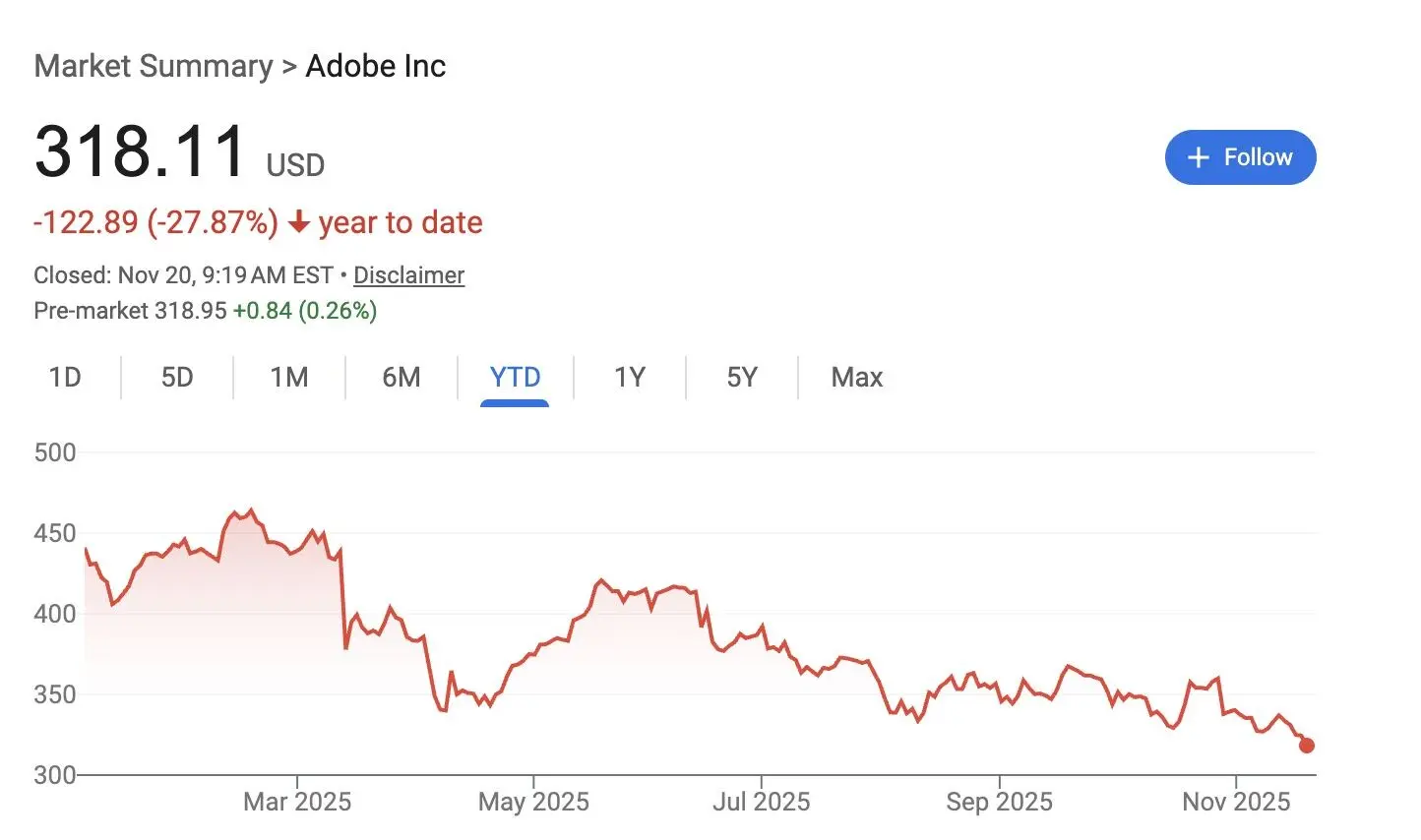
For twenty years Adobe owned the creative stack, and it was pretty untouchable. Then generative AI kicked the front door in. Now the moat isn’t Photoshop or Premiere. It’s the data underneath the work.
SEMrush gives them what they desperately need: real performance signals. Search intent. Behavioral data. The raw material for the next generation of creative agents. And that’s the real story. Not the acquisition. The shift.
Software categories aren’t expanding, they’re collapsing. Tools are becoming features. Features are becoming agents. Everything gravitates toward the platform with the most distribution and the deepest data.
Adobe sees the writing on the wall. If they don’t own the signals behind the work, they become a UI on top of someone else’s intelligence.
This deal isn’t about SEO. It’s about not becoming irrelevant. The era of “best-of-breed” point solutions is ending. The platform wars just entered the consolidation phase. And the companies that survive will be the ones that own the data that trains the agents that run the workflows.
Adobe is fighting to stay on that list. And the shakeup isn’t confined to software. The same shift is rewriting the labor market in real time.
The Labor Market is Rebooting
The U.S. added 119,000 jobs in September. Some call it a mixed report. I see it differently. The labor market is not cooling. It is rebooting.
Almost all the growth comes from three sectors:
- Healthcare
- Social assistance
- Leisure and hospitality
Outside those areas, nonfarm payrolls are down 151,000 this year. Millions are stuck between the economy they trained for and the economy taking shape. Unemployment rose to 4.4 percent. Underemployment is over 10 percent.
Shrinking roles include:
- Management
- Administration
- Information industries
- Temp agencies
These are digital, repeatable roles. Exactly where AI lands first. Corporations are freezing hiring, cutting layers, and pushing work into software. Not layoffs. Replacement.
Small companies are hiring at 50x the rate of large ones. They move faster, adopt AI faster, and treat one headcount as a hub for multiple digital workers.
The BLS still measures jobs like it is 1995. Instead of asking how many jobs we added, the question should be who is actually doing the work now. People, software, or a mix.
This report is not mixed. It is a signal that the old labor market is fading and a new one is quietly taking its place.
Zoom Out
SaaS growth is stalling. Apple is hitting the edge of its old playbook. AI infrastructure is powerful but brittle. Google and Microsoft are racing to own the operating system for the next workforce. Adobe is scrambling to stay relevant. The labor market is quietly shifting work from people to software.
This isn’t a set of separate stories. It is one pattern. The old tech economy ran on seats, screens, and workflows. The new one runs on agents, data, and autonomy. The moat is no longer the tool, it is the environment where digital workers operate.
Work is shifting to AI, and the real power sits with whoever builds the system beneath it.
