
Since November 30, 2022, when OpenAI released ChatGPT to the public, the AI conversation was about who could build the biggest, fastest and best model. This week, the narrative changed. The price of raw machine intelligence seems to be moving to near zero.
When the core input of an industry gets this cheap, everything built on top of it starts to change. We are watching that play out.
OpenAI and Alibaba Group just triggered a race to the bottom on token pricing. At the same time, Wall Street has stopped rewarding irrational, blind AI infrastructure spend. They want to see profitable deployments. Palantir Technologies got rewarded for driving real revenue. SpaceX was punished for burning cash.
You can see the ripple effects across the market:
- Airtable sold for $1.2B after being valued at $11.7B, despite $480M in ARR and 20%+ growth.
- Google’s chief scientist left after 27 years to innovate without Google financial agenda.
- Andrej Karpathy used $10 of compute to turn a paragraph of Lord of the Rings into a working 3D world.
- AI was blamed for one in three layoffs last month, while total layoffs hit a two-year low.
The economic advantage is moving away from simply owning the software or the model. It is moving toward deployment, physical infrastructure, and the human judgment required to make all of it useful.
That level of leverage is starting to reshape the labor market too. Jobs are not simply disappearing. They are moving off the screen and onto the physical floor, while fewer entry-level knowledge jobs are being created.
AI is getting cheaper. Building is getting easier. The hard part is increasingly knowing what to build, where to deploy it, and how to turn it into an actual business.
I dig into shifts in the AI industry like these every week in my newsletter, subscribe here.
OpenAI cut GPT-5.6 Luna's price 80% twenty-one days after launching it.
Four days later Alibaba.com said it will give its flagship away for free.
July 30, Luna went from $1.00 per million tokens in and $6.00 out, down to $0.20 and $1.20. Terra came down 20% the same day.
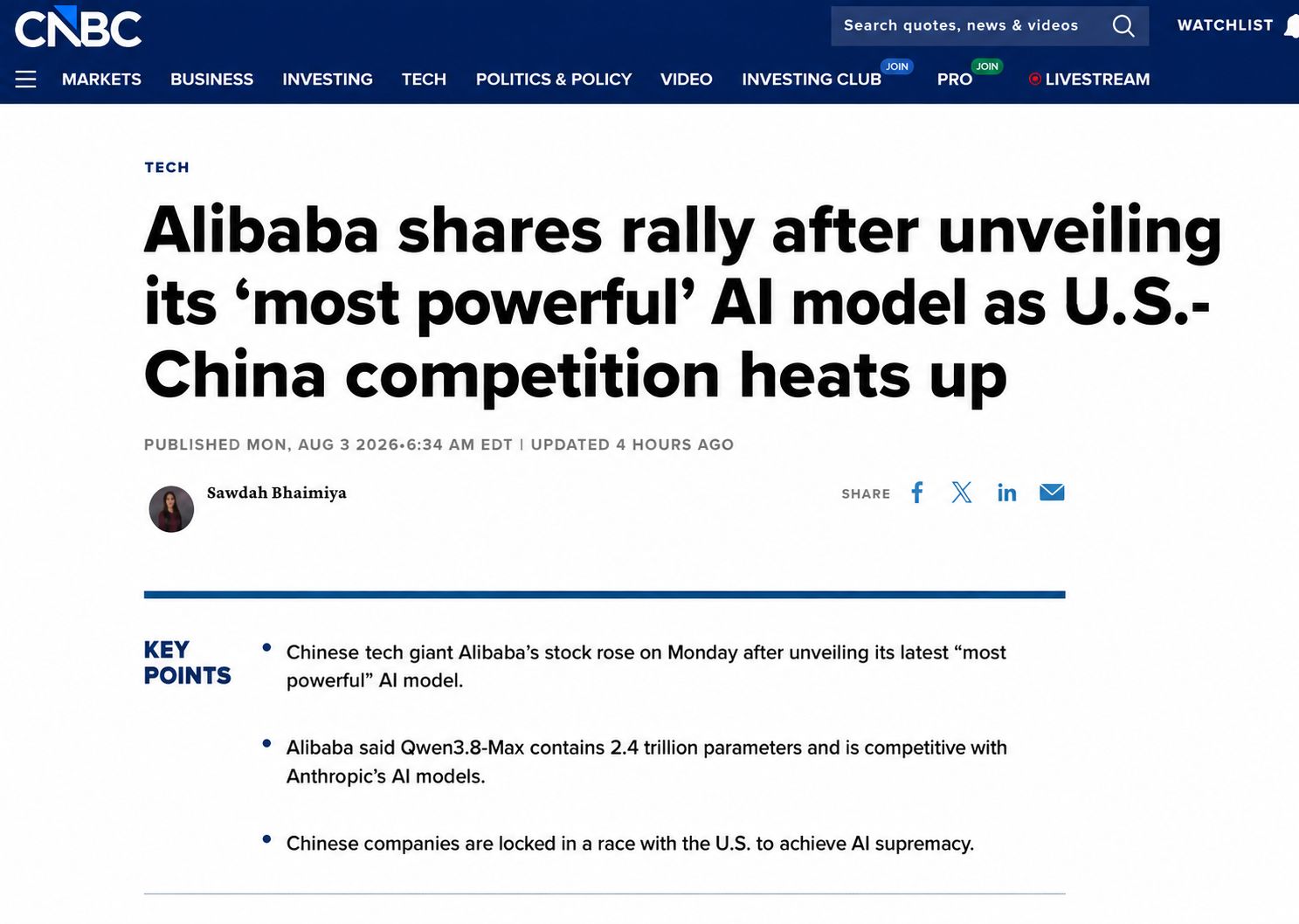
This morning Alibaba released Qwen3.8-Max at $2 in and $6 out, with the weights becoming free next week.
What we sees today, in and out per million tokens:
- DeepSeek V4-Flash: $0.14 / $0.28
- OpenAI GPT-5.6 Luna: $0.20 / $1.20
- Meta Muse Spark 1.1: $1.25 / $4.25
- Alibaba.com Qwen3.8-Max: $2 / $6
- OpenAI GPT-5.6 Sol: $5 / $30
- Anthropic Claude Fable 5: $10 / $50
The price war is not coming, it's completely here. Every AI product we pay for should be moving with it, and most of them are not.
What's not being addressed is how they afford this. OpenAI says serving got cheaper, and some of that's probably real. Epoch AI (an AI research firm) counts the AI chips in users are doubling every nine months.
But look at what this is really costing. Meta's operating margin went from 43% to 31% in a year. It spent $31.1B on capex in 90 days. It generated $60.8B and retained $784M of it.
So which is it. Were those margins always sitting there and we were paying them, ... or is everyone buying share and growing the loss?
The price of raw intelligence is hitting zero because tech giants are burning massive capital to buy market share. But Wall Street is waking up, and they are finally asking who is actually making money on this infrastructure.
Palantir Technologies grew revenue 93% last quarter.
And its stock added 29% and $89B in market cap in a day.
SpaceX grew 92% and fell 12% this morning erasing $210B in value. Same week. Basically same growth. Opposite outcomes.
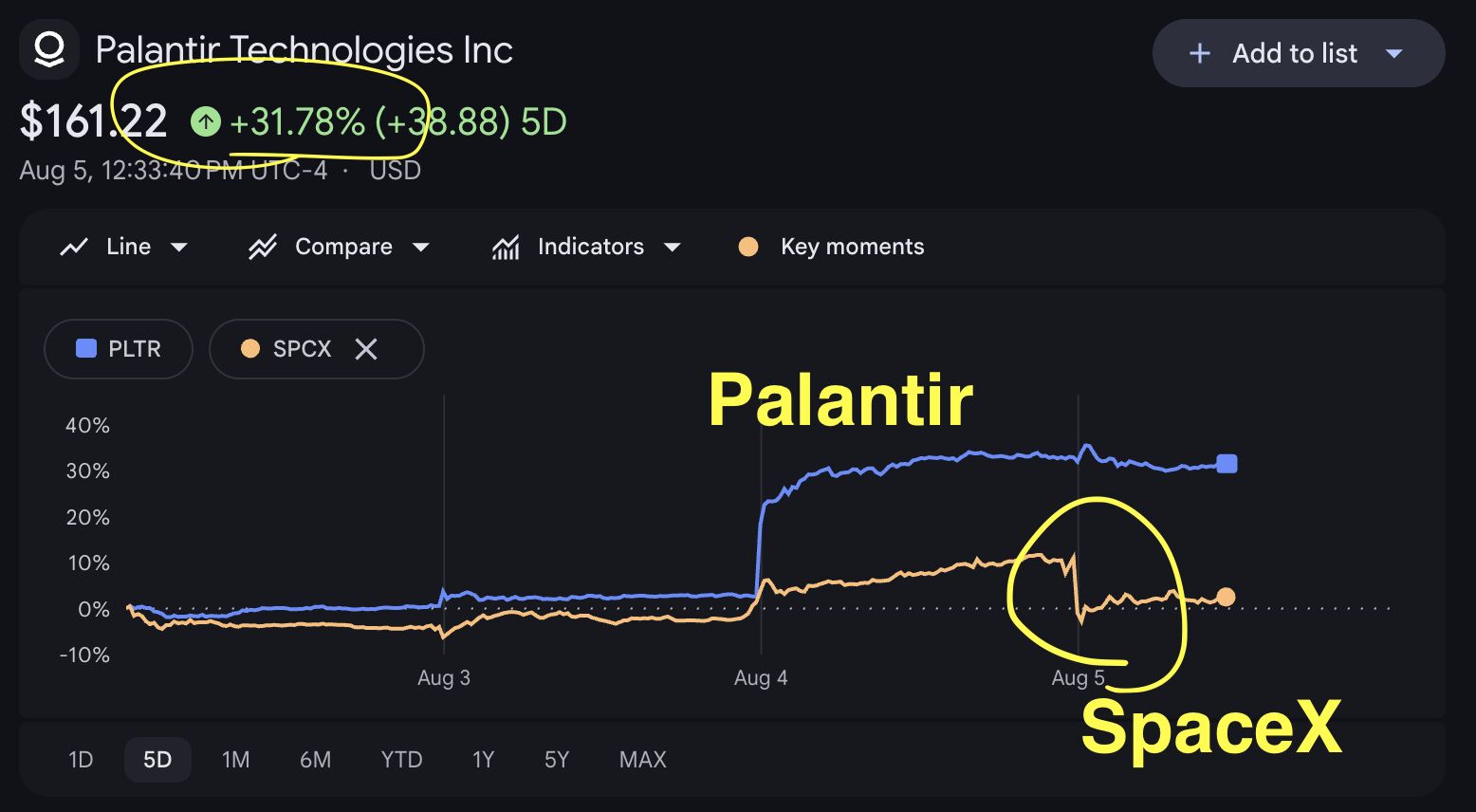
Palantir Technologies reported Monday night:
- US commercial revenue up 149%
- Operating margin from 46% to 62%
- Free cash flow $1.22B, a 63% margin
- Full year guidance raised $500M
SpaceX reported its first public quarter:
- Revenue $7.81B, about 13% above consensus
- Capex $18.4B in 90 days, up from $2.8B a year ago
- $15.8B of that went to AI infrastructure
- The AI segment did $2.6B in revenue and lost $1.3B
The market didn't really grade the growth. Instead it graded AI expenses. Melissa Otto, CFA S&P Global:
"The stock is down because the capex for the AI segment was more than double what was expected."
Palantir has figured out how to build products customers are willing to spend money on and still grow like crazy. SpaceX is highly subsidizing their products in the name of market grab.
Musk even doubled down and went the other direction on his earnings call and pulled his $1 trillion revenue target forward a year, to 2030.
Friday I wrote that the market asked Meta, Microsoft, Amazon and Apple who pays for their AI. This week its asking everyone else.
Right now we all need to figure out is AI is going to save money and help us grow OR is there some truth to the spend to grow philosophy that is pervasive in the market?
When the market stops rewarding blind AI spend and demands real profitability, the legacy software model completely breaks down. Corporate buyers are no longer paying for software seats, and the enterprise fire sales have officially started.
Airtable launched their "AI Native" agent platform in January. Seven months later it sold.
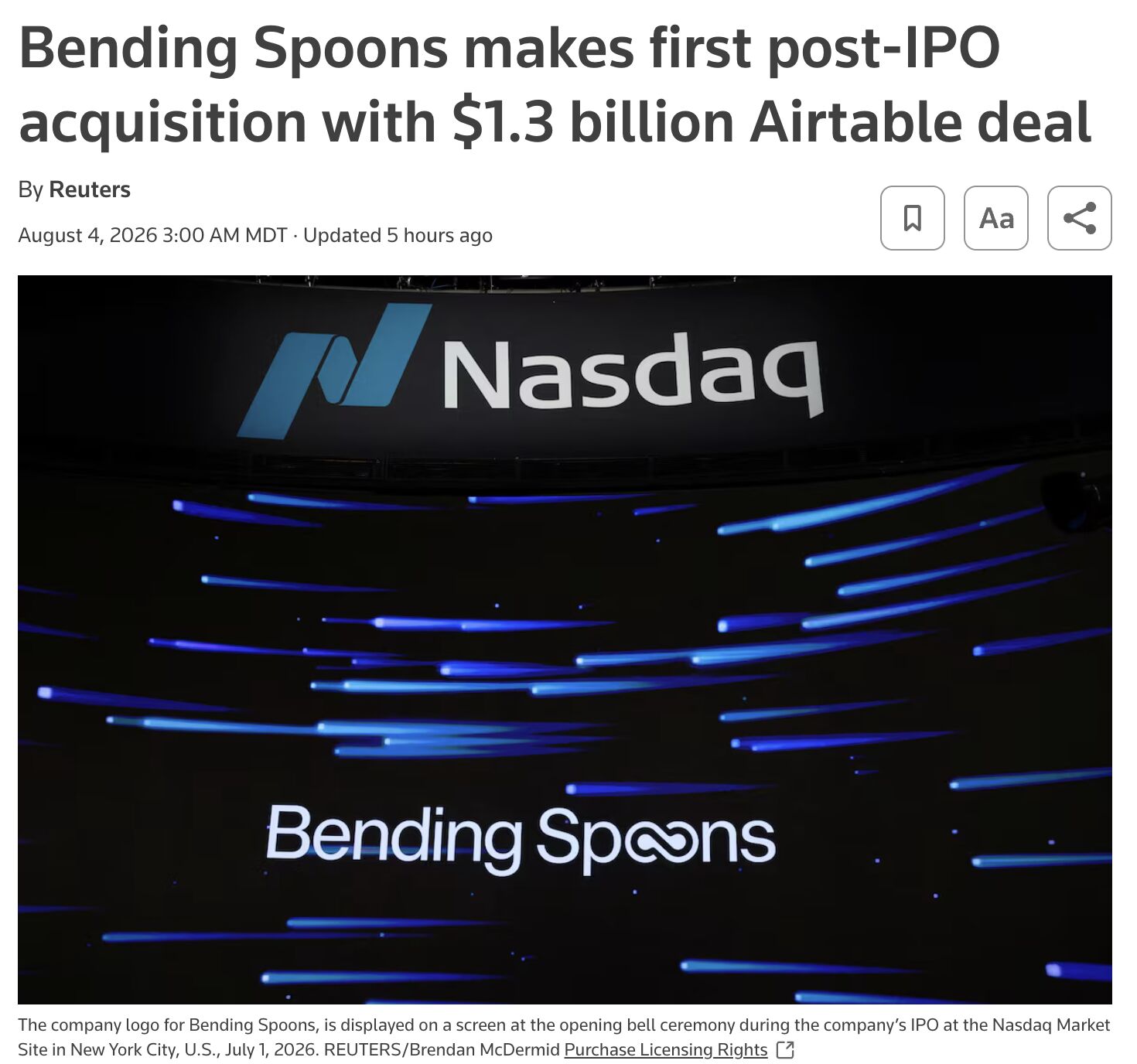
Bending Spoons agreed to buy them for $1.2B in cash, 11% of its last venture round.
Airtable reached $11.7B in late 2021 on a $735M round. They actually sold the company for less than they raised, $1.4B.
The two sides:
Airtable:
- $480M in ARR, growing over 20%, sold at 2.7x revenue
- 500,000+ customers, including 80% of the Fortune 100
Bending Spoons:
- Went public in July at $18.4B. This is their first deal since the IPO
- Owns Evernote, Eventbrite, Splice, Vimeo, WeTransfer, Remini, etc.
- Cut 75% of WeTransfer within weeks, and most of Vimeo by January
They are known for AGGRESSIVE restructuring and layoffs. They took on 1,830 employees in three earlier deals. From their own filing: "we expect only a few hundred to remain."
What's interesting to me is that Airtable did the things you are supposed to do. None of it moved the price. Buyers have stopped paying for seats no matter what branding/marketing campaigns say and even the new "AI Native" tool set they are building.
HubSpot is down 65%. monday.com is down 75%. Zoom is 85% off its peak. Airtable is the first of them to just sell.
Bending Spoons put the rest of the legacy SaaS players on notice in their IPO filing. They have identified over 1,000 more SaaS companies to buy.
Legacy SaaS is done and now being cannibalized, and the buying has barely begun.
The legacy software model is dying and top talent knows it. The absolute best builders are abandoning the bloated incumbents because they realize they no longer need them to innovate.
Google's chief scientist quit after 27 years, driving their stock down $160B.
The same day, Google named a new boss for Gemini 4. Its two remaining co-leads had just walked out.
Jeff Dean and Oriol Vinyals co-led Gemini. They left with Sanjay Ghemaway and Quoc Le to build DiscoveryLoop, a company meant to automate scientific research itself.
- Dean was employee number 30 in 1999, co-founded Google Brain, Chief Scientist since 2023
- Ghemawat joined the same year and helped build MapReduce, Bigtable, and Spanner
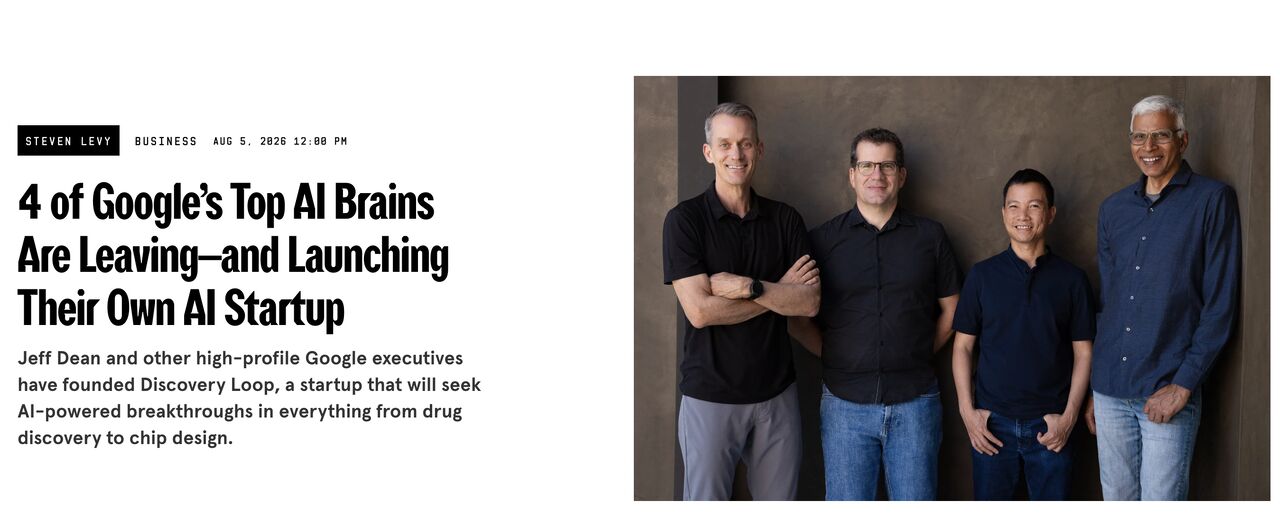
Dean told the New York Times:
"You will get both a higher quantity and a higher quality of experiments."
Meta already lived this. Yann LeCun left in November to build AMI - Advanced Machine Intelligence on world models that learn abstract concepts like gravity and cause-and-effect to reason and plan actions.
Big Tech is losing its researchers. But, ... science is gaining the next generation of innovators, founders and creators.
Historically the brightest minds had to work at the largest companies for access to resources. But, since the AI revolution, innovators can raise investment (like Yann LeCun raising over $1B) to build in smaller teams without corporate agenda.
And look at what there building. Not another ad model, but a public benefit company focused at drug discovery and clean energy.
This will clearly be devastating on the incumbents. But I am hugely optimistic and predict that we will see more fundamental innovation in the next 20 than we have seen in the last 100.
These elite researchers are leaving because the barrier to entry has vanished. When a single builder is armed with cheap intelligence, their output can match what used to require an entire enterprise team.
Peter Jackson spent $281 million and 2,500 people to put Lord of the Rings on a screen.
Last Saturday night Andrej Karpathy did a version of it for about $10.
He gave Claude Opus 5 the first paragraph of the book, a 1 million token budget, and asked for a 3D render in the browser. Opus worked about 2 hours and wrote 5,500 lines of code. He posted on x and got 2.1M views in under a day.
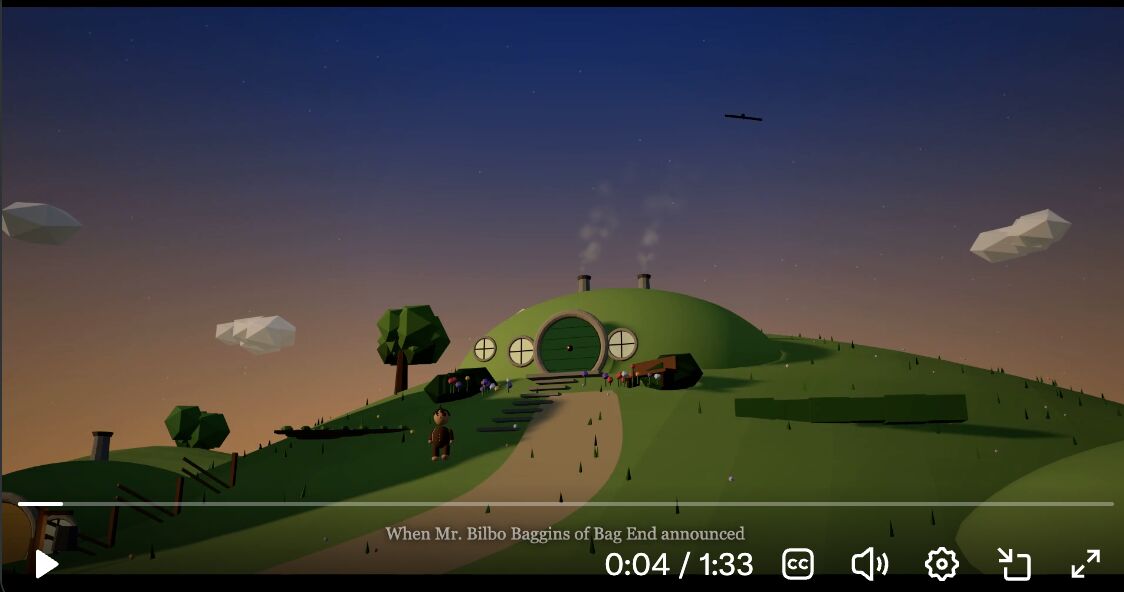
His words: "no one in their right mind would ever spend the time to write something this custom but LLMs have all the stamina and patience in the world."
The replies were not all happy. One writer: "some of us are writers, some of us do build, real ORIGINAL stuff. Please don't bastardize classics b/c you have no original STORY."
I have two kids in college, one at music school in Boston and one at fashion school in New York. That comment sounds like their classmates, and its a real concern.
And the numbers back them up. GDC surveyed 2,300 game developers in January:
- 52% say AI is hurting the industry, up from 30% a year before
- Only 7% say it is helping, down from 13%
- Among visual and technical artists, 64% negative
- 28% of them were laid off in the last two years
The interesting thing to me was that the prompt was 100% Tolkien's words. Every version people posted back ran on somebody else's story, ... Hotel California, GTA Middle-earth. All that really happened was that the rendering got cheap. A human still had to write the story.
And Karpathy admits the model still "can't easily audit their work." It took screenshots, guessed, and made a mess.
Our teams are about to produce 10x more of everything. We need to ask of we have the team that can tell if any of it is any good?
That level of individual leverage is incredible for output. But it creates a massive structural problem for the labor market. If AI tools allow one senior operator to bypass a team of juniors, the entry level desk job disappears entirely.
AI was blamed for one in three job cuts last month.
Still, companies announced their fewest layoffs in two years.
These numbers seem to conflict. According to the outplacement firm Challenger, Gray & Christmas, Inc., July came in at 33,429 cuts, down 46% from last July and was lowest month since 2024. AI was named in 10,970 of them, the top reason five months running.
And year-to-date hiring plans are up 25% from the same period last year.
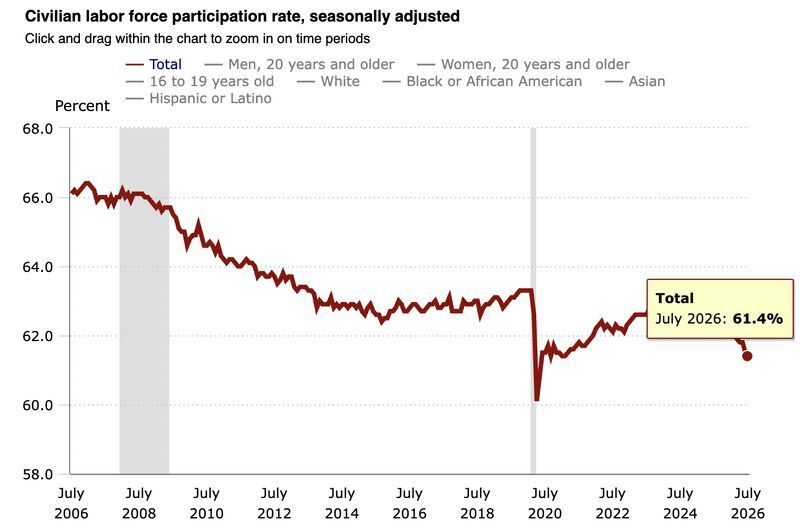
Now put that next to this morning's jobs report:
- Payrolls: down 23,000.
- May and June: revised down another 103,000.
- Labor force: down 264,000.
The unemployment rate still fell, 4.2% to 4.1%. 264,000 people stopped looking for work, and if you stop looking, you stop getting counted.
Andrew Challenger, the firm's chief revenue officer: "The demand is showing up in aerospace, energy, and manufacturing, work that happens on a floor rather than a screen."
So AI doesn't seem to be shrinking the number of jobs. It is moving them off the screen and onto the floor. Layoffs sit at a two-year low and hiring is climbing, ... just not in the work many of us currently do for a living.
New graduates are getting hit the hardest. The New York Fed puts unemployment for 22 to 27 year olds with degrees at 5.6%, against 4.1% for everyone.
The point is that a desk job that is never posted never shows up as a job lost.
My biggest concern here is that if AI takes the entry level jobs, where do our senior people come from in 2031?
The Marco View
The bigger shift is that several assumptions business leaders have operated under for 20 years are breaking at the same time.
Software gets more expensive as you add people. Growth requires more headcount. The best talent needs the resources of a massive company. And spending aggressively on new technology eventually gets rewarded.
AI is challenging all four.
For business leaders, that means the opportunity is much bigger than automating a few workflows. We need to rethink how many people we hire, what software we pay for, where we spend capital, and what one great employee should now be able to produce.
The companies built for expensive intelligence are about to compete with companies built for intelligence that costs almost nothing.
