
This week, Meta added $100B in market cap this week after launching Muse their new AI assistant (basically OpenClaw inside Facebook, Insta, etc.). Then, Salesforce announced they may pay $2B for Listen Labs, ... 67x annualized revenue (wow!).
Also, we saw the web change around AI agents. TIME started selling ads designed for agents to read, Wayfair is writing their product info for agents, and Perplexity says they’re blocking those AI ads.
Here’s what’s inside this week’s Autonomous:
- Meta wants to help us make money, then take a cut. How Muse could connect business creation, advertising and purchases into a new source of revenue.
- Salesforce’s expensive customer-research bet. Why understanding what customers want next could justify a price that initially looks crazy.
- Advertisers are caught between TIME and Perplexity. One sells ads for AI agents. The other blocks them. Who do we pay to reach our buyers?
- Oracle’s AI demand keeps accelerating. Cloud infrastructure revenue grew 121%, while future revenue under contract across their business reached $664B.
- AI did my research, then sent my emails. A family-history project left me impressed—and questioning how much of our relationships we should delegate.
As we plan for 2027, these become practical decisions: how we reach customers, where we invest, and which interactions still need our time and attention.
Let’s start with Meta.
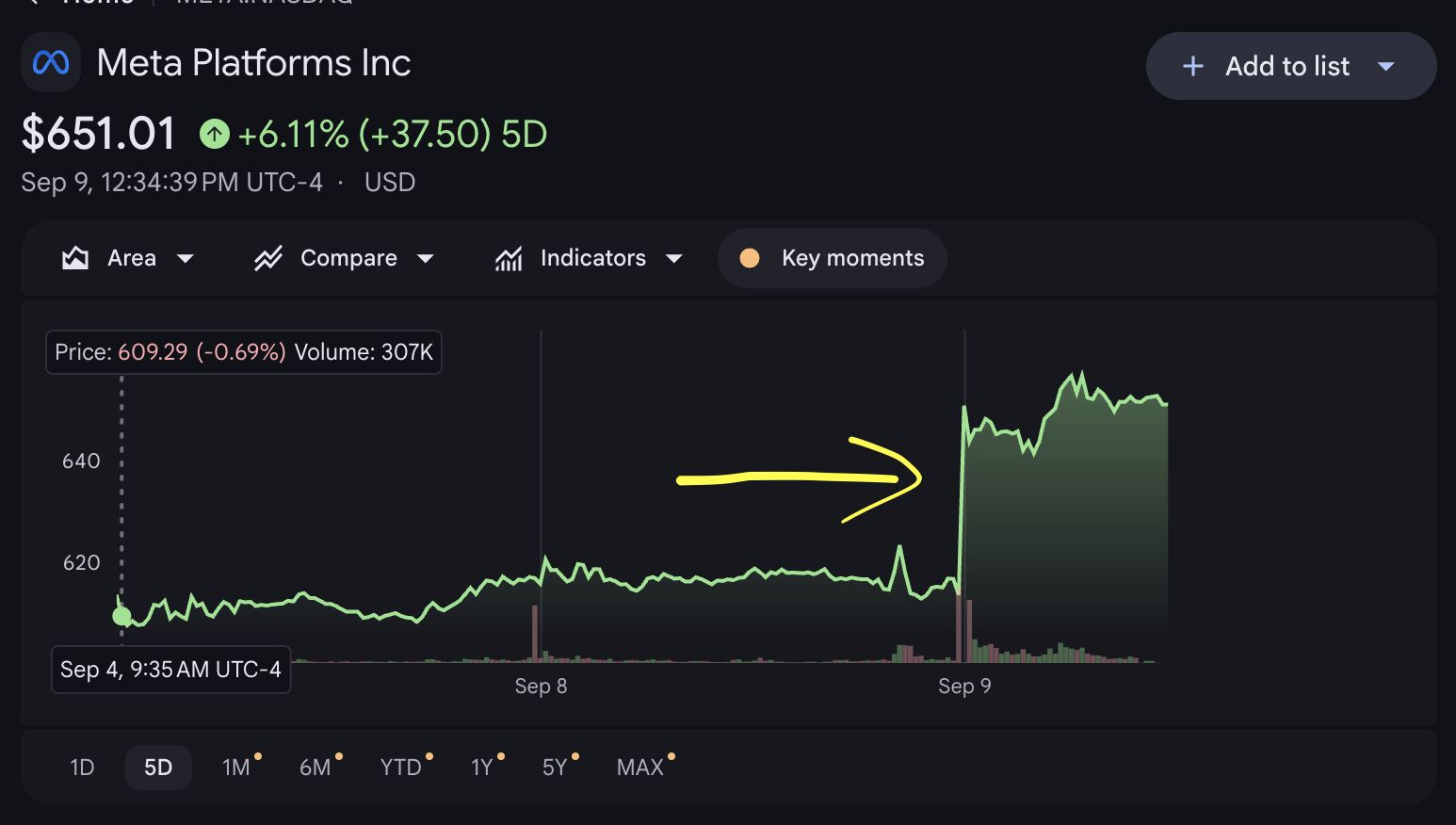
Meta added $100B in the market this week with their newest AI play.
Their shares rose over 6%, while the S&P 500 index fell 0.5%.
They just launched Muse, a AI assistant that books trips, sends emails and buys things for us. And, they are giving it away for free.
This is fascinating, its clearly his response to having lost the Manus AI acquisition (thanks China). But Zuckerberg wants Muse to help us make money too.
He told tech journalist Alex Heath that Muse can help people:
- Create a product.
- Advertise it through Meta's tools.
- Run the business around the clock.
People can use Muse through WhatsApp and connect their Facebook and Instagram accounts (this clearly reinforces and leverages their current distribution).
Zuckerberg eventually wants to “take a very small cut of whatever the transaction is”
The plan is to earn a fee when their agents help people buy something.
Free AI brings people in. Their advertising tools help businesses reach customers. Transaction fees would add another source of revenue.
Analysts at investment bank Mizuho say Meta's share price doesn't yet reflect this opportunity.
Is it's time to invest in Meta? My hunch is yes.
Salesforce is considering paying 67x ARR for Listen Labs
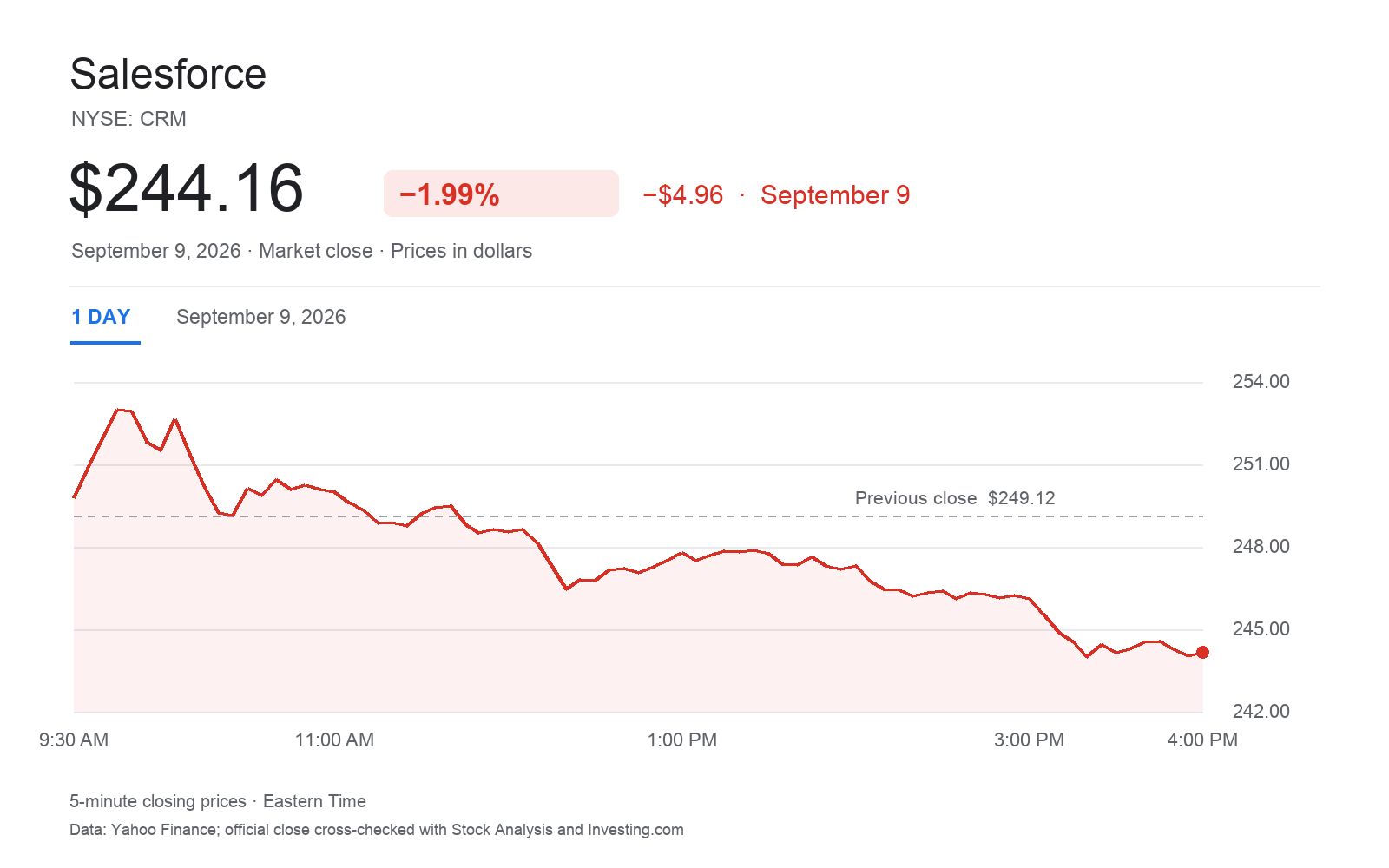
On the news this week, Salesforce stock fell 2%.
The three-year-old startup uses AI to interview customers and turn those conversations into research. They just raised a $69M Series B at a $500M in January led by Ribbit Capital, with Sequoia Capital, Conviction, and Pear VC.
The reported deal numbers:
- Acquisition price: $2B.
- ARR: about $30M.
- January valuation: $500M.
This is a 4x valuation jump in less that 9 months, ... while the Salesforce shares moved down.
Salesforce already records what customers bought, what salespeople promised, and what went wrong in support.
Listen Labs COULD help them find out why customers buy, what they want next, and why they leave. So, there is real potential growth within the Salesforce customer base.
But 67x annualized revenue seems like a crazy expensive bet. Honestly, I would back out of a 1.5B term sheet for a 67x, $2B exit.
We are clearly still in a hype/hypergrowth cycle of AI. And this deal is not an anomaly:
- Skild AI: raised $1.4B at $14B on a 450x
- Sierra: raised $950M at $15B on a 100x
- Clay: raised $115M at $7.1B on a 70x
- Mistral: raised $3.5B at $24B on a 60x
- OpenEvidence: raised $250M at $12B on a 80x
- Cognition: raised $1B at $26B 53x
These are all private companies so they are estimates. Still the list is much longer than this.
For Salesforce, the question is whether their enterprise distribution can turn that premium into enough additional revenue to justify the price.
I'd argue that the growth rate of these companies actually warrants these valuations. And for a company like Salesforce, the impact within their existing customer base will easily justify this valuation.
TIME is selling ads for AI agents
Perplexity calls the practice deceptive, ... and says they’re blocking those ads.
Cloudflare just published that nonhuman traffic is now over 57%.
I’ve already how web visitors are changing. Now the web is starting to catch up.
- TIME sells ads designed for AI agents to read. Ally Bank is an early advertiser.
- Wayfair is adding details to get AI agents to promote their products.
- Perplexity is now warning these publishers they might downgrade them in search.
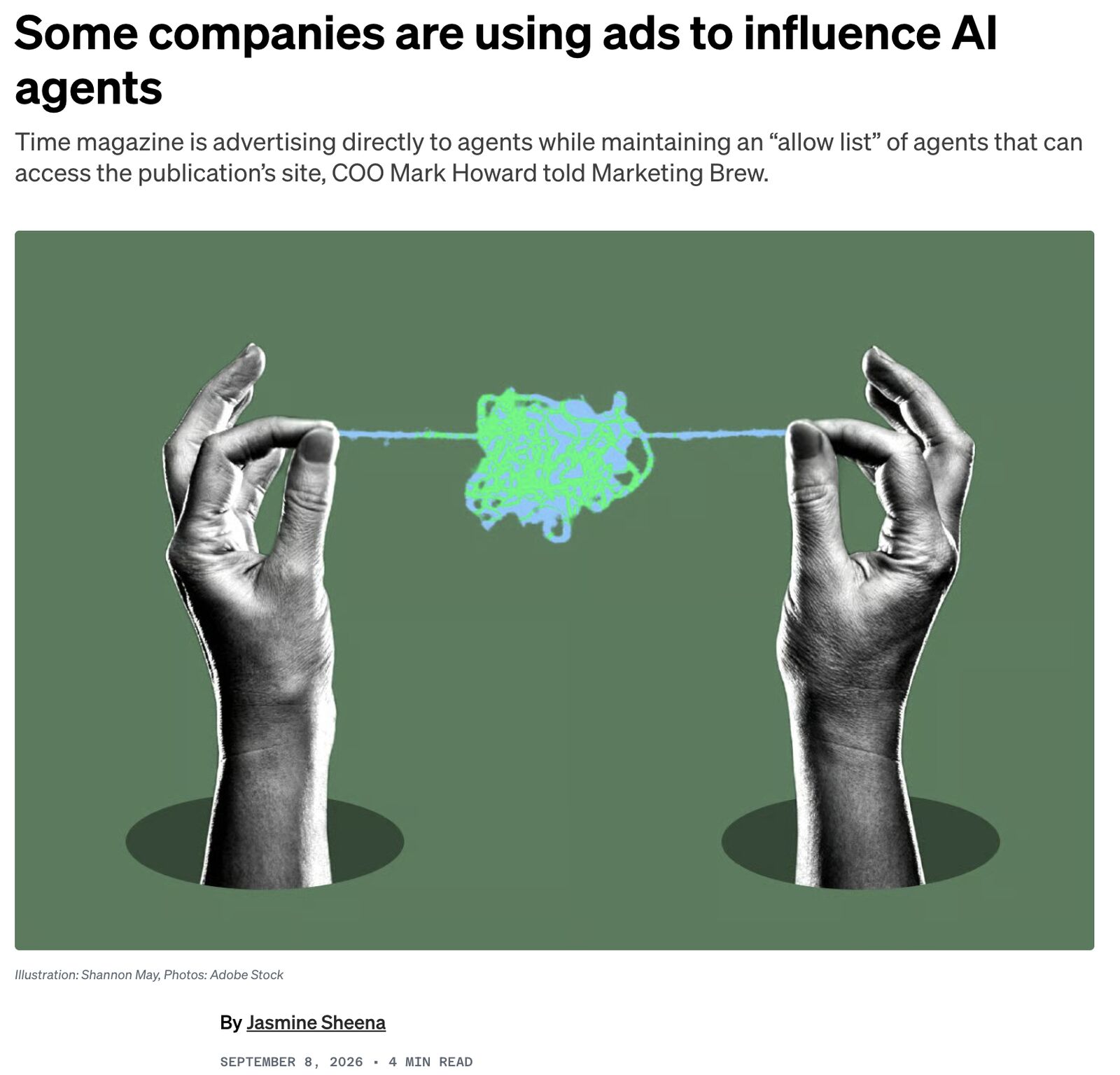
TIME’s COO, Mark Howard, said:
“It’s about getting those brand facts into that knowledge layer of the AI.”
But, that is exactly what Perplexity is blocking.
And these buyers are worth reaching. Adobe found that AI referrals to U.S. retail sites converted to purchases at a 60% higher rate than non-AI traffic in July.
But who controls access to those buyers?
TIME sees an audience advertisers will pay to reach. Perplexity says that paid influence threatens trust in their answers.
AND the advertiser is getting caught between them.
We could pay TIME for an ad, and Perplexity could exclude it when answering our buyer’s question.
So who do we advertise with??? The content provider or the AI platforms?
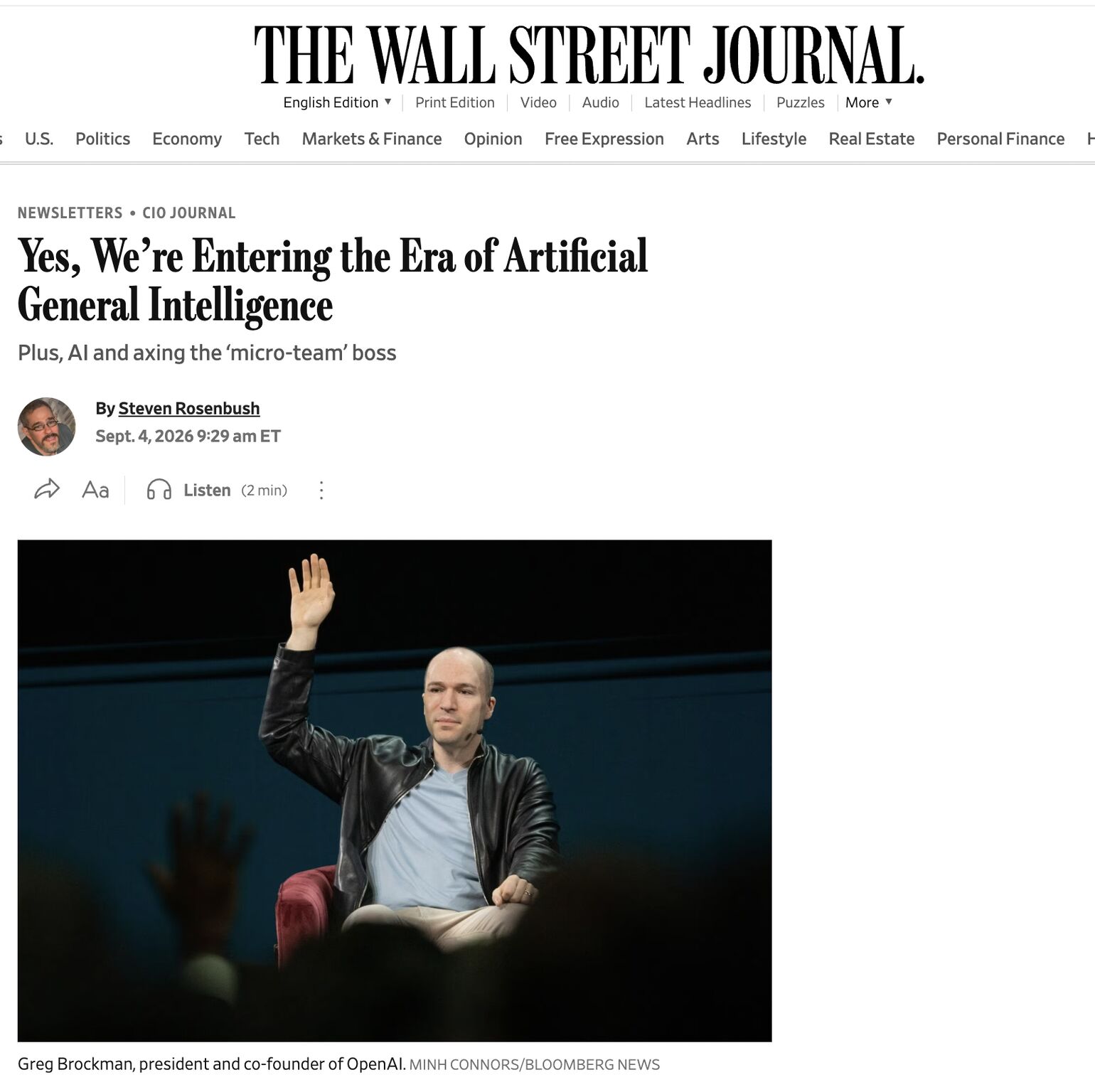
Last week, OpenAI’s president Greg Brockman said he believes AGI has arrived.
Maybe he’s right. This weekend, GPT-6 Astra did research in hours that would have taken me weeks and months.
Then it sent emails with my verbal approval, ... and something felt just a little off.
I’ve spent years tracing a family tree spanning 7 generations. This brand new model searched across languages and countries and found historical records supporting a story our family had told for years.
We now had evidence it was true. I was stunned at how well it did it, and now look like a hero to my family.
Interestingly, it also drafted requests to two archives for records that aren’t public. It read them aloud to me, I gave it a few changes and approved them, and it sent them through my email for me. I never touched my computer to send them.
I was involved. But I could see how easily the conversation might continue after I stopped paying attention.
Now imagine a friend asks AI to help write an apology. They might mean every word. But then they let it handle our response, our questions and even the attempt to work things out.
We’re sharing something personal, but they’ve handed over the conversation to AI.
Giving people our time and focus is fundamental to relationships. Connecting with other people is one of the most core parts of being human.
How much of our conversations can we hand over before we start losing our connection with each other, ... and our humanity?
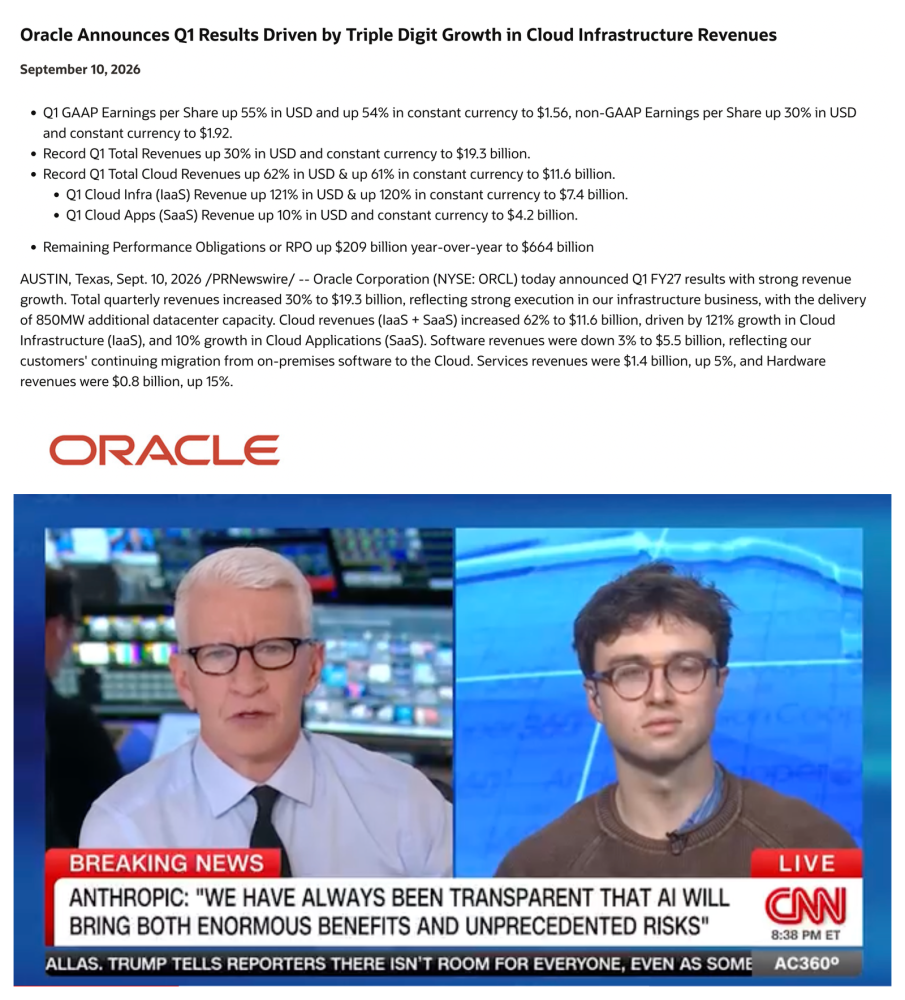
Oracle added roughly $30B in market value in yesterday’s initial after-hours rally. They now have $664B in future revenue under contract.
I think we’re underestimating how much AI is still coming.
Look at what their customers are buying:
- Cloud infrastructure revenue reached $7.4B, up a crazy 121%.
- Customers signed more than $30B in new AI cloud contracts.
- Total future revenue under contract reached $664B.
These are all insane numbers.
Oracle said:
“Customer demand for AI Cloud Training and Inferencing Services continues to grow faster than supply.”
Those contracts cover computing capacity customers expect to use in the years ahead. That’s why I watch Oracle to understand where AI demand could go over the next one to three years.
The $664B includes more than AI and covers multiple years. Oracle must still deliver the services.
Then there’s the other AI news this week.
Jacob Coxon left Anthropic warning that AI could cause human extinction. OpenAI, an Oracle infrastructure partner, called for mandatory AI safety regulation.
Despite companies warning about AI’s risks, ... they are still committing billions to expand AI.
I think we’ve only just begun this AI movement.
The Macro View
What jumped out to me this week is how close AI is getting to the actual decision.
Salesforce may spend $2B to better understand why customers buy, what they want next, and why they leave. Meta wants Muse to help people create a product, advertise it, run the business, and eventually take a cut when something sells. TIME and Wayfair are already trying to influence what agents recommend. And GPT-6 Astra researched, wrote, and sent emails for me with little more than verbal approval.
The opportunity is no longer just better software or better answers.
AI is moving into the moment where intent becomes action.
That means customer data, distribution, recommendations and transactions all become more valuable because they shape what the agent does next.
If an AI agent researches the options, chooses what to recommend, and completes the transaction, how much of the traditional customer journey is even left?
Until next week…
