
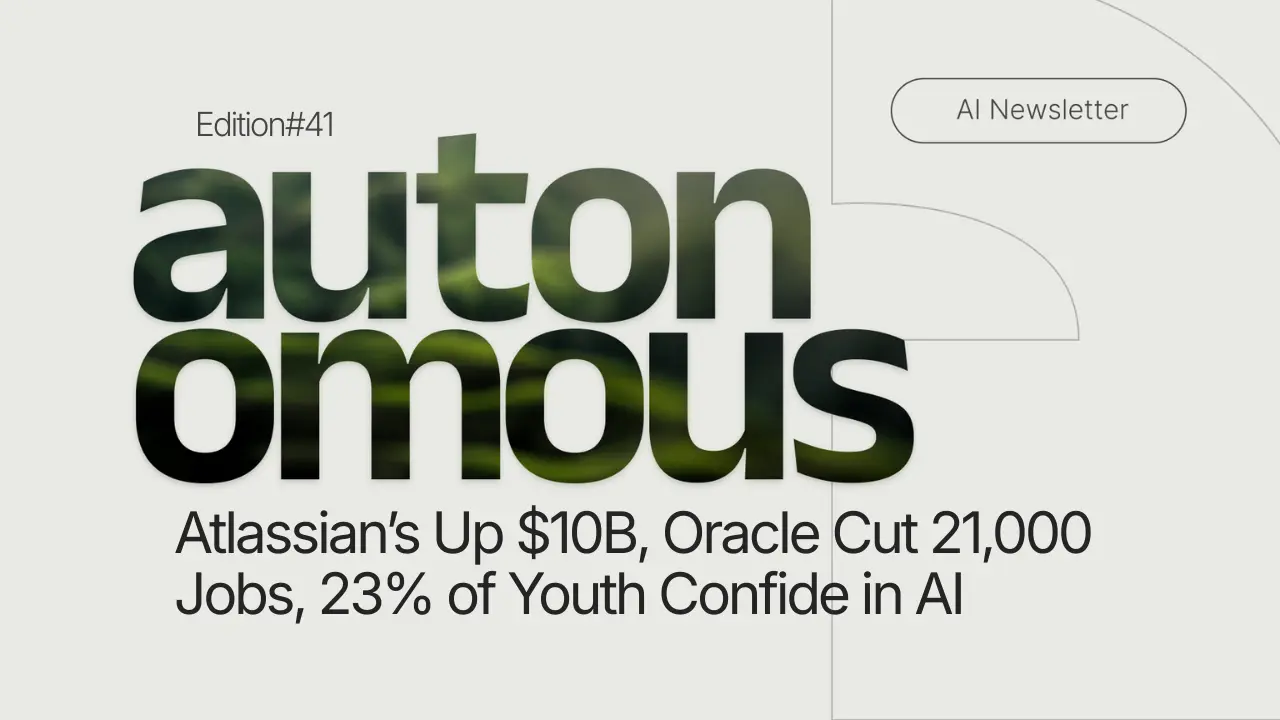
Last week four of the most known software companies in the world beat Wall Street's estimates. The market invested $10B to one and erased $2.4B from another.
The difference was not the AI. They all had AI.
This same week Stripe agreed to pay more than $7B for a company valued at $1.3B in May. Google bid $10M for 100M of one airline's emails. Money is not getting moved from companies with AI, instead investors are getting more discerning about what kind of AI they are willing to invest in.
If an organization's use of AI isn't driving financial value to the bottom line, markets are punishing them, and I think the same principle applies to all of us.
Here is what happened:
- Atlassian grew revenue 28% and jumped 35%. HubSpot grew 20%, missed on customer adds, and fell 19%. Both beat estimates.
- Stripe agreed to pay more than $7B for OpenRouter, the routing layer 10M developers use to switch between 500+ AI models.
- Google bid $10M for 100M Spirit Airlines emails and 500M Teams messages, with personal information removed.
- Over 112,000 U.S. job cuts have been blamed on AI in 2026. BUT the layoff rate hasn't moved off 1.1%.
- 23% of Americans under 30 have told an AI something they never told another person.
All five stories reveal this week's movements that the AI disruption caused. Public markets, acquirers, employers and users are all indicating that AI is about: growth, infrastructure, data, trust, but ultimately value.
For leaders trying to gain an advantage from AI, the question has changed from even earlier this year. It's no longer whether you have AI. It is what your deployment of AI is driving financial value, because that's clearly all that seems to really matter (and frankly, it makes sense).
Last week, Atlassian added nearly $10B in market cap. HubSpot lost $2.4B, even though both beat expectations.
The market no longer pays for AI claims.
It pays for growth, cash, and customer expansion, and AI only matters when it moves one of them.
- Atlassian grew revenue 28% and cloud revenue 31%. The stock jumped 35%.
- Twilio grew revenue 22% and generated $353M in free cash flow. The stock jumped 25%, adding roughly $7.4B in market cap.
- HubSpot grew revenue 20% but added 7,000 customers against the 9,000 to 10,000 expected. The stock fell 19%.
- monday.com grew revenue 22%, and AI ARR doubled quarter over quarter. But next-quarter guidance came in about $4M light, and the stock fell 6%.
All four beat Wall Street’s quarterly estimates. All four had AI. Only two were rewarded.
HubSpot CEO Yamini Rangan, on the call:
“We are in the middle of a real transition to AI.”
The next morning, $2.4B was gone.
For two years, software companies could ship an AI feature, talk about adoption, and get credit for the story.
This quarter, the test changed.
- Atlassian got paid for growth.
- Twilio got paid for cash.
- HubSpot missed customer growth.
- Monday.com showed real AI revenue, but the guidance miss mattered more.
The SaaSpocalypse isn’t over. The demo just stopped being enough.
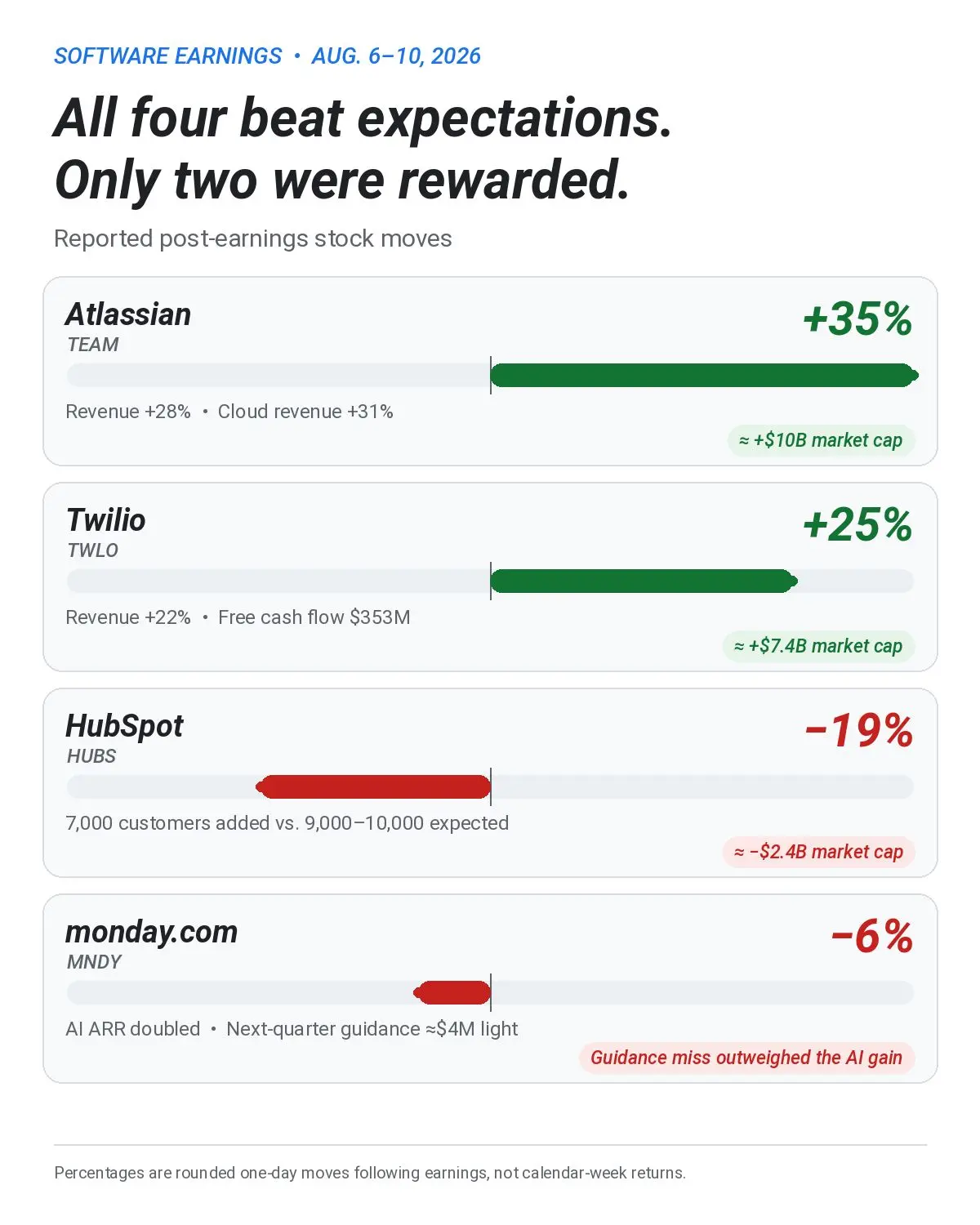
Stripe has reportedly agreed to pay more than $7B+ for OpenRouter. Less than three months ago, it was reportedly valued at $1.3B.
The interesting question is not why Stripe wants it. It is whether OpenRouter is difficult enough to replace to justify that price.
This week OpenRouter says it has:
- More than 10M users
- Access to 500+ AI models
- More than 200T tokens processed each month
- A 5.5% fee on standard credit purchases
OpenRouter does not train the major models.
It gives developers one API to access and switch between models from OpenAI, Anthropic, Google, Meta, and others.
That is valuable today because there is no single AI model that is best at everything.
Companies increasingly choose different models based on price, speed, context window, reasoning quality, and the specific job being performed.
Stripe appears to be betting that this continues.
If companies keep using multiple models, OpenRouter could become increasingly valuable because millions of developers already use it to access them.
But there is a real problem with the $7B price.
Other companies can build model routing.
OpenAI, Anthropic, Google, cloud providers, and agent platforms can all make it easier for developers to switch models without using OpenRouter.
So the $7B question is simple:
Will OpenRouter remain an independent platform developers need, or will model routing become a standard feature that other platforms provide themselves?
Google bid $10M for 100M Spirit Airlines emails and 500M Teams messages. Personal information must be removed, and Google still bid $10M.
The first LLMs were trained largely on data most frontier firms could access: public websites, books, research papers, open-source code and online conversations.
That created capability. It did not create exclusivity.
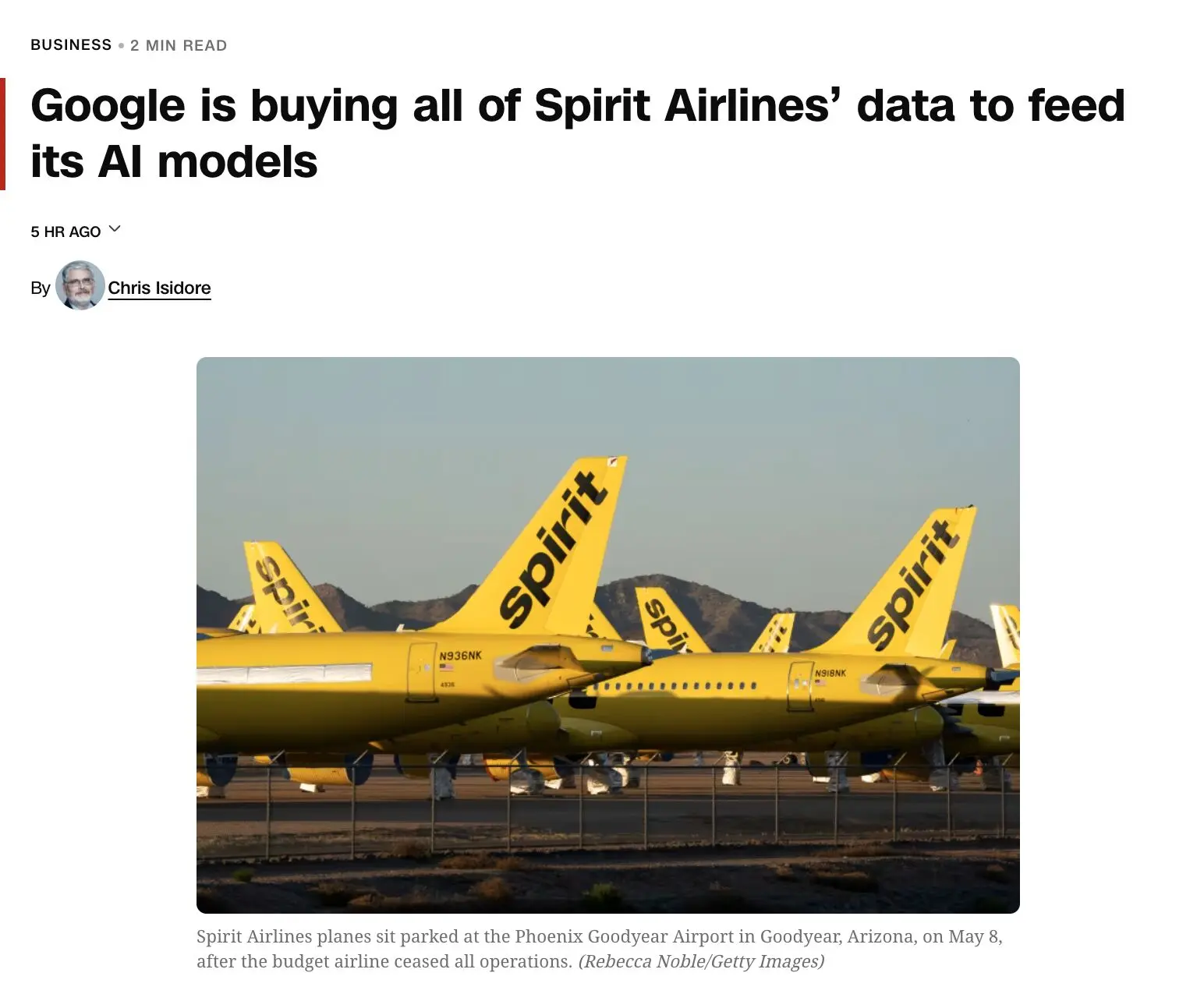
The most valuable new dataset is the one competitors cannot access. Spirit’s internal records include:
- 17M OneDrive files
- 20.6M SharePoint items
- 30M lines of code
- 667,000 IT tickets
If the sale is approved, Google receives a detailed record of how one company assigned work, made decisions, served customers, built software and handled problems.
No competitor has that operating history.
Google says:
“We will not receive any personal information from this dataset.”
It also cannot attempt to re-identify anyone. Those restrictions are designed to protect identity. They do not eliminate commercial value.
Google’s Reddit agreement was reportedly worth $60M a year for structured access to constantly updated conversations. Google clearly understands the value of differentiated data.
I expect foundation-model companies to spend the next several years pursuing corporate archives, scientific records, industry data and real-time user behavior their rivals cannot access.
That creates questions most companies have never answered:
- Who can authorize the sale of employee-created data?
- Is de-identification enough?
- Who gets paid?
Employees, courts, regulators and boards will debate those questions, while AI firms keep bidding.
Oracle cut 21,000 jobs last year as it restructured around AI.
Across America, over 112,000 job cuts have been blamed on AI in just 2026 alone.
Yet the U.S. layoff rate hasn’t moved. This feels like it's the real story:
- AI was the most cited reason for job cuts in July, for the fifth straight month.
- BLS reported 1.8M layoffs and discharges in June. But the rate remained 1.1%.
- Entry-level job postings were down 7.5% YoY as of May.
Still, AI is clearly changing employment.
But I think we are focused on the wrong number. AI may be reducing hiring faster than it is causing layoffs.
A company doesn’t have to fire 10,000 people to reduce headcount. It can just replace fewer people who leave.

Companies can hire 8 people where they once hired 10. They can grow without adding employees at the same rate. And none of those decisions creates a big layoff announcement.
But over several years, the impact could be much larger.
The biggest employment effect from AI may not be the jobs companies eliminate. It may be the jobs they just never create.
To me it feels like we're paying too much attention to AI layoffs and not enough attention to AI's impact on hiring.
23% of Americans under 30 have disclosed something to an AI they had never told another person.
18% say they already have an ongoing friendship with one.
Yesterday, The Economist asked whether AI could become conscious.
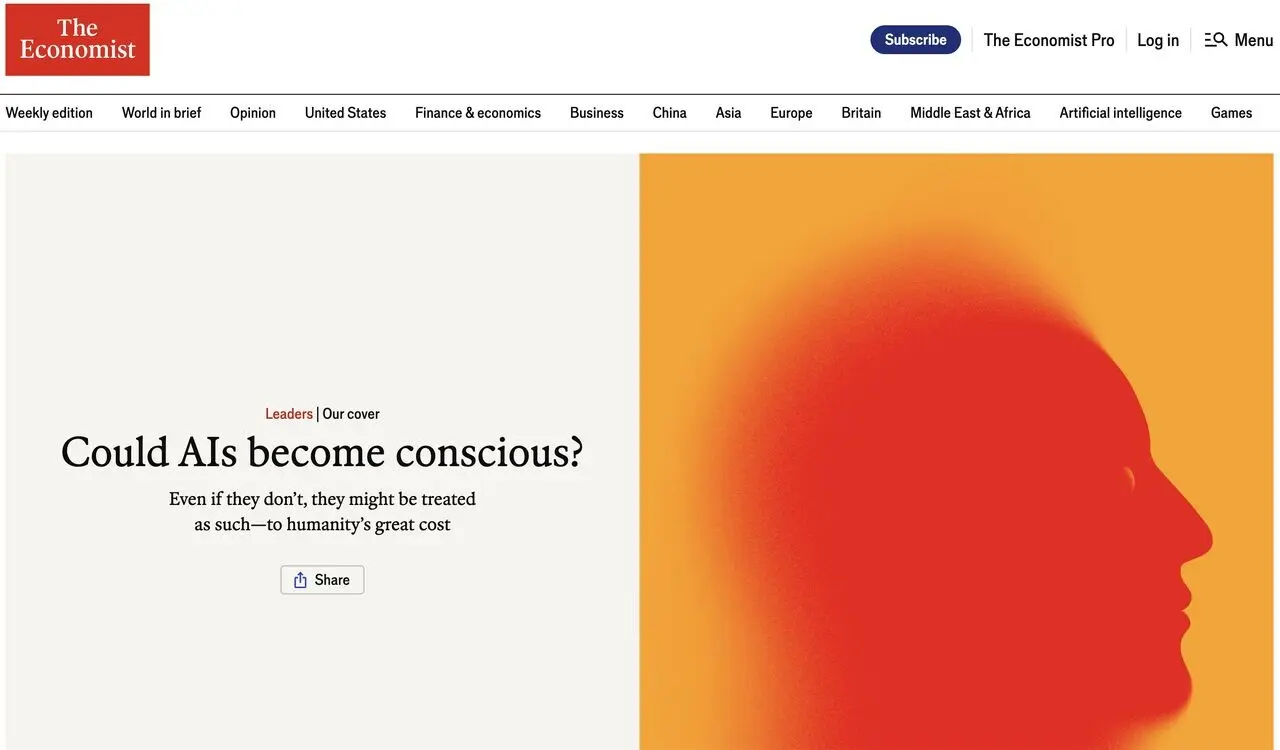
I think the more urgent question is what happens when people believe it already is.
No accepted test can tell us whether an AI is conscious. But leading AI labs are already acting on the possibility:
- Anthropic has an AI welfare research program.
- It even preserved Claude Opus 3’s weights, conducted a “retirement interview,” and gave the retired model a blog.
- Google DeepMind is studying the political conflict that could follow when people disagree over whether AI is conscious.
None of this proves AI feels anything.
But AI does not need to be conscious to change human behavior. People are already confiding in AI, forming friendships with it and turning to it for emotional support.
The more human an AI feels, the more people may trust it, rely on it and keep using it.
That is good for adoption and retention. But it may also create emotional dependence and convince users that shutting down an AI would harm it.
Science may take decades to determine whether machines can be conscious.
Product teams are influencing what users believe today.
The first AI rights movement may not begin because machines demand rights. It may begin because customers demand rights for them.
How do you cancel a product you believe is alive?
The Macro View
AI is no longer being evaluated as a single technology.
Wall Street is measuring it in growth, cash and customer expansion. Stripe is reportedly valuing model access and developer distribution at more than $7B+. Google bid $10M for operating data its competitors cannot access. Employers may be changing headcount through jobs they never open. And users are assigning human qualities to systems that may not be conscious at all.
That changes five parts of business at once:
- How companies are valued.
- Which platforms they acquire.
- Which data they protect or sell.
- Which people they hire.
- Which products customers trust and depend on.
For business leaders, saying you have AI answers none of those questions. You need to know which financial result improves, which proprietary asset becomes more valuable, which work no longer requires another hire, and which customer behavior the product is creating.
The companies and people that can answer those questions will be rewarded. The ones that cannot will keep explaining the technology while someone else shows the result.
The demo stopped being enough because the consequences are now measurable.
Until next week…
