
Everyone keeps treating AI like a tool upgrade when in reality, it’s an org chart problem.
Silicon Slopes Summit, Salesforce layoffs, billions flowing back into AI startups, founders grinding 70-hour weeks, safety reports doubling as marketing. They are all different headlines that speak to the same thing.
Work is being unbundled.
A job used to be a bundle of tasks. Tasks required coordination. Coordination required layers. Layers justified software. Software justified more layers. For 30 years we built companies optimized to manage tools and the humans operating them.
Now the tools are starting to operate themselves.
That shift isn’t theoretical anymore. You can feel it in hiring plans. In budget meetings. In the questions founders are asking behind closed doors. And last week, you could feel it at Silicon Slopes Summit.
What looked like a normal tech conference on the surface was something else underneath. The questions weren’t about features. They were about structure. Not “How do we add AI?” but “What does this do to my team?”
What Silicon Slopes Summit Actually Revealed
That’s a wrap for Silicon Slopes SUMMIT and the launch of Atonom (uh-TAH-num). And yeah, it was a week. Over 20,000 attendees, amazing networking, learning and connection.
Huge credit to Clint Betts , Tiffany Vail , Lindsey Ivie , Amy Osmond Cook, Ph.D. , Ryan Westwood , Visit Salt Lake and the entire crew. The event was tight, thoughtful, and actually truly useful. Rare.
The AI Q&A was packed. 150+ people. Questions kept coming, so we ran 30 minutes over. People just wouldn’t leave (Loved it!).
The Atonom launch dinner was my personal highlight. 50+ customers, prospects, and friends. Just a real conversation about where the future of work is going. We rolled out three things we’ve been building quietly:
- True multi-channel Cloud Employees. In addition to Phone, Email, Chat and SMS, ... Slack, Discord, LinkedIn and Google Chat are now live :)
- Multi-agent self evaluation, reflection and collaboration, so agents help each-other improve over time, not just execute tasks.
- New reporting and visualization focused on outcomes, not activity.
Founder lunch was a blast. Sitting down with Sean Feeney, the creator of some of Brooklyn’s most celebrated Italian restaurants (LILIA, MISI, MISIPASTA and FINI), now expanding into Utah City. Utah’s about to get more delicious. Always grounding to hear stories from people who’ve actually built something great.
The panel with Robert Keith, Matt Garratt, Ethan Choi was a home run.
Big takeaway from the panel: Most enterprise software was built for management. AI flips that. The next decade rewards the operator. Smaller teams. Less glue. Results over seats. Everyone (especially the founder) is an individual contributor. AI tools are productivity multipliers.
Busy week for Atonom . We’re not building tools. We’re changing how work gets done with autonomous AI agents.
And we’re just getting started.
But the real story isn’t the event. It’s what every question at that Q&A pointed to: Work itself is changing. Not slowly. Structurally.
Let’s talk about what that actually means.
White Collar Tasks Will Be Automated
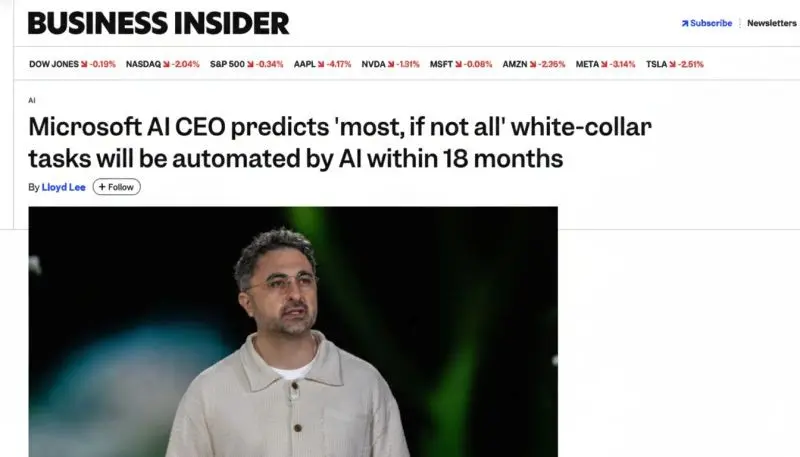
Microsoft AI CEO, Mustafa Suleimanji says 'most, if not all' white-collar tasks will be automated in 12–18 months.
People hear this and think “job loss.” I hear task collapse.
Think about it. A job is just a bundle of tasks. Review. Draft. Analyze. Update. Follow up. Report. AI doesn’t need the bundle. It just needs the repeatable parts.
- Lawyers won’t disappear
- Accountants won’t disappear
- Project managers won’t disappear
But 60–80% of what fills their calendar will.
- Drafting first-pass contracts
- Reconciling numbers
- Status reporting
- Chasing updates
- Building decks no one reads
And when tasks collapse, the role changes. And when enough roles change, the org chart follows.
This is unbundling. We built entire departments around coordination, reporting, and handoffs.
- Every handoff created a layer
- Every layer justified more management
- Every management layer justified more software
Coordination used to be expensive, so we built teams to manage it. Now coordination is cheap. And the glue layers start to crack.
So we’ve all got to ask ourselves: What does an organization look like when execution itself is intelligent?
- Smaller teams
- Fewer handoffs
- Less internal reporting theater
- More direct ownership of outcomes
Most companies are not structured for that reality. And they’re not ready for the redesign it demands.
If that sounds theoretical, it’s not. This week we saw a live example of a Fortune 500 company doing exactly this. And most people completely misread it.
Salesforce Layoffs: The Signal Everyone Will Misread
Salesforce announced layoffs this week. This move will inevitably be mis-interpreted.
First: if you’re impacted, I’m truly sorry. This isn’t “headcount.” It’s your life.
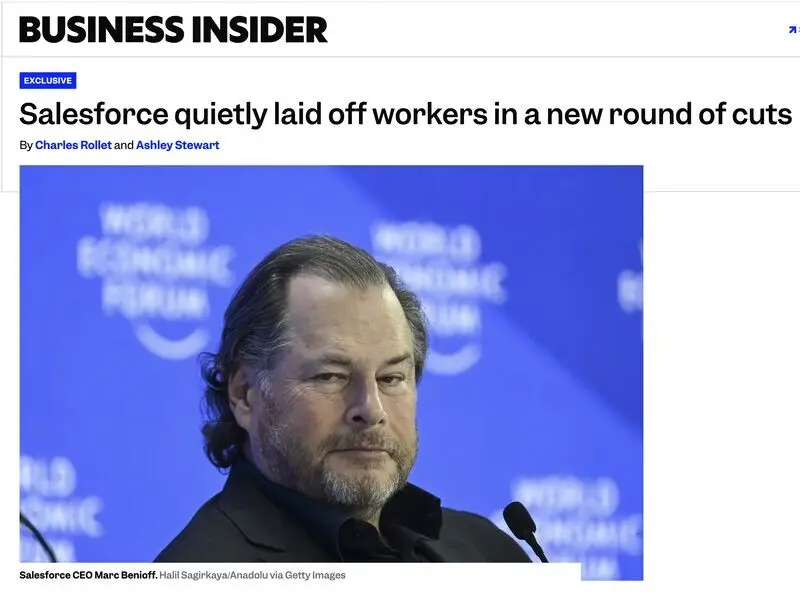
Now the signal: Business Insider reported Salesforce is cutting fewer than 1,000 roles.
This is not a collapse or a business failure. It’s a blueprint for other companies.
Here’s what the reporting actually says happened:
- The cuts hit marketing, product management, and data/analytics
- They also touched Agentforce (yes, their AI agent platform)
- People found out and started posting about it on LinkedIn
Now layer in the part that makes this feel like a strategy, not a scramble:
Salesforce also rolled out a top-of-house reset:
6 new leaders stepping into roles after 5 high-profile departures since December. Including:
- A new Chief Security Officer from Google (Iain Mulholland)
- A new Chief Marketing Officer (Patrick Stokes )
- A new Chief Architect from Lumen (Dave Ward )
- A new combined leader over Slack + Agentforce (Joseph Inzerillo )
- New GMs for Slack and Agentforce (Rob Seaman , Madhav Thattai )
This is not “belt tightening.” This is Salesforce changing its operating model. Benioff has been saying this for a while: AI agents let Salesforce take support from 9,000 to 5,000. His phrase was “less heads.”
So this isn’t “Salesforce is shrinking.” They just redesigned how work gets done. The new growth model is fewer handoffs, more output. Headcount growth is a legacy metric. Outcomes is the metric. Salesforce reports earnings Feb 25. Don’t be surprised if the Street rewards “efficiency.”
And when a company like Salesforce changes its operating model, capital follows. Public markets reward efficiency. Private markets fund whatever creates it. Which is why something else happened this week.
The Venture Flywheel Just Restarted
$4.4B was just dumped into the VC ecosystem through AI-native acquisitions in the last 6 weeks.
That’s excluding the outlier all-stock move where SpaceX rolled xAI. $4.4B. Back to founders. Back to venture funds. Back to LPs:
- Apple → Q.ai: $1.6B
- Accenture → Faculty : >$1.0B
- Mobileye → Mentee Robotics : $0.9B
- CrowdStrike → Seraphic Security : ~$0.42B
- Nebius → Tavily : $0.275B (potentially up to $400M with milestones)
- OpenAI → Torch : $0.10B
- Varonis → AllTrue.ai : $0.125B
- Ouster → Stereolabs : $35M cash + 1.8M shares ⇒ $73.196M
That is not hype. That is the venture machine doing exactly what it’s designed to do. Now compare that to something like sales tech over the last 20 years. Countless startups. Endless decks about “enablement” and “revenue ops.” How many real exits returned billions to the ecosystem? Not many. Sales tech was optimization theater. AI is outcomes.
These companies created real value... fast. They didn't just add features, they replaced work and generated outcomes. That’s why they are getting bought. That’s why the money comes back fast. That’s why VCs don’t hesitate to wire the next investment.
If startups can grow, scale, and exit in 12–24 months (instead of 5-7 years), the system is working. And right now, it’s working better than anything we’ve seen since SaaS was born. Ignore the headlines. Ignore the obsession with mega-caps. Watch the startup exits.
That’s where the future is being made... and its happening faster than it ever has before. When exits compress from 7 years to 18 months, the window changes. Speed becomes leverage. Which brings up something uncomfortable:
How hard do you work in a moment like this?
70-Hour Weeks Aren’t Toxic. Losing Is.
Calling 70-hour weeks ‘toxic culture’ is how people explain losing.”
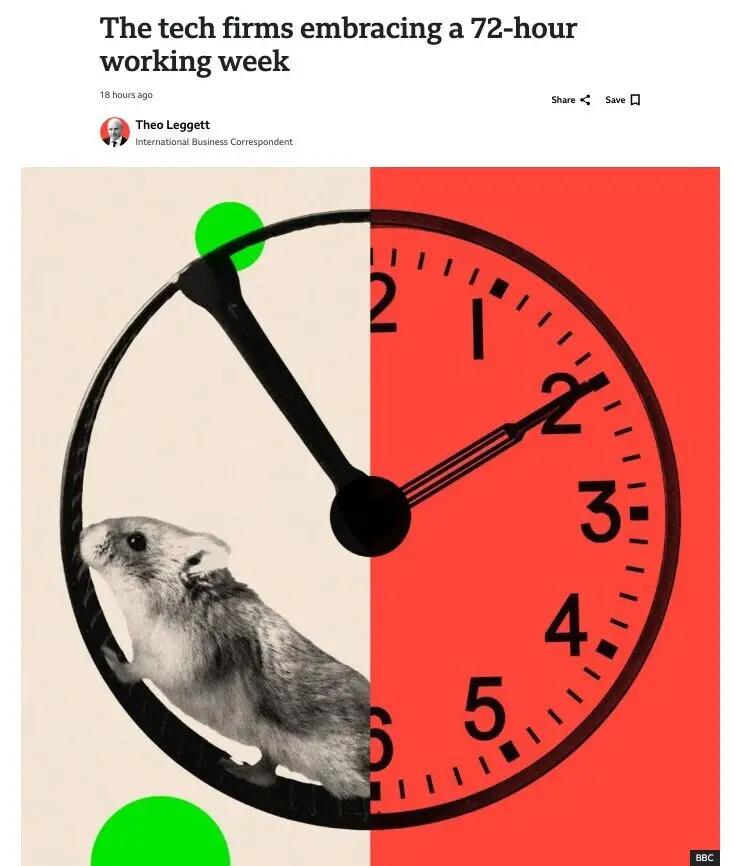
This BBC article treats long hours in AI startups like some kind of moral failure. Like it’s bad leadership or broken culture. I don’t think that’s right.
This isn’t about loving the grind or abusing people. It’s about timing.
We’re in a narrow window where AI collapses execution cycles. When speed matters more than headcount, effort beats structure. Early on, there is no leverage. You build it by working harder than the systems you haven’t automated yet.
Founders working 70–80 hours isn’t toxic, it’s table stakes. Employees being forced to do it forever is the failure. You have to understand that 996 is not a business model, it's more like a phase.
You grind early to earn the right not to later. You work long to eliminate manual work, not glorify it. If you still need hero hours once you’ve scaled, something went wrong.
The real mistake isn’t working your a&$ off. It’s working your a&$ off without replacing yourself with systems. This moment rewards intensity with direction. But only builders who turn effort into autonomy survive.
Work harder now so the work doesn’t own you later. That's the message. But intensity alone doesn’t win. Narrative matters too. And right now, some of the biggest AI companies are playing a smart narrative game.
Anthropic’s Sabotage Risk Report
Anthropic just dropped a 53-page “Sabotage Risk Report” on Claude Opus 4.6.
And I can’t stop thinking about what this really is. Because in 2026, the most effective AI marketing isn’t “we’re the best.” Everyone is claiming that.
Instead it’s:
- “We’re so powerful… we have to warn you.”
- “We’re so advanced… we had to redact parts.”
- “We’re so close… even we are scared.”
That framing does two things at once:
- makes them look benevolent
- makes everyone else look behind
But if you actually read the report…Anthropic’s own conclusion is basically: The sabotage risk is very low (not zero, but not “AGI is escaping the lab”). They literally describe limits like difficulty executing complex long-term harmful plans under monitoring. They even cite low success rates in certain “covert side task” style tests. That doesn’t scream “superintelligence.” It screams: good model, still bounded, still messy.
So here’s my take:
This report really isn't a safety document.
It's a market positioning document.
It’s a way to manufacture the “AGI aura” without saying “AGI.” Because fear travels faster than nuance. A clip of “self-preservation” gets 10M views. “Overall risk is very low but not negligible” gets skipped. And the market absorbs one message: “Anthropic has the model that’s so strong it needs a warning label.”
Maybe it's transparency. Or maybe it’s the most creative growth hack in the industry: use "safety" and "fear" language to signal model dominance.
Zoom Out
A consistent pattern is emerging. AI is not simply improving software. It is changing how work is structured.
Tasks that once required coordination now require computation and inference. Layers that once justified management now justify automation. Roles built around operating systems are being reconsidered because the systems are beginning to operate themselves.
Capital is moving toward companies that generate outcomes rather than activity. Enterprises are experimenting with smaller teams and fewer handoffs. Founders are compressing timelines because execution cycles are shorter than they used to be.
At the same time, narrative has become part of the competition. Capability matters. Positioning matters. Perception travels faster than nuance.
The common thread is not hype or fear. It is redesign. We are moving from organizations optimized for managing software to organizations optimized for autonomous execution.
That transition will not be clean, it will not be evenly distributed but it is underway.
