
There's important change happening because of AI, and most people seem to be misreading it.
The AI debate keeps getting stuck on the same stuff. Who’s winning. Is it a bubble. Which model is better. Who raised the most money. Whose valuation is the highest... All loud questions. None of them are the point. The bigger change is something else.
Work that historically sat half-done, waiting on someone, getting pushed to next week, now just gets completed. Almost be without being realized. And when that happens, a lot of systems start to teeter. Anything built around delay, handoffs, vague ownership, or manual follow-up stops working the way it used to.
Once you notice it, you see it everywhere.
It's in how individuals work. In how companies staff teams. In revenue ops. In strategy conversations. All the examples look different on the surface, but they’re pointing to the same thing.
Intelligence is cheap now. Completion isn’t rare anymore.
That idea hit me somewhere I didn’t expect. Not in sales numbers or product roadmaps, but in math. A field where leaving things unfinished was normal, even for years. Where partial progress was often the best you could do. That’s now changing also.
AI Solves the Unsolvable
AI isn’t coming for your job. It’s coming for the work you never quite finished.
That showed up clearly last week. AI didn’t just answer a question. It finished the work.
For context: Paul Erdős was one of the most prolific mathematicians in history. When he died, he left behind hundreds of unsolved problems. Some of them have been open for decades. They’re famous precisely because they resisted closure.
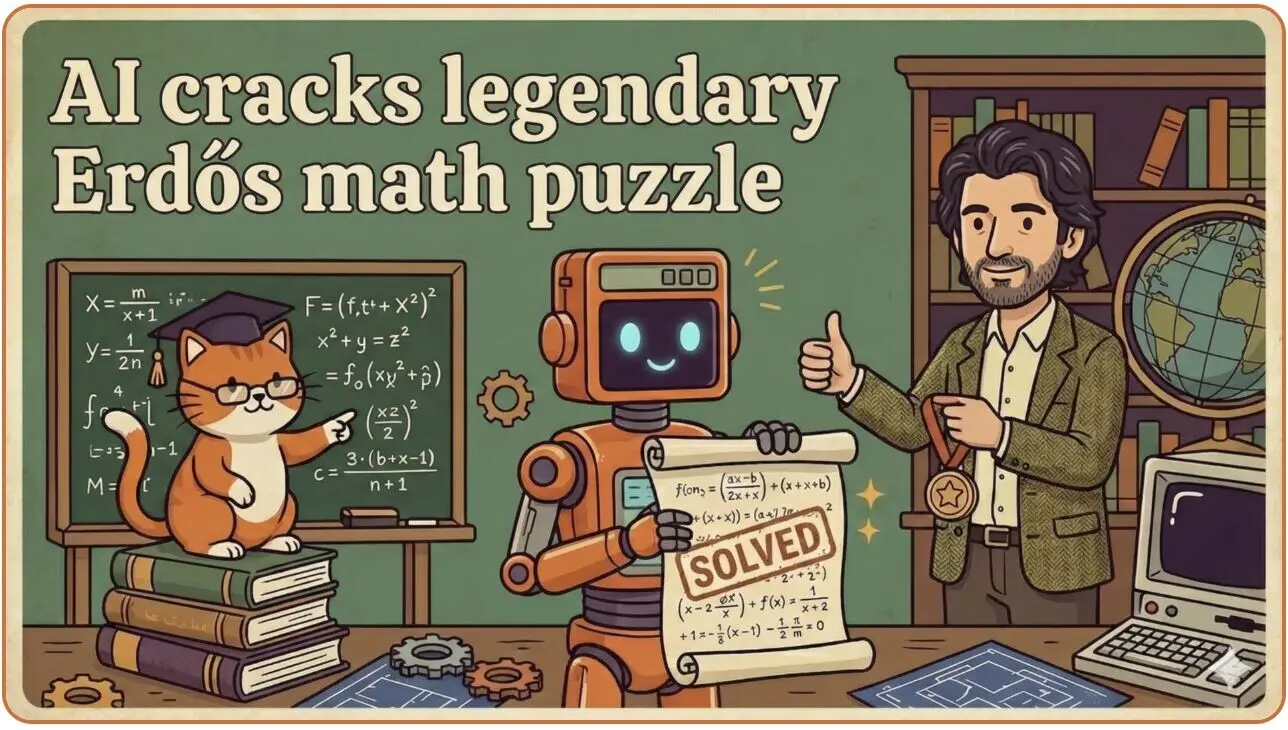
This last weekend, a model generated an original proof to one of those problems. Not by searching old papers. By reasoning it through. The proof held. Fields Medalist Terence Tao verified it. As a math nerd, I love this. As a human who works for a living, this part is way more important. Because most white-collar work looks exactly like those problems did. Things we start but don’t finish.
- Analyses that get 80 percent of the way there.
- Decisions we park with “we’ll come back to this.”
- Known problems that stay known because nobody has the time to close the loop.
For a long time, that last mile belonged to humans. Not because it was anything special, it was simply unfinished. AI isn’t taking ideas from humans. It’s taking responsibility for finishing things.
That mile just got a lot cheaper. And in some cases, automated.
I'm not going to argue whether AI replaces jobs. That’s the lazy framing. I think the more intriguing part here is what happens when the unfinished work disappears.
- When follow-ups happen by default.
- When the obvious next step gets taken without a meeting.
- When the lowest-hanging fruit is gone before the conversation even starts.
This started as a math story I nerded out on. It ended as a reminder of how much “unfinished” work we all rely on.
What looks like a one-off breakthrough in math is actually a preview of something broader. When the last mile of work gets cheap to complete, the impact is not personal productivity. It is organizational design.
McKinsey Hires 25,000 AI Agents
McKinsey & Company CEO Bob Sternfels says the firm now has 40,000 humans and 25,000 AI agents. They didn’t just “adopt AI.” They hired it.
Read that again, slowly, because it’s a strong statement about how the firm believes work itself should operate in the future. This isn’t software deployment. It’s workforce design.
When Bob Sternfels says that every employee will be “enabled by one or more agents,” he isn’t really talking about assistance. He’s pointing to a change in how the job itself is structured. Consulting is no longer a "human-only" role.
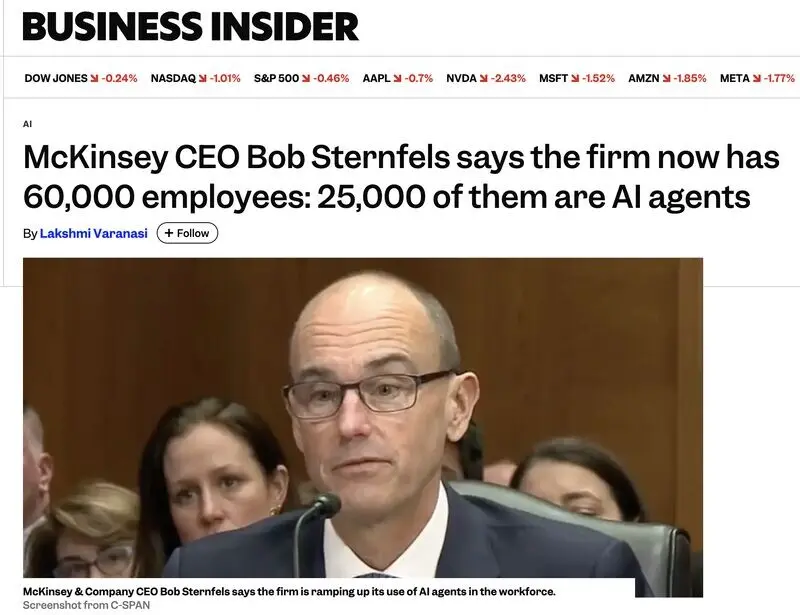
McKinsey reorganized the firm around a belief that intelligence is becoming abundant, and execution is becoming the real bottleneck.
These firms were built when smart thinking was scarce and analysis was the advantage. As reasoning becomes cheap, the bottleneck shifts from thinking to deciding, acting, and owning the results.
What’s happening here ISN'T the removal of people. It’s a reorganization of the work. Humans spend their time on judgment, creativity, innovation, context, and owning decisions, while agents handle the analytical and repeatable tasks that once took up most of the day without creating much advantage.
And once this all happens, the business model has to follow. You don’t sell hours when labor can scale without headcount. You sell outcomes, impact, and the willingness to stand behind results. That’s why McKinsey’s move toward underwriting outcomes instead of billing is a logical consequence of a new labor reality.
This marks a new operating system for work. I like the question McKinsey is asking: what does the organization become when AI shows up as labor, not software?
Once AI shows up as labor instead of software, revenue is one of the first places where weak systems get exposed. And Gong’s AI report made that clear.
96 Percent AI Adoption, 42 Percent Quota
I was reading Gong’s State of AI report and two numbers stopped me cold.
- 96% of revenue teams are now using AI.
- Quota attainment still fell to 42%
Those numbers don’t contradict each other. They explain what’s broken. AI adoption isn’t the constraint. The way revenue teams are designed is.
What went wrong:
- Automated busywork instead of fixing decisions
- Scaled activity instead of outcomes
- Executed faster on broken processes
The report makes this part clear. Adoption alone doesn’t drive results. Depth does. Teams that treat AI as a strategic layer, not a productivity shortcut, see real gains. Everyone else just gets busier.
What stood out in the data is that once AI is everywhere, it stops being a differentiator. The advantage shifts to the teams that redesign how revenue actually works and how intelligence flows through the organization. Remember, AI doesn’t fix weak systems, it exposes them.
Many leaders assume advantage comes from having the best model or the loudest AI narrative. But once intelligence is everywhere, the advantage shifts to who controls where it actually shows up.
Apple Switches it’s AI strategy
The “Apple sucks and is losing the AI race” take is lazy. The more accurate take is harder and more interesting. Apple is not losing the intelligence race. They opted out of it. They outsourced the intelligence layer of Siri to Google on purpose.
Here’s the part people are getting wrong:
- If the race is who has the flashiest model demo, Apple is behind, no question.
- If the race is who controls where AI actually shows up in real life, Apple is still ahead of almost everyone.
I believe this wasn't an accident. Apple looked at the landscape and realized:
- Models are converging fast
- Performance gaps close
- Costs fall
- Switching gets easier
- Intelligence becomes a commodity
Meanwhile, shipping matters more than training. Apple’s risk was not model quality. It was time. Siri needed to work inside real products, at scale, now. And the real power was never the model anyway. It’s everything around it.
- The device
- The operating system
- Permissions
- User experience
- Trust
- Distribution
That’s where Apple still has a structural edge. So instead of pretending they could out-train Google, Nvidia, Microsoft, and OpenAI simultaneously, they did the rational thing. They rented the intelligence and kept control of everything that actually matters.
That’s not giving up in my opinion, that’s being realistic.
Now, here’s the fair critique. Apple underestimated how much visible AI leadership would become to consumers, developers, and even the market. Perception matters and momentum matters. And yes, they gave up some mindshare.
But confusing mindshare loss with strategic failure is a mistake. Apple didn’t lose the race. They changed the race conditions. This isn’t about who has the best model. It’s about who controls where AI actually shows up and does something.
On that front, Apple is still very much in the game. The real work now is redesigning systems, not debating tools. Those conversations are increasingly happening in person, among people who are actually building through the shift.
The Future of AI
Salt Lake City is about to become base camp for the Future of AI.
Utah is celebrating 10 years of Silicon Slopes with SUMMIT 2026: Feb 4–7 in downtown SLC at the Salt Palace Convention Center. This year’s theme is simple: The Future of AI.
Not demos. Not hype. Real builders + real leaders talking about what’s next for business, tech, and society. Speaker lineup is stacked (and getting deeper):
- Jared Hess + Jerusha Hess (Napoleon Dynamite / Nacho Libre / Minecraft)
- Henry Schuck (CEO, ZoomInfo )
- Amit Bendov (CEO, Gong )
- Sean Desmond (CEO, nCino )
- Jean Oelwang (CEO, Virgin Unite )
- Jaspreet Singh (CEO, Druva )
- Lorraine K. Lee (“Unforgettable Presence”)
- Dan Reynolds (Imagine Dragons)
And it’s not just a stage show. 10+ countries. Networking cafes, curated lounges, invite-only gatherings, live music… and a Winter Roundup finale that mixes innovation + adrenaline + community.
If you’ve been feeling the shift…
If you’re building through it…
This is the room.
Register here.
Zoom Out
When you line all of this up, a pattern starts to show.
AI is closing things that used to just hang around.
In math, that looks like problems people left alone for decades suddenly getting solved. In consulting, it looks like firms treating AI less like a tool and more like labor, then reshaping jobs around that reality.
In revenue teams, the numbers tell a stranger story. Almost everyone is using AI, yet quota attainment is slipping. A lot of teams automated motion instead of fixing the calls that actually require judgment.
In platform strategy, you see it with companies like Apple paying less attention to having the best model and more attention to controlling where intelligence shows up and how it’s allowed to work.
None of this depends on AI having better instincts than people.
What really changes is the slack that used to live in half-finished tasks, manual steps, and the quiet delays that absorbed mistakes and bought people time, and when that slack disappears, systems that once seemed fine start to come apart in ways that are hard to ignore.
The companies moving fastest aren’t making a big show of it. They’re deciding where humans still need to think, where they don’t, and what breaks when work stops lingering and starts finishing whether the system is ready or not.
