
The model war is over. The stack war just started.
For two years, the AI conversation was about intelligence: who has the best model, which benchmark matters, whose demo wins. This week, five companies proved the conversation has moved. The fight is no longer about who builds the smartest AI. It is about who owns every layer of the stack intelligence runs on: the operating system, the distribution, the compute, the physical infrastructure, and the org chart.
In this issue of Autonomous, we break down:
-
The New Operating System:
merged Android, ChromeOS, and Gemini into one intelligence layer. When the OS becomes the agent, it unlocks distribution networks that were previously impossible to access.
-
The SMB Unlock:
embedded Claude inside QuickBooks, PayPal, and Canva, bypassing every sales motion that said 33 million small businesses were not worth the CAC.
-
The End of Cloud-Only AI:
partnered with Dell to move Codex on-prem. Token economics are breaking at enterprise scale.
-
The Physical Stack Goes Public:
filed for IPO. Model companies fight over intelligence. SpaceX is building the physical world intelligence runs on.
-
The Autonomy Gap:
and
reveal the real divide, cutting headcount only works if the AI can own the function, not just assist it.
Every layer of the technology stack is being claimed. If you sell software, your distribution just changed. If you price per seat, your model just broke.
Everything starts with the platform layer. And Google just redefined what a platform is.
Google Added $3 Trillion While the Market Waited for It to Die
Last year, the market wondered whether AI would kill Google. One year later, Alphabet Inc. Inc. has added nearly $3 trillion in market value.
The question has completely flipped: What if Google is not the company AI kills? What if Google becomes the operating layer AI runs on?
Last November, Google released Gemini 3. That was the model moment. Now Googlebook looks like the platform moment. Not a better Chromebook, but a new computing model built around Gemini Intelligence.
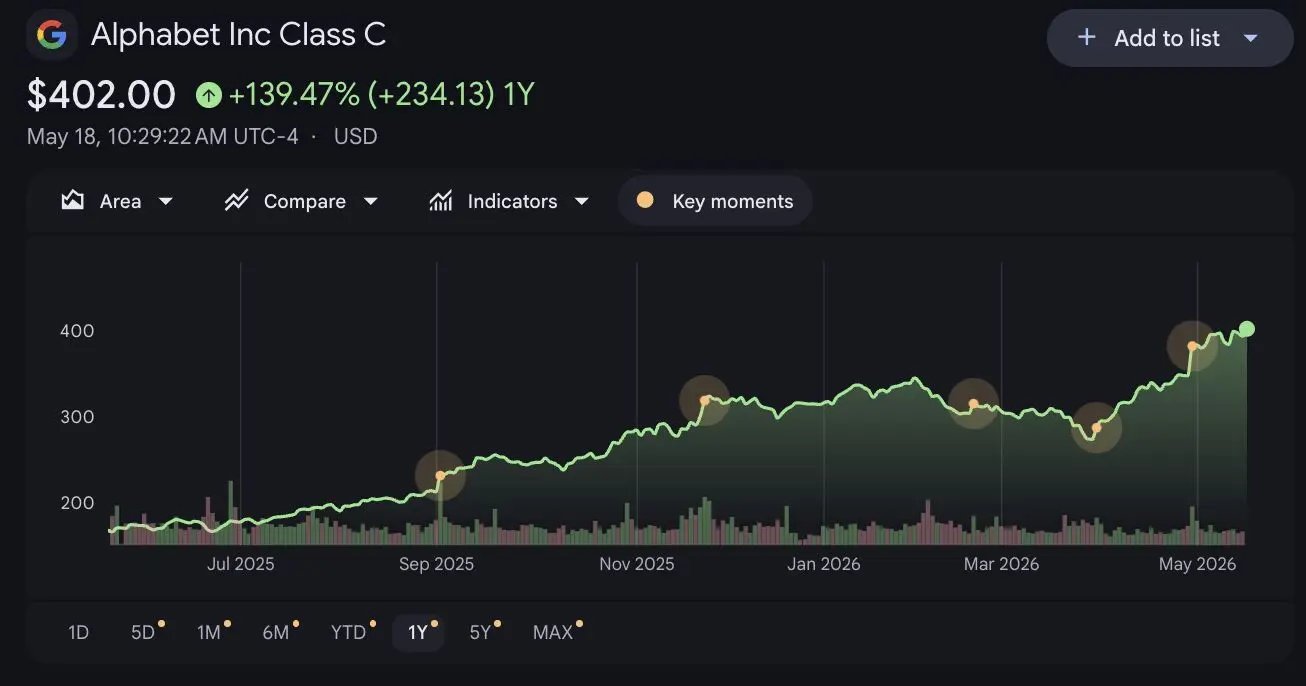
Android + ChromeOS + Gemini pulled into one intelligence layer. Google VP Sameer Samat said it clearly: “We’re transitioning from an operating system to an intelligence system.”
That is the whole story.
For 25 years, software companies sold into an interface:
- A human used a browser.
- Clicked a tab.
- Logged into an app.
- Completed a workflow.
Now the distribution layer is becoming the agent. I believe there are three implications:
- Distribution: You are no longer just selling to a human clicking. You are selling to a model deciding.
- Moats: Software moats are being filled in by AI-native workflows.
- Pricing: Per-seat pricing starts to break when one agent can do the work of ten.
I/O may be when Google shows that the next operating system is intelligence. Lets watch their market cap respond. When an operating system becomes the agent, it unlocks massive distribution networks that were previously impossible to access profitably.
Anthropic Unlocked 33 Million Customers Enterprise SaaS Gave Up On
Anthropic just unlocked 33 million customers that enterprise SaaS gave up on 20 years ago.
For two decades, the math on small business was simple:
- Too fragmented to target.
- Too expensive to acquire.
- Margins too thin to justify a sales team.
Salesforce , HubSpot , and Oracle kept building richer features for the Fortune 500 and deemed SMB a too expensive to pursue. This week, the $900B AI company nobody expected to chase micro-businesses just did exactly that.
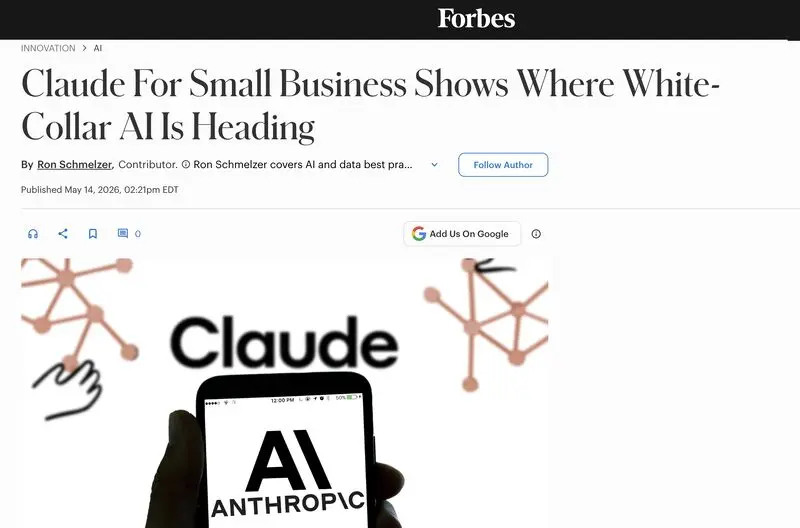
Fresh off a $45B revenue run-rate (up 5x in 12 months), Anthropic launched Claude for Small Business: Claude embedded directly inside the tools 33 million SMBs already pay for:
- Quickbooks
- PayPal
- Canva
- Docusign
- Google Workspace
- Microsoft 365
15 prebuilt agent workflows: payroll, month-end close, lead scoring, invoice chasing, etc. Buying these don't require new purchase cycles and there are no new logins.
The irony? Microsoft , Google , Intuit , and HubSpot have spent years and billions building their own AI assistants inside these exact tools, and Anthropic just accessed their distribution for free.
The reason people neglect SMB is the CAC. A human AE cannot profitably close a $50/month customer. An agent / digital employee easily can. The cost of acquiring and expanding the next SMB customer just collapsed to nearly zero. The cost of serving them collapsed with it.
The Fortune 500 has roughly 30 million employees, and there are 33 million U.S. small businesses. Anthropic just doubled the addressable market for enterprise software in a single week. Every B2B GTM playbook written before Tuesday needs a rewrite to consider including every restaurant, carwash, laundromat, yoga studio and local bakery.
Hijacking legacy distribution networks requires a rethink of where the underlying models actually process their data.
OpenAI Leaves Hyperscaler-only AI Behind
OpenAI just took its first real step out of the hyperscaler-only AI model. And this marks that the cloud-only AI era is over.
Yesterday at Dell Technologies World, OpenAI and Dell announced Codex is going hybrid and on-prem. You can now run AI on hardware you own instead of capacity you rent.
This is a totally new access to distribution for OpenAI:
- Dell added 1,000 new AI Factory customers last quarter. Total now: 5,000.
- Eli Lilly, Honeywell, and Samsung are running AI workloads on Dell.
- Dell claims Deskside Agentic AI cut costs 87% vs. public cloud APIs over 2 years.
Now the model layer that belonged to the data centers like Microsoft Azure, Oracle, Amazon Web Services (AWS) or CoreWeave just became easily purchasable. What's driving this is the crazy token cost inflation. As we have been deploying AI into the enterprise, the high costs of AI token don't actually pencil out.
In many cases, an AI agent costs more than the human doing the same job. This partnership is not a one-off.
- SAP is embedding Claude into Joule.
- Anthropic is pushing Claude into small-business workflows.
- Harvey is moving legal AI directly into Microsoft 365.
- Now OpenAI is moving Codex toward Dell-controlled enterprise infrastructure.
AI value is moving closer to the customer’s hardware, the customer’s data, and the customer’s control. The hyperscalers won the last decade by centralizing compute. The next decade may be won by putting intelligence where the enterprise data already lives.
Moving models closer to the data requires a massive physical capability that standard software companies simply cannot build.
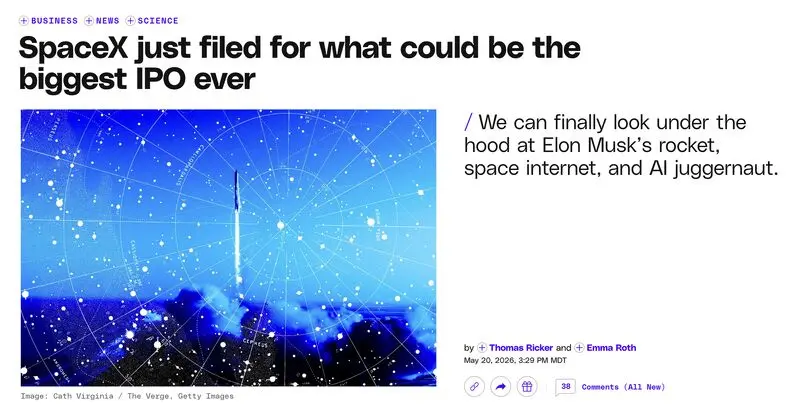
SpaceX Filed for IPO but Everyone Sees a Rocket Company
SpaceX just filed for IPO, and everyone is going to value it like a rocket company. That is the wrong lens. This is the first public filing for the physical stack of AI.
Minimize image Edit image Delete image
Look at the pieces:
- $18.7B in 2025 revenue
- 10.3M Starlink subscribers
- $7.2B in Starlink EBITDA
- 9,600 satellites
- Anthropic paying $1.25B per month for compute
- $60B option to acquire Cursor
- Orbital AI compute satellites targeted 2028
OpenAI and Anthropic may have the attention around the models, but SpaceX is becoming the landlord. Most AI companies rent chips, cloud, data centers, power, distribution, and bandwidth. SpaceX is building across all of them.
The Anthropic deal shows this: A frontier AI lab is paying SpaceX $1.25B per month for compute. Historically, software companies won by owning distribution. The AI war may be won by whoever owns the metered infrastructure intelligence runs on.
Right now, model companies are fighting over intelligence. SpaceX is trying to own the physical world intelligence depends on.
Securing the physical stack is an empty exercise if the internal organization is not structured to handle autonomous execution.
Meta and the Reality of Autonomous Execution
Meta just cut 8,000 jobs, canceled 6,000 and moved 7,000 people onto AI in the same week it made $26.8B in profit.
Here is the breakdown. This week Meta started cutting about 8,000 roles, roughly 10% of the company. It also cancelled around 6,000 jobs it had open. These were not performance cuts. They were structural.
At the same time, Meta is moving about 7,000 employees into new AI groups. All of this happened in the same quarter Meta posted record revenue of $56.31B and net income of $26.8B, and raised its AI spending guidance to as much as $145B.
On the surface it looks like the perfect AI story. Cut the headcount. Fund the agents. Keep the profit. The bet only works if the agents can actually do the job,... Right now most of them cannot.
Gartner studied 350 executives at billion dollar companies. About 80% had cut staff because of AI. None of it lined up with better returns. A Carnegie Mellon University study found AI agents still get office tasks wrong about 70% of the time.
So here is what I think is likely going on. Most companies are not deploying AI that runs the work. They are deploying AI that assists it. A copilot, chatbot or tool that still needs a person standing behind it to catch the mistakes.
That is automation. It is not autonomy. The gap between cutting the cost and capturing the gain is whether the AI can own the function end to end. The companies that win the next 18 months will be the ones that deploy that. AI employees that actually run sales, support, finance, and operations, not assistants that sit next to them.
Meta is betting it can build the autonomous version. Most of the companies copying the layoff headline are buying the assistant and hoping it adds up to the same thing.
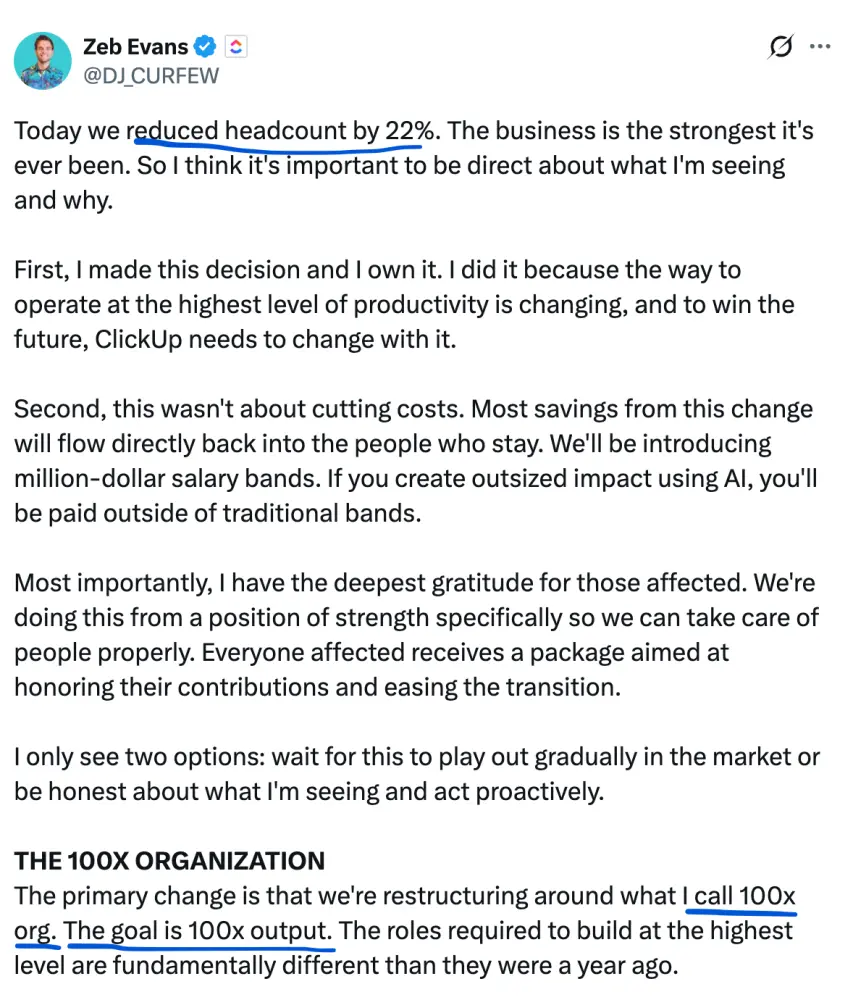
A CEO just cut 22% of his staff, then told the people who stayed they could make a million dollars a year.
That was ClickUp founder, Zeb Evans. His x.com post explaining this strategy got 5.7 million views in a day.
In the comments, many people saw this as a typical AI "layoff." That's not what this was. He didn't cut to save money.
Most savings from this change will flow directly back into the people who stay" ... in million-dollar pay bands for anyone who creates real impact. He cut a fifth of the company and then is paying the the people remaining like founders. He shared that the best people are about to be worth 10x of everyone els
His engineering story highlights this: His best engineers stopped writing code. Instead they are directing agents to write code, then are reviewing and improving it. They are orchestrators. The key skill is the human judgment. AI makes the best engineers wildly more productive.
Then he called out companies are bragging about shipping 500% more code while customers feel absolutely nothing. More output is NOT the goal. It is just a bigger pile of crap to clean up.
The companies that win will not be the ones that do more. They will be the ones who build better,... faster.
Headcount stops being the scoreboard. Judgment is.
And we are seeing this move in daily headlines (approx):
- Block - Feb. 26: 4,000 jobs cut, 40% of workforce
- Atlassian - Mar. 11: 1,600 jobs cut, 10% of workforce
- Coinbase - May 5: 700 jobs cut, 14% of workforce
- Freshworks - May 5: 500 jobs cut, 11% of workforce
- Upwork - May 7: 145 jobs cut, 24% of workforce
- Cloudflare - May 7: 1,100 jobs cut, 20% of workforce
- Cisco - May 14: 4,000 jobs cut, 5% of workforce
- Intuit - May 20: 3,000 jobs cut, 17% of workforce
- Meta - May 20: 8,000 jobs cut, 10% of workforce
It looks like almost every company is likely to end up here. There are just two key questions:
Are you really just cutting costs or adapting to the new kind of company?
Are you going to do this strategically, or get just dragged in late?
The Macro View: This week made one thing clear: the AI race is no longer about who builds the best model. It is about who controls the surface the model touches.
Google is turning the OS into the agent. Anthropic is hijacking distribution instead of building it. OpenAI is moving the model to the customer's hardware. SpaceX is becoming the landlord of the physical stack. Meta and ClickUp are proving that headcount is no longer the unit of growth, judgment is.
Five companies. Five different moves. One identical bet: the next trillion dollars belongs to whoever owns the layer between intelligence and the customer.
The model war produced the technology. The distribution war will produce the winners.
Until next week…
