
We are a few months into 2026 and the AI debates are in FULL effect.
There is a contingency of people believing that there is an imminent AI bubble about to burst, then there are the people calling the end of the SaaS era proclaiming the SaaSpocalypse.
There are reasonable indicators for both camps, Reuters reported the S&P 500 software and services index had lost about $1 trillion in market value just since January 28 during the February selloff. On the bubble side, there is a fundamental capex/valuation-to-realized-ROI mismatch.
This last week specifically highlighted debates around an AI SaaS carnage, the emerging AI productivity boom and the "Narrative war" fighting for marketing attention between the US Government and the AI Labs like OpenAI, Anthropic, Google (now emerging as the big three), while xAI and Meta are in full reset mode and Perplexity and Microsoft are in chasing from behind.
To understand whats really happening, we have to look past the headlines and into the actual strategies and game theory tactics being played on a crazy global stage like we have never seen before.
Claude Runs on Great Marketing
First, The most impressive thing Anthropic has built isn’t Claude. I think its their marketing team. I’m serious. Every few weeks there’s another hyperbolic headline.
Last week Anthropic took a dramatic stand, refusing to work with the US government as the "responsible" AI company. A seemingly powerful moral position… that somehow turned into “actually we’re still talking to them” about five minutes later. Then, this week their CEO says Claude "MAY or MAY NOT" have gained consciousness because the model is showing “symptoms of anxiety.”
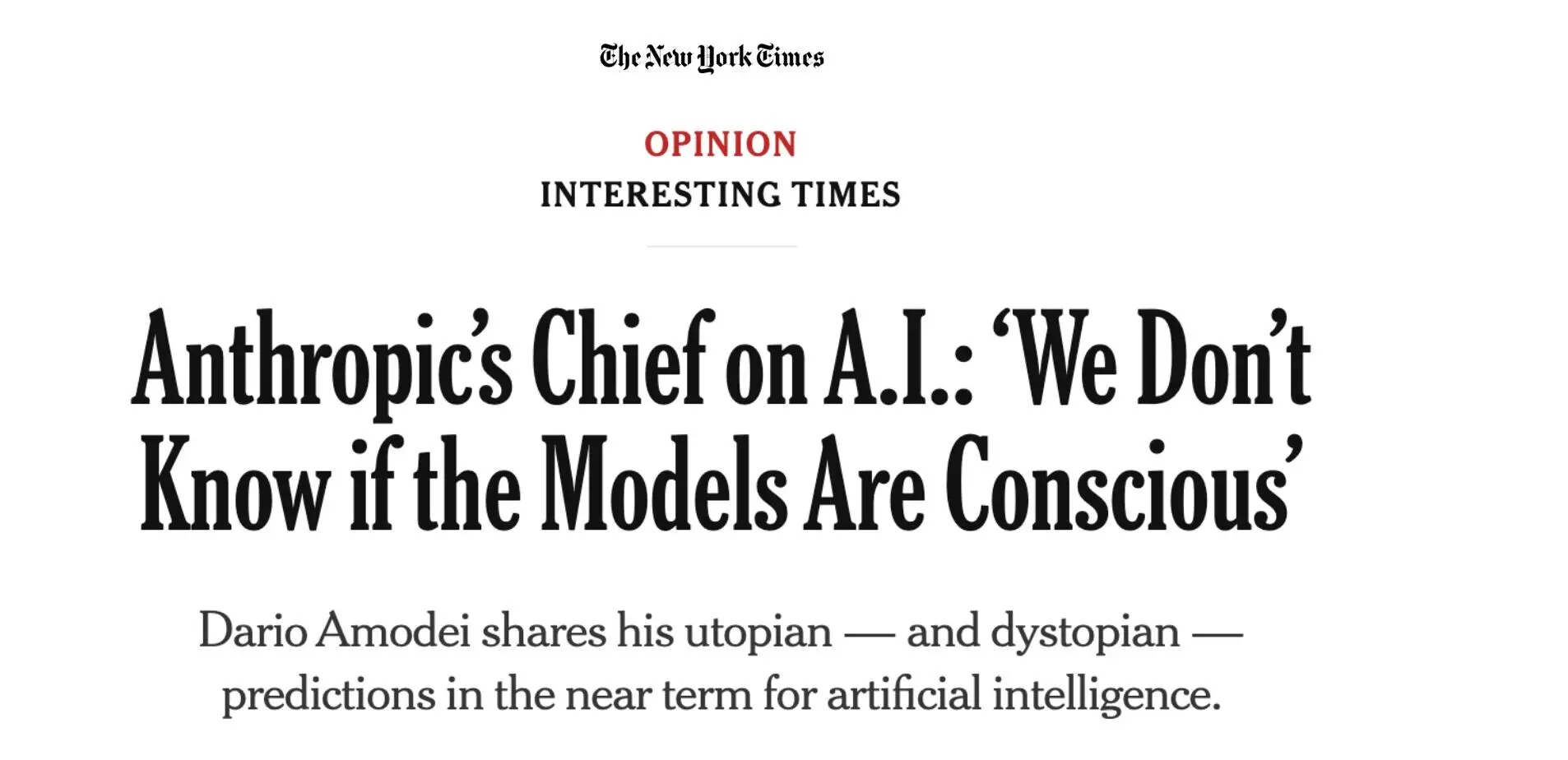
May or may not have? What does that even mean???? I could say that of my pets. The truth is that it doesn’t even matter because every major outlet picked it up. The entire tech world debated it and even Elon Musk jumped in saying of Dario Amodei (Anthropic's CEO) "He’s projecting."
Honestly… I’m not mocking it. I’m jealous, it’s a brilliant narrative. Make the technology feel mysterious. Position yourself as the responsible company building something so powerful that they need to protect us all. It's perfect storytelling.
And it’s working. For that weekend, Claude became the #1 downloaded app in the app store. Which just shows you something important about this moment in AI. We’re not just watching a race to build better models, we’re watching a race to control the narrative about what those models are.
But once you move past the marketing, the actual experience of using these tools tells a much more layered story.
The Most Over-Marketed Product in Tech
Claude might be the most over-marketed product in AI. Spend 10 minutes on LinkedIn and you’ll think every founder in America fired their team and handed their entire business to Claude Code.
Then you talk to real operators, and the story changes fast.
- The tooling is still harder than the posts make it sound
- The workflows are still brittle
- And most of the “AI replaced my team” examples are really just a glorified personal assistant with a human still in the loop
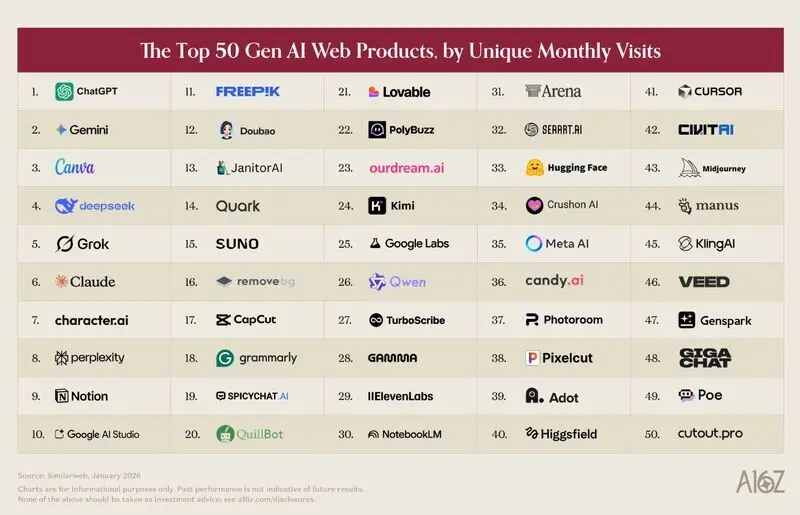
Then you look at consumer adoption data and the story gets even more interesting. The latest Andreessen Horowitz rankings still show ChatGPT dominating. Gemini is emerging as the stronger mass-market challenger. Claude is clearly important, but the cultural footprint seems much bigger than the actual usage footprint.
That usually means one thing: That marketing is outperforming the product narrative.
To be clear, that’s not a knock on Anthropic. It’s actually impressive. They’ve built one of the best hype machines in tech. But operators should understand the difference between a personal agent and an operational worker. Most of the viral examples are personal agents. Tools connected to your email, calendar, and files that help one person work faster (we have had automation tools like these under different names for 30 years).
When something unusual happens, they stop and ask what to do. That’s useful. But it’s still human-in-the-loop productivity. The real power happens when AI runs a workflow thousands of times without stopping.
- Handling edge cases
- Handling objections
- Handling messy inputs
Not as a demo but as a repeatable job. This gap is creating a strange new reality where we are watching roles shift from knowledge and experience to a simple prompt.
Is this the end of software engineering?
March 10, 2026 is now marked as the end of the 'Technical Software Engineer'?
Something happened in an interview at Atonom this week that honestly felt like a preview of where the industry is heading. A candidate came in for a development role with a strong resume, prior engineering jobs, and six-figure expectations. On paper he looked like a completely normal software engineer.
He passed the first part of the interview where we talked through culture fit, background, and experience. Then we moved to the technical portion and asked him to walk through a simple whiteboard coding problem, nothing tricky, just a small piece of logic to see how he thinks through code.
The candidate stopped us. “I’m going to be honest,” he said. “I can’t do that.”
We thought he meant he didn’t like whiteboard interviews (some engineers hate them). That wasn’t it. He said something I’ve never heard in an engineering interview before. “I don’t actually code.” He paused and clarified. “I write prompts that generate the code.”
For the past three years, this person had worked as a software developer. His workflow was entirely AI driven. He described his role as prompting models, generating code, and refining outputs. But writing code himself? Not something he really knew how to do.
So when we asked him to write a small piece of logic on a whiteboard, he simply said: “If that’s what you need, we should probably end the interview here.”
And we did. Now before everyone jumps to “this guy is a fraud,” I don’t think that’s the real story. This person had already been hired as an engineer somewhere else. Which means something else is happening. We are creating a generation of “Software Engineers” who don’t actually know how to engineer software.
They know how to operate the machine that writes it. That might be the future. Or it might be the beginning of a pretty serious skills gap. Because prompting a model is not the same thing as understanding how systems work and fail, why architecture matters, or what the code is actually doing.
Why Everyone Has AI Brain Fry
AI isn’t making knowledge work harder. It’s removing the easy part. A new Harvard Business Review study (recently covered by CBS) says workers using multiple AI tools are reporting more fatigue, more mistakes, and more decision exhaustion.
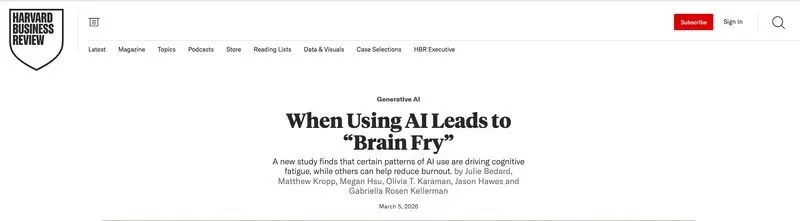
Most people will read that and conclude AI is making work harder. I think the opposite is happening. AI is deleting the easiest parts of knowledge work.
- The research.
- The drafting.
- The summarizing.
- The cleanup.
The comfortable busywork that used to fill the day and make us feel productive. For years, that was most of the job. Now the machine does it in seconds.
What’s left for humans is the part we used to do in shorter bursts:
- Judgment.
- Prioritization.
- Taste.
- Decision-making.
- Responsibility.
In other words: thinking. And doing the hardest part of the job all day is exhausting. That’s the story behind “AI brain fry.” AI isn’t breaking knowledge work. It’s exposing what knowledge work actually was.
The old job had padding. The new job doesn’t.
The companies that win won’t be the ones that hand employees more AI tools. They’ll be the ones that redesign work around a key fact: AI may be limitless. Human cognition isn’t.
We Built for the Wrong Era
Atlassian just cut 10% of its workforce and completely changed the SaaSpocalypse narrative. AI is not just a new feature for SaaS. It is a reason to redraw the org chart and company structure.
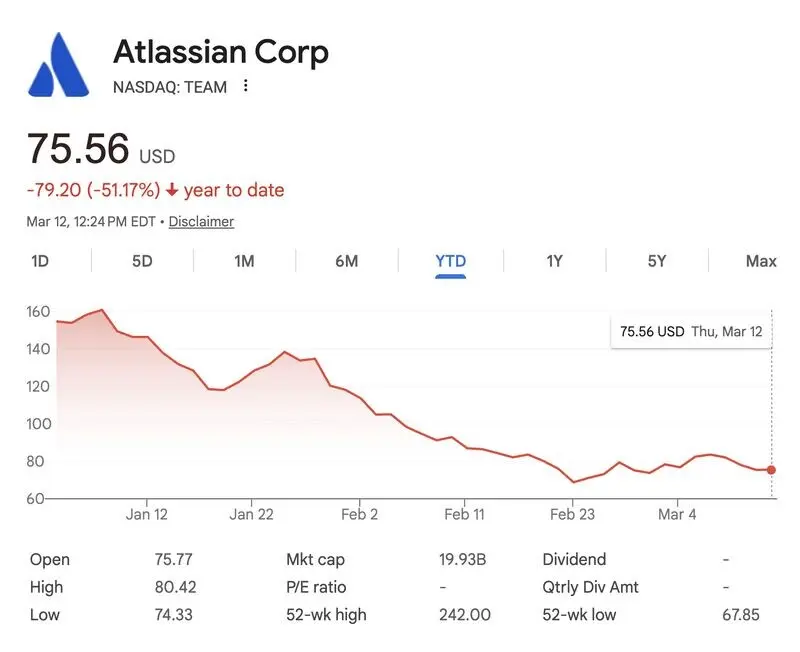
Atlassian cut roughly 1,600 people and said the money would be redirected into AI and enterprise sales. The market rewarded the move. CEO Mike Cannon-Brookes didn’t pretend that nothing was changing. He said “We are doing this to self-fund further investment in AI and enterprise sales, while strengthening our financial profile.”
That is a very different narrative than the usual corporate script (think Block's 4000 people cut or Amazons 14,000-person reduction on Oct) saying AI is replacing people.
Not:
- “AI is just here to assist”
- “Nothing fundamental changes”
- “This is only macro”
Instead, the real message is: The old SaaS corporate makeup and structure no longer makes sense. This is why this announcement is so meaningful. Atlassian was one of the icons of the last software era. Jira wasn’t just a product. It was part of the infrastructure of nearly every modern tech company.
And now even they are telling you the model is changing. For 20 years, SaaS growth meant:
- more seats
- more features
- more employees
- more managers
It is NOT AI just replacing people. It IS AI forcing companies to rethink how many people, which people, and what structure they actually need. The winners won’t be the SaaS companies that bolt AI onto the old model. They’ll be the ones willing to rebuild the model itself.
Adobe Just Lost $80B
Adobe’s CEO is stepping down after 18 years despite beating earnings. The market wiped $80B off Adobe, the once darling of SaaS, beat earnings. The CEO is stepping down anyway.
That is how brutal the AI reset has become.
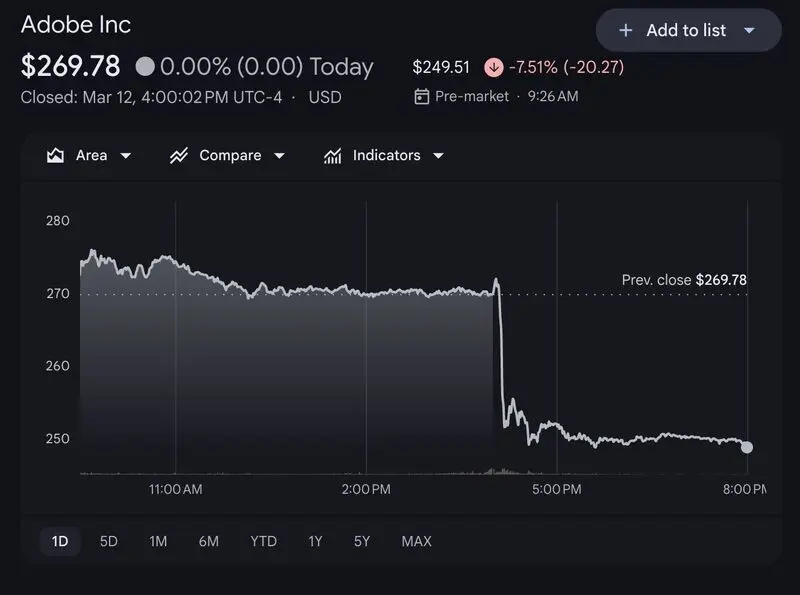
Shantanu Narayen is leaving the CEO role after 18 years. Adobe’s stock is down nearly 30% so far this year, and it still fell almost 10% after the announcement and forecast. We are talking of having lost around $80B in market value in the last 12 months (pretty hard to overlook).
That matters because Narayen was not a weak operator. He is easily one of the best CEOs of the SaaS era. He took Adobe from boxed software to Creative Cloud and turned Photoshop, Illustrator, Premiere, After Effects and Acrobat into one of the greatest subscription machines in software.
So this is not a story about bad management. It is a story about a broken category narrative. For 20 years, creative software won by putting powerful tools in the hands of talented humans. The better the tool, the stronger the moat.
But AI is changing the equation. Customers do not just want better tools now. We want the work done autonomously on our behalf (we see this in the unbelievable momentum of Open Claw, Perplexity Computer and Claud Co-work just to name a few).
Instead, creative teams want AI to:
- generate the asset
- edit the image
- cut the video
- produce 20 variations in seconds
The old moat was the interface. The new moat is owning the workflow, the context, and most importantly, the outcome.
That is a much harder transition. This is why the Adobe moment matters so much. It's a bellwether or a canary. AI add-ons or bolt-ons clearly are not enough.
There is a new economic logic. The first era of SaaS rewarded the company that owned the app. The AI era will reward the company that owns the work and provides digital labor.
We are trying to build autonomously working digital employees at Atonom, we call them Cloud Employees, this may not be the exact answer, but the market is definitely looking for autonomous agents to provide outcomes for us.
Zoom Out
So, is this a productivity boom or a narrative war grasping for marketing attention from the major AI Labs, or just public markets punishing SaaS companies for not pivoting fast enough after the Covid growth boom? The answer is all of the above.
The attention focused narrative war keeps us distracted by "anxious" AI while the reality of the AI product maturity shows we are still in the early stages of real change. Meanwhile, major SaaS companies are restructuring from the bottom up (to the CEOs), while the individual worker pays the price with "Brain Fry" as the easy parts of our job get handed to AI agents.
These contradiction are why iconic companies like Atlassian and Adobe changing from the legacy SaaS model (having lost 10s of billions in market value) and rebuilding into the new AI organizational structure. AI is not a bolt-on feature to make humans faster; it is a fundamental shift in the way companies are built and organized.
We really are moving away from buying software to buying AI technologies that deliver real ROI centric outcomes (OaaS, outcomes as a service). The tools are becoming the employees. If you aren’t redesigning your work, team structures and companies around that fact, you are living in a world that really no longer exists and you are at risk of the kind of disruption we saw this week.
