
This week governments, incumbents, and talent all made the same move. They grabbed for control before the window closed.
The talent wars, the acquisition wars, and the sovereignty wars all landed at the same time. Here is what happened:
- Noam Shazeer co-wrote the paper that built modern AI. Google paid $2.7B to get him back. He left anyway and joined OpenAI. Belief beat the biggest retention check in tech history.
- Salesforce spent $3.6B on Intercom. Two years after launching AgentForce and telling the market they had enterprise AI support solved, they bought the company that actually built it.
- The US government shut off Anthropic's two frontier models for every foreign user on earth, including Anthropic's own engineers on visas. No hearing. No process. No timeline to reverse it.
- SpaceX used its first week as a public company to buy Cursor for $60B in stock. The rocket company now owns the tool millions of engineers open every morning.
The companies that understood what phase the market was entering are moving. The ones still defending what they built in the last cycle are spending billions to patch the gap.
The strategic question for business leaders right now is not whether to invest in AI. It is whether the platforms you are betting on will still be accessible, independent, and competitive in 18 months.
Google paid $2.7 billion to get one man back
Less than two years later, he walked to OpenAI for free. Noam Shazeer. He co-wrote "Attention Is All You Need", the 2017 paper the entire modern AI industry is built on.
He left Google, co-founded Character.AI, and in 2024 Google paid $2.7B to bring him and his team home. They made him VP of Engineering and co-lead of Gemini. This week, he joined the IPO ready OpenAI as Lead for AI Architecture Research.
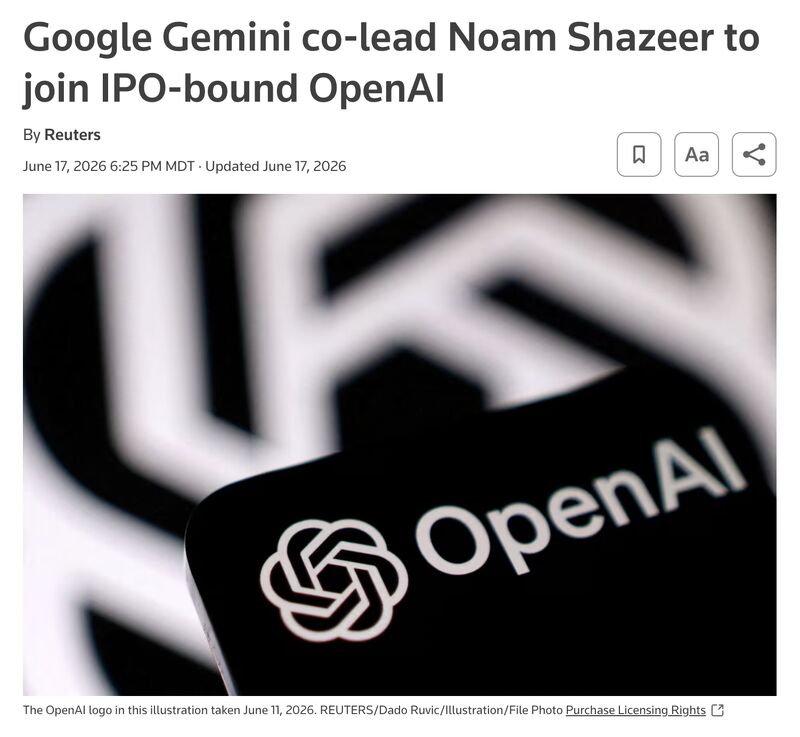
Now he's going to help them best the very thing he just built. This was never about pay. Google already showed it will pay anything to keep him. He left anyway.
And he isn't the only one.
- OpenAI hired the marketing and sales leaders out of Salesforce and ServiceNow.
- They hired the deployment teams out of Palantir Technologies.
- Now they're hiring the researchers who built what everyone else is chasing.
OpenAI isn't just hiring talent. They're hiring the specific people who already built the thing their rivals are still trying to finish. When your best people finally take the call, they don't always leave for a bigger paycheck. They leave because they believe in where they're going.
Google had the money. It didn't have the belief. And belief is the one thing you can't counteroffer.
Builders stay for belief, not cash. When an incumbent loses that, execution dies. The only move left is spending billions to buy the exact tech they just told the market they already built.
Salesforce just dropped $3.6B on Intercom
They bought the capability they claimed they already had and have been selling. For 2 years Salesforce has been pitching AgentForce arguing the markets are wrong to have price their stock down nearly 38% this year.
And now is seems they conceded and have supplemented AgentForce with Intercom (Support) and Qualified (Sales). The challenge is that these were not native-AI startups, but legacy SaaS companies "mid-pivot" into AI with customers on their "old school" SaaS platforms.
In the case of Intercom, the markets lost interest in them in 2023. They had raised $240.8M, growth had dropped to 10%, and the IPO never came.
So the company did the only thing left. They bet everything on a pivot, rebuilt the product around support that runs itself, renamed it Fin, and shifted from selling seats toward selling outcomes.
The numbers started to recover:
- Growth from 10% to 25%
- Revenue moved toward $400M a year
- Fin past $100M, growing about 350% a year
- Net retention from 112% to 146%
Respectable. But notice how it ends. Not with an IPO. Not as an independent winner, but with a sale to the incumbent it was supposed to be disrupting.
Conversely, Salesforce had 2 years and every advantage to build this in-house. They ultimately indicated the success of this effort by buying another struggling SaaS player to supliment AgentForce support chat.
The public markets were not pleased with this news. On a day the S&P was up +1.65%, Salesforce was down -0.81%, thats a 2.46% swing on an announcement that usually would have markets excited.
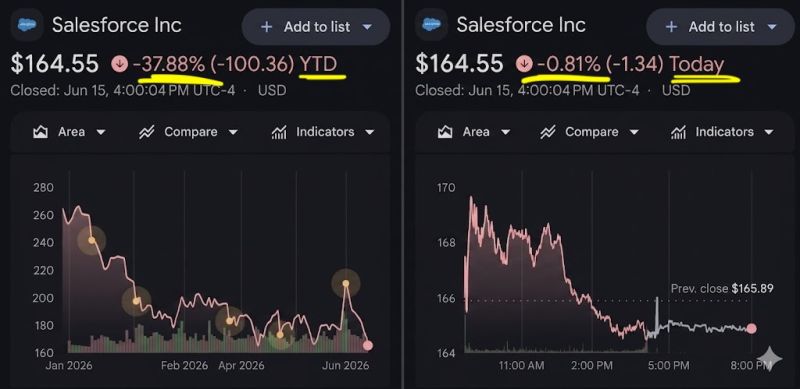
Despite spending $3.6B, gaining 30k customers and nearly $400M in revenue, this does not feel like a power move into the next generation of AI CRM engagement. Instead, this appears to be a consolidation of older technologies trying to survive the AI disruption dilemma.
You can buy a startup to patch a hole in your product roadmap. You can't buy your way out of federal export controls. This week Washington unplugged Anthropic’s models, and that should scare everyone.
Anthropic just had the US government tell them who can use their models
Making them illegal for most of the planet. That clearly should terrify every board, founder, exec, leader and foreign government.
The US government just shut down Anthropic's Fable 5 and Mythos 5 for foreign nationals and governments. That can mean customers, developers, researchers, API users and even people working inside Anthropic.
Something like this has never done this to an American company before. Emerson Brooking at the Atlantic Council said this "changed everything." Every ally assumed they would build their own models AND keep buying from the US.
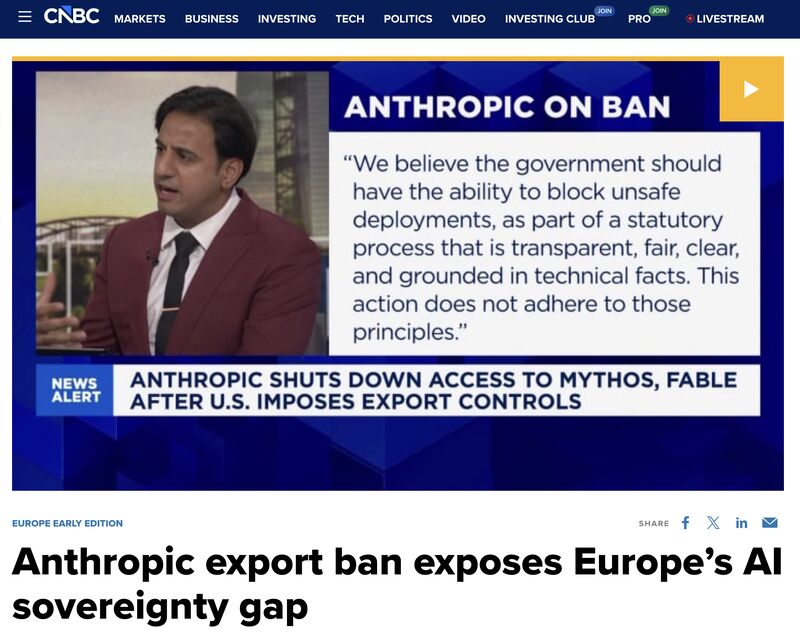
Now they know America will cut off friends, not just rivals.
Here is the timeline:
- Thursday: a 'partner' flags a way to jailbreak the model
- Friday, 5pm: Commerce orders Fable 5 and Mythos 5 pulled
- That weekend: both go dark for every foreign user on earth, including Anthropic's own engineers on visas
- This week: Dario Amodei is at a G7 lunch in France, sitting next to Sam Altman, trying to get his product back
The official reason? The jailbreak surfaced a few security flaws already sitting on the public internet. The kind of thing a dozen other tools hand you every day. So this was never really about the jailbreak. This was a control game.
For the first time, Washington reached into a private company and flipped the kill switch on its best product. No hearing. No process. No clear way to earn it back.
So then who benefits:
- Open models that run locally
- Sovereign clouds
- Non-US model companies
- Private labs
- Founders building outside the blast radius
The US may be trying to keep the strongest models out of the wrong hands. But, demand like this does not die when you ban it. Instead, it goes underground and everywhere else. You cannot 'export-control' your way out of something the whole world wants.
Governments are trying to build fences around AI models. But the ultimate operators are bypassing the middleman entirely. They are building stacks so deep, and so highly capitalized, that they are completely immune to traditional market limitations.
SpaceX just spent $60B to buy Cursor using their stock
And saw $269B of market cap growth. So the acquisition was basically free, well I guess they netted $209B??
This is the context:
Just a few days after going public, SpaceX is using its freshly-minted stock to buy the fastest-growing software company in the world. All stock. No cash. The market is loving it. They are up about 10.63% and $269B in market cap (at the time I wrote this) on the news.
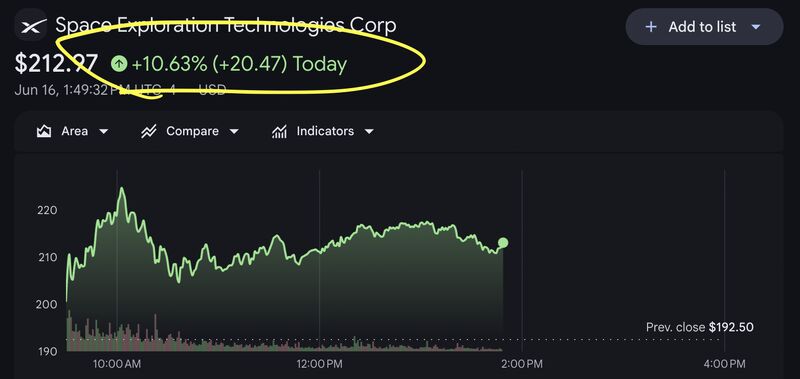
Now the rocket company owns the AI coding layer.
This is the deal detail:
- $60B all-stock for Anysphere, the maker of Cursor
- Shares convert at SpaceX's 7-day average price, closing Q3
- It replaces the $2B round Cursor was about to raise at a $50B valuation
- Cursor is doing $4B in annualized revenue, so this is about 15x revenue
The underlining message here is that the IPO was never the finish line. It was the war chest. The moment SpaceX's stock became public currency, it became the most powerful acquisition tool in tech. You don't burn cash when your equity is the most coveted paper on the market. You print it and go shopping.
And look at what they bought. Not a satellite company. Not a launch competitor. The application layer for AI. Musk now controls the full stack: the compute (xAI), the data centers, the models, and now the tool millions of engineers actually open every morning. Vertical integration from the rocket to the cursor blinking on your screen.
Anthropic has Claude Code. OpenAI has Codex. Google and Microsoft are bundling. The "we'll stay neutral and ride on top of everyone's models" strategy just got a lot harder, because the model owners are buying the apps.
Cursor had a choice: raise $2B and stay independent, or take $60B in stock and plug into infinite compute, distribution, resources and the Elon Musk factor. They chose the giant and will likely crush the AI dev market with those backwinds.
This is the beginning of AI the consolidation phase of this market. Anthropic and OpenAI are about to go public. Expect a LOT more founders to make the same call this year.
The Marco View: Noam Shazeer knew where the puck was going. So did the US government. So did SpaceX.
The people with the most information made their moves this week. The researcher who built the foundation picked his next bet. The government showed it will pull a kill switch without warning. The rocket company skipped the neutrality of renting the app layer and just bought it.
Salesforce is the cautionary tale. Two years of selling a vision they had not finished building. The market noticed before they did.
Business leaders do not need to move at the speed of a venture fund. But they do need to ask harder questions about what their AI vendors actually have versus what they are selling. And they need to ask them now, before the next kill switch drops on something they built their roadmap around.
