

Most leaders are still clinging to the biggest lie in business: that headcount equals growth. For years, the linear relationship between human labor and revenue was the only math that mattered. That math is officially changed. Humans are no longer the primary unit of value. In the Autonomous Enterprise, humans don't do the manual work. They direct the agents that do. This isn't a "future" trend anymore, it's happening every earnings release where CEO talk about AI restructure and "native AI pods" as their new team structure.
This week, we look at the four specific shifts signaling the end of the old SaaS model:
- The Move to Physical AI: Why "Lifecording" and wearable hardware are the new eyes and ears of the enterprise.
- Agent Pricing Model: Microsoft’s pivot to a pricing model where agents are the new revenue drivers and humans are just the floor.
- A New Operating Model: Why GitLab is cutting management layers and replacing them with pods of builders and agents.
- Decoupling the P&L: Cisco just proved that record revenue and headcount reduction are no longer mutually exclusive.
The shift begins at the hardware layer with the way we capture the data that fuels these systems.
Investor Who Called Nvidia Before AI Boom’s Third Call
The investor who called Nvidia before the AI boom just made a third call, and Wall Street doesn't have a name for it yet. In 2016, Lux Capital co-founder Josh Wolfe publicly pitched NVIDIA, arguing the GPU value would shift from gaming to simulation and AI. It returned 80x.
Earlier this year, he made another call on memory chips (I should have listened!!). Now, he is betting on a paradigm shift he is calling: "LIFECORDING".
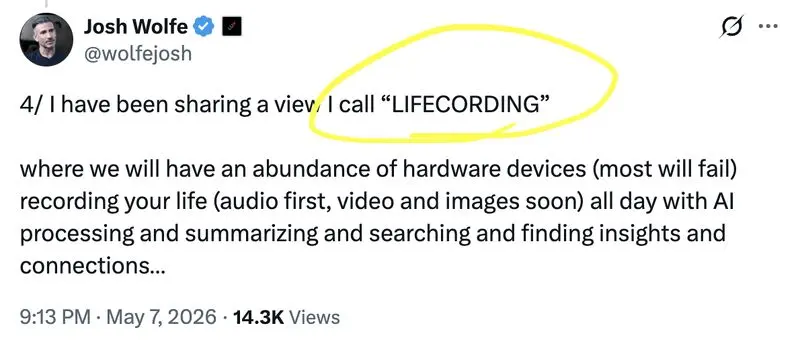
AI is moving off our screens into Physical AI on our bodies. This is the theory: wearable hardware will record our lives: audio first, then video and images.
AI will stop being a chatbot we have to open. It will be a continuous background process: processing, summarizing, and finding connections from our lives.
We are already seeing the giants scramble for position:
- Meta has their Ray-Bans and acquired Limitless.
- Amazon bought wearable startup Bee.
- OpenAI and Jony Ive are building a secretive physical device.
- Apple announced AI glasses and is in testing AirPods with cameras.
Wolfe isn't betting on the application layer yet. He is betting on the infrastructure. Before we all wear AI, there is going to be a massive "demand shock." The biggest tech companies in the world are about to place unusually large orders for physical components to make these devices.
The real winners right now will be the "arms dealers". The companies building Bluetooth Low Energy, ultra-low-power Edge AI chips, and the micro-cameras acting as the new "eyes and ears" of AI.
Wolfe identified these companies as the likely winners:
- Nordic Semiconductor
- TDK
- Himax Technologies, Inc.
- Ambiq
- Infineon Technologies
- Ceva, Inc.
- Synaptics Incorporated
- Evonix
- Cirrus Logic.
He believes that the era of staring at a screen and typing is over ... I think I agree. The next tech giants won't just be measured by the software they code. They will be measured by the "life data" they capture.
Once we have the hardware to capture the data, the next logical step is changing how we monetize the intelligence it produces.
Microsoft Sells Software to Robots
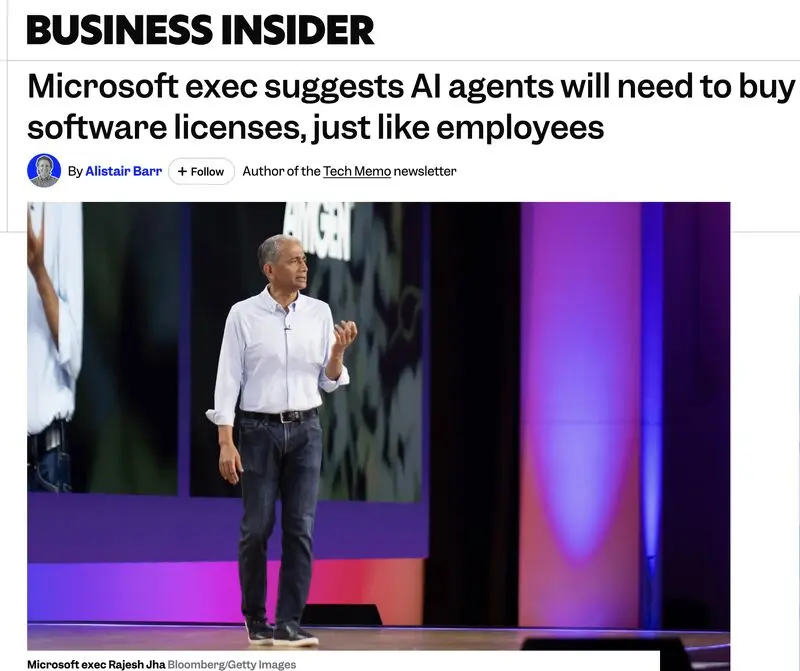
Microsoft just figured out how to sell software to robots. Microsoft's EVP Rajesh Jha just gave SaaS a new pricing model:
"All of those embodied agents are seat opportunities.”
For 30 years, enterprise software was priced one way: per human.
- more employees
- more seats
- more revenue
Headcount was the meter.
That model just got a second customer: The agent.
Look at what Microsoft reported:
- 20M paid Copilot seats.
- Agents priced on top through metered usage.
- $627B in commercial remaining performance obligations, up 99% year over year.
(That's 2.5 years of contracted revenue locked in before the new data centers even come online.)
Wall Street spent the week arguing about Microsoft's capex. I feel like they're looking at the wrong metric. The pricing model is the real story.
When your customers are humans, TAM is global headcount. When your customers are agents, every workflow is a potential revenue.
A 5,000 employee company doesn't just buy 5,000 seats. It buys 5,000 seats + the agents running sales, support, finance, security, engineering, and operations.
Microsoft is not abandoning the seat model. It is turning the seat into the floor. Then charging for the digital employee that runs on top. IDC now says pure seat-based pricing will be obsolete by 2028,... Microsoft is not waiting.
The last software supercycle was sold to people. The next one will be sold to the agents working beside them.
This change in revenue models forces a complete redesign of how internal teams are structured and managed.
GitLab’s Second Act and Layoffs
GitLab just announced layoffs, reaffirmed full-year guidance, and watched its stock drop 8% in after-hours trading. Yesterday, CEO Bill Staples published a memo titled “GitLab Act 2.”
These are the numbers he shared:
- Workforce reduction, with final scope coming June 2.
- Up to 30% cut to their country footprint.
- Up to 3 management layers removed.
- 60 new R&D pods with end-to-end ownership.
In a normal market, reaffirming guidance and trimming complexity sends a stock up. Instead, GitLab extended a 12-month decline from $52 to $26.
The market treated it like AI cover for layoffs. Staples called it something else:
“This is not an AI optimization or cost cutting exercise.”
I think he’s right and the market is missing it. GitLab isn’t cutting people to protect margins. They are rebuilding the company around AI agents that review code, automate approvals, and handle operational handoffs that used to need a human in the loop.
The 60 pods aren't org chart cosmetics. They are containers for a new company operating model: Small teams of people directing large teams of agents.
This is the same playbook we are starting to see everywhere:
- Cloudflare: cutting 1,100 jobs after internal AI usage spiked 600%.
- Coinbase: killing pure managers and testing one-person teams.
- Meta: reorganizing teams around AI builders and AI infrastructure.
- Atlassian: reducing headcount to fund AI and enterprise sales.
Every company is basically facing two paths:
- Path one: Use AI to make existing teams 20% more productive.
- Path two: Rebuild the company so a smaller team can do 10x more.
Path one keeps investors and Wall Street happy for two quarters. Path two breaks traditional valuation models but potentially wins the long game. When these internal efficiencies are applied at scale, they finally catch the attention of the public markets.
Cisco killed 20 Year Myth
Cisco just killed a 20-year tech industry myth in a single day.
Here is the breakdown of their recent quarter:
- $15.8B in revenue (highest ever).
- Up 12%.
- 4,000 jobs cut (5% of their workforce).
The stock jumped 15%. A lot of people are saying the market "just changed its mind" about layoffs: that cuts used to signal weakness, but now they signal discipline.
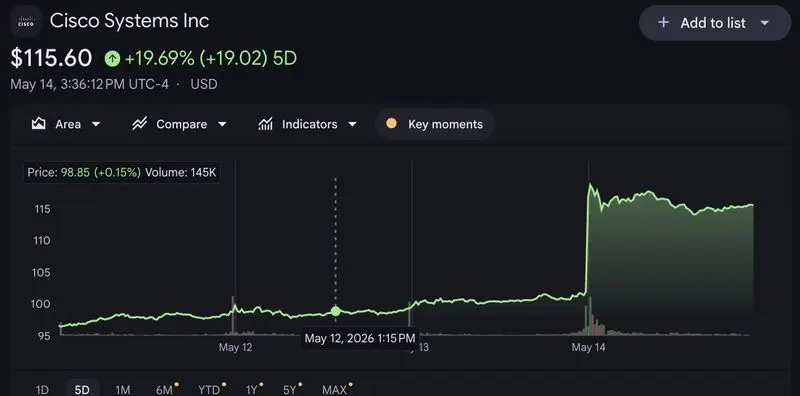
That is historically inaccurate. Wall Street has always loved cost-cutting. What actually changed is that tech is finally playing by traditional Wall Street rules, and using AI as the ultimate catalyst.
During the zero-interest-rate (ZIRP) era, tech valuations were tied purely to hyper-growth. If a SaaS darling cut staff, the market panicked because it meant the growth engine was stalling. But Cisco isn't a venture-backed startup, it's a mature, dividend-paying giant. By cutting headcount to free up $1B to restructure around silicon, security, and Enterprise AI, they aren't signaling weakness. They are signaling capital discipline.
Historically, the B2B tech playbook was linear: More revenue = More headcount. Cisco just declared that those two metrics are officially decoupled. And investors rewarded them handsomely for it.
The era of "growth at all costs" is dead. The "Year of Efficiency" is now a permanent operating model.
The Macro View: Most leaders are still managing as if headcount is an asset. In an AI-native market, large teams are often a liability. If you want to survive this transition, you have to change how you measure the value of your organization.
These are the key takeaways:
-
Evaluate your organization:
not by the number of people on the org chart, but by the
ECE Ratio
(employee to cloud employee) and the number of builders to managers. Layers of middle management that exist only to move information are overhead.
-
Stop viewing AI as a productivity tool.
Start viewing it as a
new type of employee
. AI will work in the org chart with your other team members. They require their own seat and budget. If you aren’t budgeting for digital labor, you’re missing the biggest margin opportunity since the internet boom.
-
Recognize that investors have changed
. They are no longer rewarding growth at all costs. They are rewarding the structural discipline that AI makes possible.
Leaders who fail to decouple revenue from headcount will be left behind in the AI era. Efficiency is no longer a “nice to have.” It is becoming the core operating system of modern companies.
