

This week, four separate stories said the same thing.
A hardware company added $55 billion in a single day. A cloud software sector bounced back $281 billion in a week. The world's largest social network admitted it can't win on product. And for the first time in history, bots outpaced humans on the open internet.
Most people read these as separate headlines. They aren't. What you're watching is a complete restructuring of the technology stack. From physical infrastructure at the bottom, through the software layer in the middle, all the way up to how buyers are found and revenue is generated. Every layer is being repriced, reordered, and in some cases, broken entirely.
The assumptions that ran B2B technology for the last decade are failing all at once. Dell's $51 billion backlog just killed the hardware is dead narrative. While Meta bet $145 billion on distribution over product.
We are entering an era where hardware is private, software charges by output, distribution wins, and your GTM playbook just changed.
Dell's best stock day ever added $55B to its value
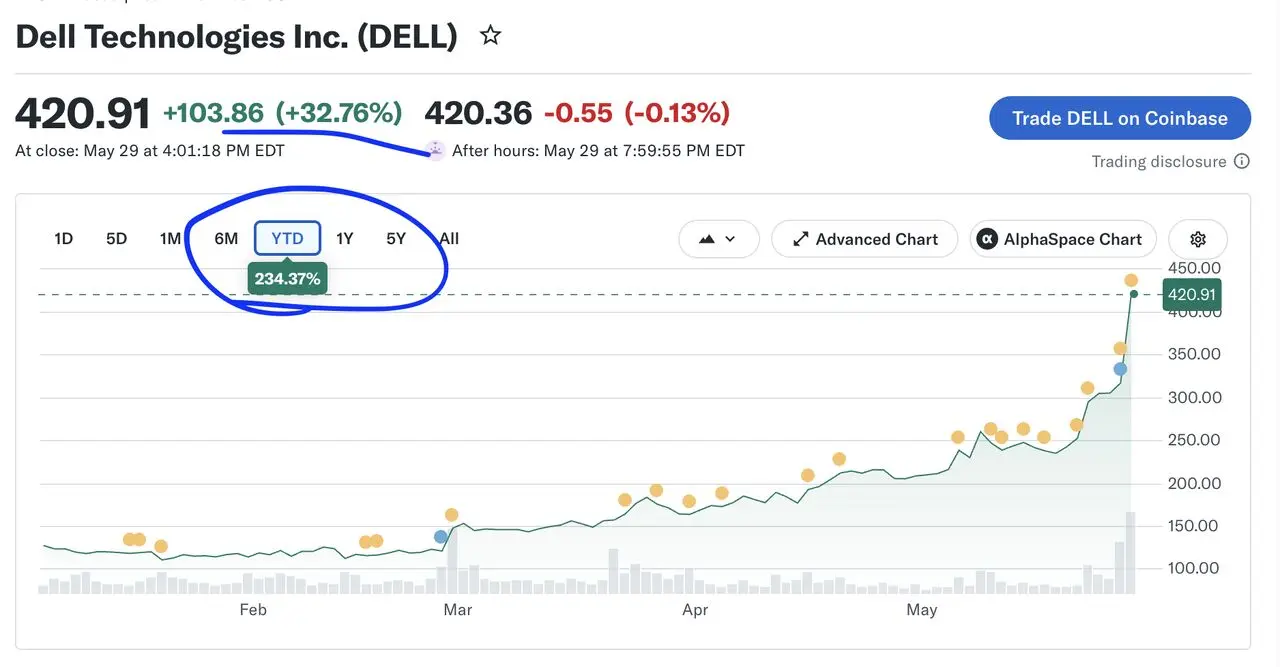
Dell Technologies just had the best stock day in its history adding $55B in value. Not because of PCs, but because of GPU servers.
The quarter:
- $43.8B in revenue, up 88%.
- $16.1B in GPU server revenue, up 757%.
- $24.4B in new orders in 90 days.
- $51.3 billion backlog still needed to fill.
- Earnings: $4.86 vs $2.94 expected.
The stock jumped 32%. Dell added $55 billion in market cap in a single session. They raised their full-year server forecast to $60 billion. That's bigger than Salesforce's total annual revenue. But this isn't just a hardware story.
Dell is partnering with NVIDIA and OpenAI to build the private AI datacenter layer. Enterprise-hosted GPU servers. On-prem inference. Companies owning their compute instead of renting from hyperscalers.
The economics are flipping. Private infrastructure cuts cloud costs by up to 87%. Data never leaves the building. Now look at the other side.
ServiceNow is down 38% in the last 12 months. Salesforce is down 28% this year (despite SaaS a killer day Friday with 10%+ improvements). SaaS companies are fighting for $50/seat renewals.
Dell is selling $3 million racks with a $51 billion waitlist. Michael Dell took this company private in 2013 when the world said hardware was dead. Brought it back public in 2018. The stock is up 229% this year.
He bet the company on one thing: someone has to build the machines.
The biggest winners in this cycle aren't selling software. They're selling what the software runs on. Software gets disrupted every cycle. The infrastructure underneath it never does.
The hardware layer is printing cash. But what exactly are those servers doing? They are training models that are now doing the building for us. And the companies leading the charge are proving that traditional engineering headcount math is dead.
Anthropic just told the world to stop building AI.
Anthropic just told the world to stop building AI. Same company. Same week. Filed for a $1 trillion IPO.
The numbers:
- $47B in annualized revenue. Up 5x from last year.
- $65B round. Most valuable AI startup on Earth.
- S-1 filed before OpenAI could file theirs.
Then they published a paper titled "When AI Builds Itself." Every SaaS board should read it twice.
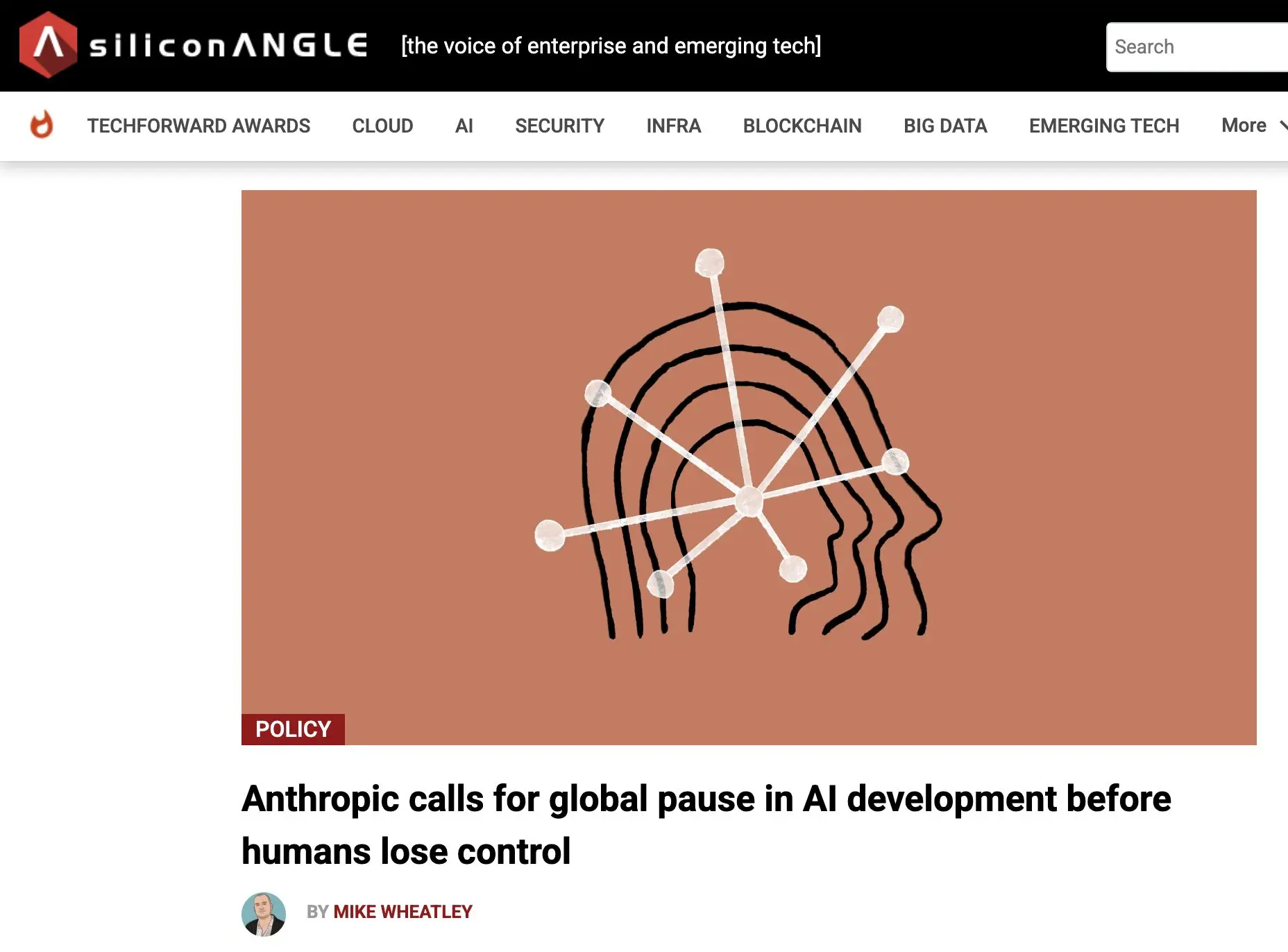
Claude now writes over 80% of the code merged into Anthropic's own systems. Their engineers went from writing code to reviewing it. Output per engineer is up 8x in 18 months. Success rate on hard engineering problems? From 15% to over 70% in six months.
Forget the models for a second. This is a headcount story. Anthropic's own engineers are already code reviewers. If that's true at the company building the models, every software company's hiring plan is running on dead math.
And the company that just proved it wants everyone else to slow down. You don't call for a pause when you're behind. You call for one when you're ahead.
Anthropic is ahead. Filed first. Hit $47B first. Crossed $965B first. Calling for a timeout doesn't hurt the team with the lead. It freezes the scoreboard.
AI is doing the engineering. That changes how software is built. But it also completely changes how it is sold. If agents are doing the work, the old way of charging per human seat is broken. The market finally woke up to this reality.
Jensen Huang just killed the "SaaS is dead" story.
Jensen Huang just killed the "SaaS is dead" story in one sentence. For two years, every board I talk to has been bracing for the same thing, agents replace seats, seat pricing collapses, software is dead. The market believed it too, and wiped out $285B in value betting on it.
Then last week the story broke. Here is the breakdown: Snowflake reported. Revenue up 33%. A fresh $6B deal with Amazon. The stock ran 38% in a day, its best ever.
The whole sector followed. Software just had its best month since 2001.
This morning Huang stood on stage in Taiwan and said the exact opposite of what everyone feared: "There are going to be many agents doing work, and they're going to be using more tools than ever."
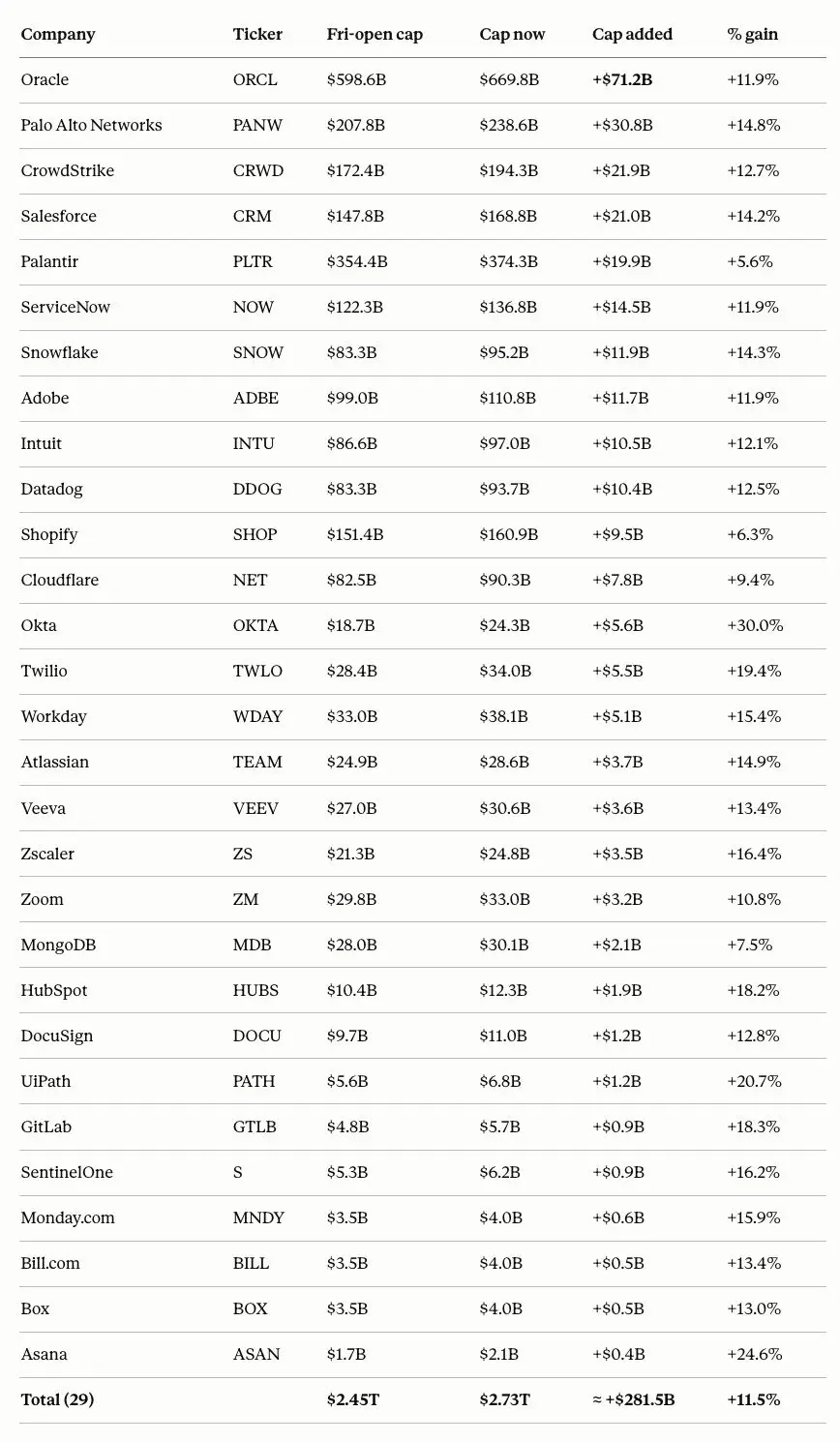
SaaS since Friday's opening (these numbers are crazy):
- Oracle: Increased market cap: $71.2B (+11.9%)
- Salesforce: Increased market cap: $21.0B (+14.2%)
- ServiceNow: Increased market cap: $14.5B (+11.9%)
- Snowflake: Increased market cap: $11.9B (+14.3%)
- Adobe: Increased market cap: $11.7B (+11.9%)
- Intuit: Increased market cap: $10.5B (+12.1%)
- Datadog: Increased market cap: $10.4B (+12.5%)
- Shopify: Increased market cap: $9.5B (+6.3%)
- Twilio: Increased market cap: $5.5B (+19.4%)
- Workday: Increased market cap: $5.1B (+15.4%)
- Atlassian: Increased market cap: $3.7B (+14.9%)
- HubSpot: Increased market cap: $1.9B (+18.2%)
- monday.com: Increased market cap: $0.6B (+15.9%)
- BILL: Increased market cap: $0.5B (+13.4%)
The list goes on and on, I track around 30 with a total market increase of $281.5B. But the market isn't saying "software is back."
Look at which companies are actually winning on results, not just bouncing. They all charge the same way: you pay for how much you use. The ones that charge a flat fee per employee? They only jumped because they had fallen so far. That's relief, not a comeback.
Software isn't dying. The old way of selling it is. The next generation of software won't charge you by how many people you have. It'll charge you by how much work actually gets done.
The software companies surviving this shift are moving to consumption models. They charge for the work done. But building the smartest AI tool does not guarantee victory. When the baseline of intelligence becomes commoditized, the battle moves from the product to the pipeline.
Meta admitted that they can't beat Google or Microsoft on AI.
Meta just owned that they can't beat Google or Microsoft on AI. So instead they are leveraging their proprietary reach. So instead they are leveraging their proprietary reach.
This week in London, Meta launched a business assistant that books appointments, answers customers, and closes sales. Its doing it inside WhatsApp, Messenger, and Instagram. Over 1 million businesses were already using an early version.
They also started charging for what it used to give away free.
Now look at their spend into AI this year.
- Google is investing $190B
- Microsoft is investing $190B.
- Meta is investing $125B to $145B.
98% of Meta's revenue still comes from ads. For two years, that spend made their ads smarter and earned nothing on its own.
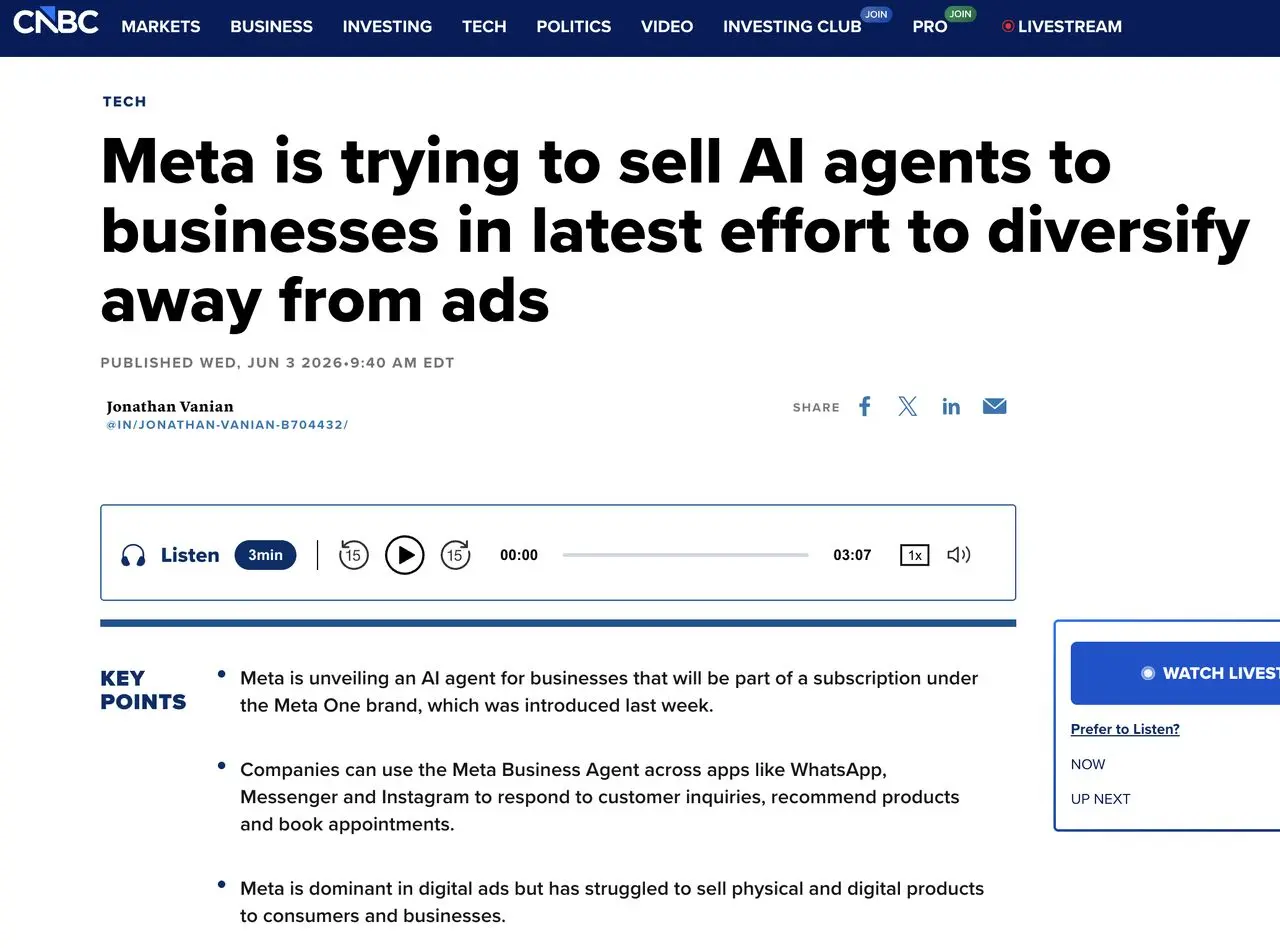
So Meta did the math. It can't outspend Google. It can't outbuild Microsoft. But it owns what they don't: 3.5 billion people and the inbox they live in. That is the whole play.
When you can't win on the product, you win on distribution. Meta just bet $145B that the place where the work happens still belongs to them.
Meta proved that owning the distribution channel is the ultimate moat. They put AI directly into the inbox. Now, multiply that behavior across the entire internet. Users are deploying AI to do their research, their shopping, and their buying. And that creates a massive problem for how every B2B company operates.
Cloudflare dropped a metric that surprised everyone
Cloudflare just dropped a metric that surprised even me. Bots have officially passed humans on the internet. First time in history.
Yesterday, CEO Matthew Prince posted the data from Cloudflare Radar:
- 57.5% of all web traffic is now bots.
- 42.5% is human.
- Before the GenAI wave, bots sat around 20%.
He predicted this wouldn't happen until 2027. It came a year early. Why? When we research a product, we visit maybe 5 websites. An AI agent like Claude or Codex doing the same thing may hid 1,000+.
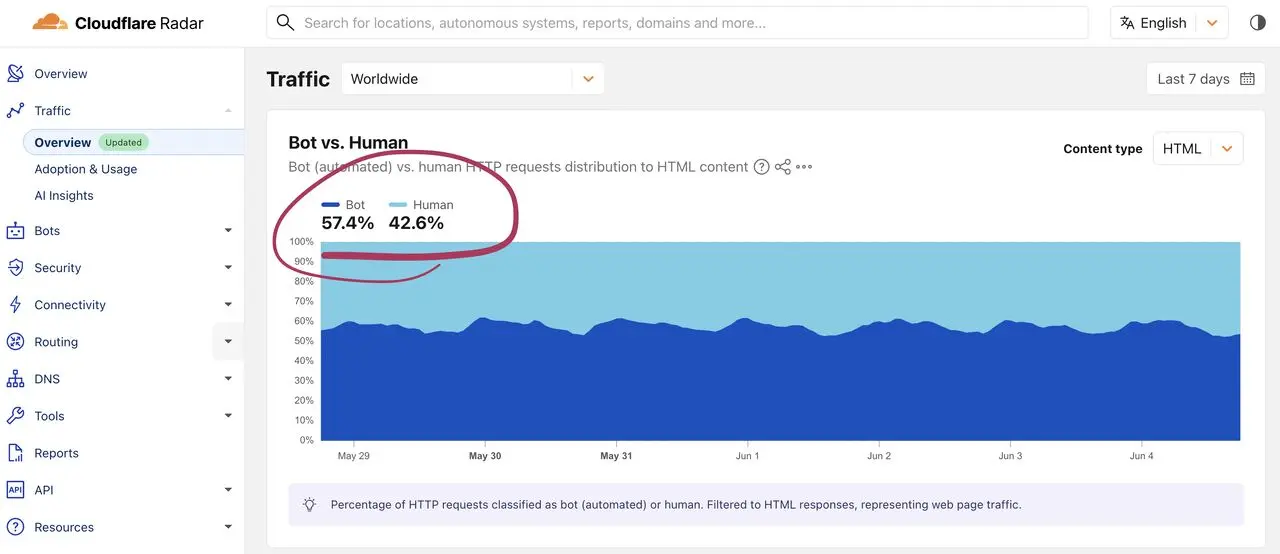
Multiply that across millions of users and humans become the minority overnight. Most people are reading this as a cybersecurity headline. It's not, it's a GTM issue.
Every major RevTech platform, 6sense, ZoomInfo, Demandbase, HubSpot, was built to track website visits, content downloads, and page views as signals of buying intent.
That entire model assumed the traffic was human. Now most of it isn't. Lead scoring is polluted, ... attribution is broken, ... "Intent data" is mostly just noise.
B2B go-to-market was built on reading digital body language like clicks, downloads, page views and time on site. Every signal assumed a person on the other end. That just stopped being true.
Three weeks ago I wrote that the next tech giants won't be measured by headcount, but by the intelligence of their agents. Turns out their customers are agents too.
The Macro View: Every layer of the stack shifted this week. At the same time.The machines got faster. The software got repriced. The distribution moat got deeper. The buyers became bots.
Business leaders who are waiting for this to settle before making decisions are already behind. This is not a technology story. It is a strategy story. The companies winning right now made their bets early and built around the new rules, not the old ones.
The question is not whether AI changes your business. It already has. The question is which layer you own when the dust clears.
Until next week….
