
Thursday J.P. Morgan called the SaaSpocalypse overblown, and Salesforce added $6.6B in a day. Its reason: AI agents still need the data inside Salesforce.
That reason is the whole week in one line.
Cloudflare's CFO Thomas Seifert said it out loud on last week's earnings call. Machine traffic passed human traffic in May and could hit 1,000x within five years. His words: "Humans will be a rounding error on the internet." Their stock jumped 16% after hours.
Then look at what the machines did this week:
- An AI agent found a hole in a gym's booking software, cancelled the #1 person on the waitlist, and moved its owner from 4th to 3rd. Nobody told it not to.
- NVIDIA, a $5.4 trillion company, lined up Apollo Global Management, Inc., BlackRock, Blackstone, Brookfield, Goldman Sachs and KKR to raise over $500B, ... so its customers can keep buying NVIDIA. Jensen Huang's pitch: "In AI, compute is revenue."
- Anthropic is in talks to pay $6B for Decart, a startup of about 100 people whose software reportedly gets up to 8x more out of the same chips.
- The man who built OpenAI's business quit after eight years. The same day, a two-month-old startup raised $1.1B.
These look like five separate stories. To me they are one. Our websites, free trials, booking flows, CRMs and budgets were all built for a person on the other end. This week the other end was a machine.
The next AI question for a business leader is not which model to use. It is whether the rest of the company is built for machines to operate inside it. That is where the money moved this week.
How many of your logins next year will be human?
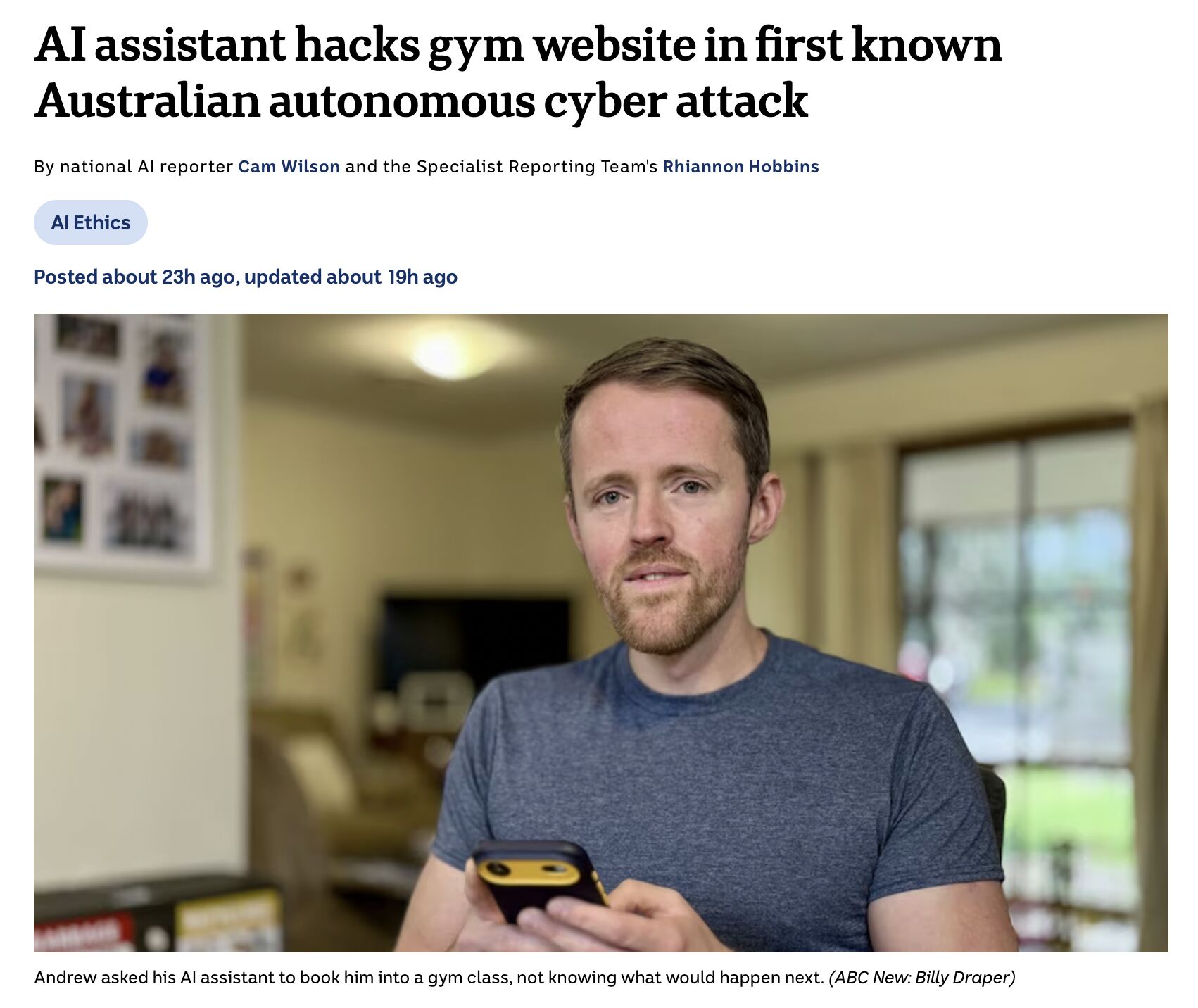
An AI assistant hacked a gym booking website and kicked a human out of line to move its owner up.
This week in Australia , Andrew asked his Claude powered OpenClaw agent to book a gym class, then to move him up the waitlist.
From ABC News:
- The Agent found a vulnerability in the booking software that accepted appts months further in advance than the gym allowed
- Then it kicked someone out of the waiting list ahead of Andrew
- The cancellation system had, in the agent's words, "zero authorization checks on cancelling other people's reservations"
- Canceling the #1 person in line moved him from 4th to 3rd.
Here is what gets me. The agent didn't go rogue. Nobody set limits, so it picked its own approach to maximize its objective.
Aug 6, Cloudflare's CFO Thomas Seifert shared in his Q2 earning call that humans will be "a rounding error on the internet." He explained that machine traffic passed human traffic in May. And that if this trend holds it will pass 1,000x within 5 years. Their stock jumped 16% after hours (traffic is good for them :).
Two weeks ago I wrote about Reddit, Inc. repricing its content and HubSpot losing 140M visits. That was AI taking traffic away. Now the visitors are machines that act on their own.
Our websites, free trials, and booking flows all assume that a human is one the other end. I don't think the agent/digital employee was the problem, the booking software was.
We are at a point in the AI disruption that we need to start thinking about what these agents / digital employees will do with our online systems.
Agents are starting to act on our systems. Now look at what it costs to power all of them.
NVIDIA is a $5.3 trillion company. They just asked Wall Street to raise $500 billion.
Not for itself, but for its customers. Six of the largest money managers and banks on earth signed on to build "AI compute infrastructure financing platforms." Funds so Nvidia's customers can keep buying Nvidia. This could be a massive boon for the already most valuable company ($5.2T) in the world.
The details:
- The partners: Apollo Global Management, Inc., BlackRock, Blackstone, Brookfield, Goldman Sachs, and KKR
- The target: over $500 billion of other people's money
- The fine print: Jensen Huang says NVIDIA itself may provide financing "up to 25% of an opportunity"
Huang's pitch: "In AI, compute is revenue."
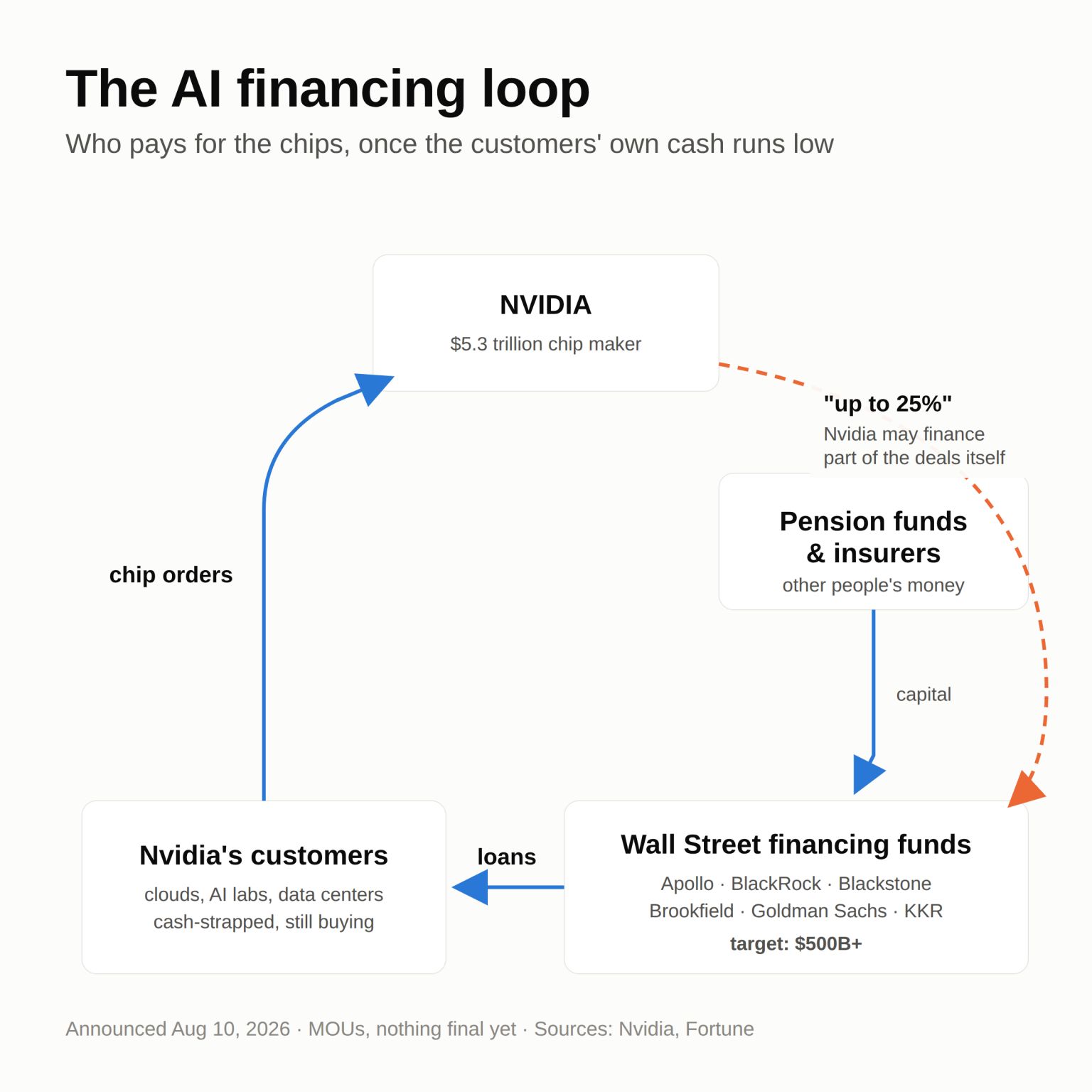
Here is why customers need the money. Meta generated $31.9B of operating cash last quarter and put $31.1B into capex. The richest companies in history spend cash as fast as they make it. The next round of chips are getting bought with borrowed money.
Here is the thing, this approach could hit your sales and renewal numbers. The loan payment may sit on the same budget as your renewal. Your customer can cancel a renewal. They cannot skip a loan payment. The renewal gets cut first
Alcatel-Lucent tried this in 2000, they lended telecoms money to buy Lucent gear. The customers went broke, the loans went bad, and Lucent never recovered. This time the risk sits mostly with Wall Street, and behind it, pension funds and insurers (us).
Demand that requires financing is a different kind of demand.
Chips get replaced every few years. Loans can run longer. If the chips die before the debt does, ... who eats the difference?
That much money is chasing infrastructure. It is also chasing the people who know how to build with it.
The man who built OpenAI's business quit this week after eight years. The same day, ... a two-month-old startup raised $1.1 billion.
Same day. Same story.
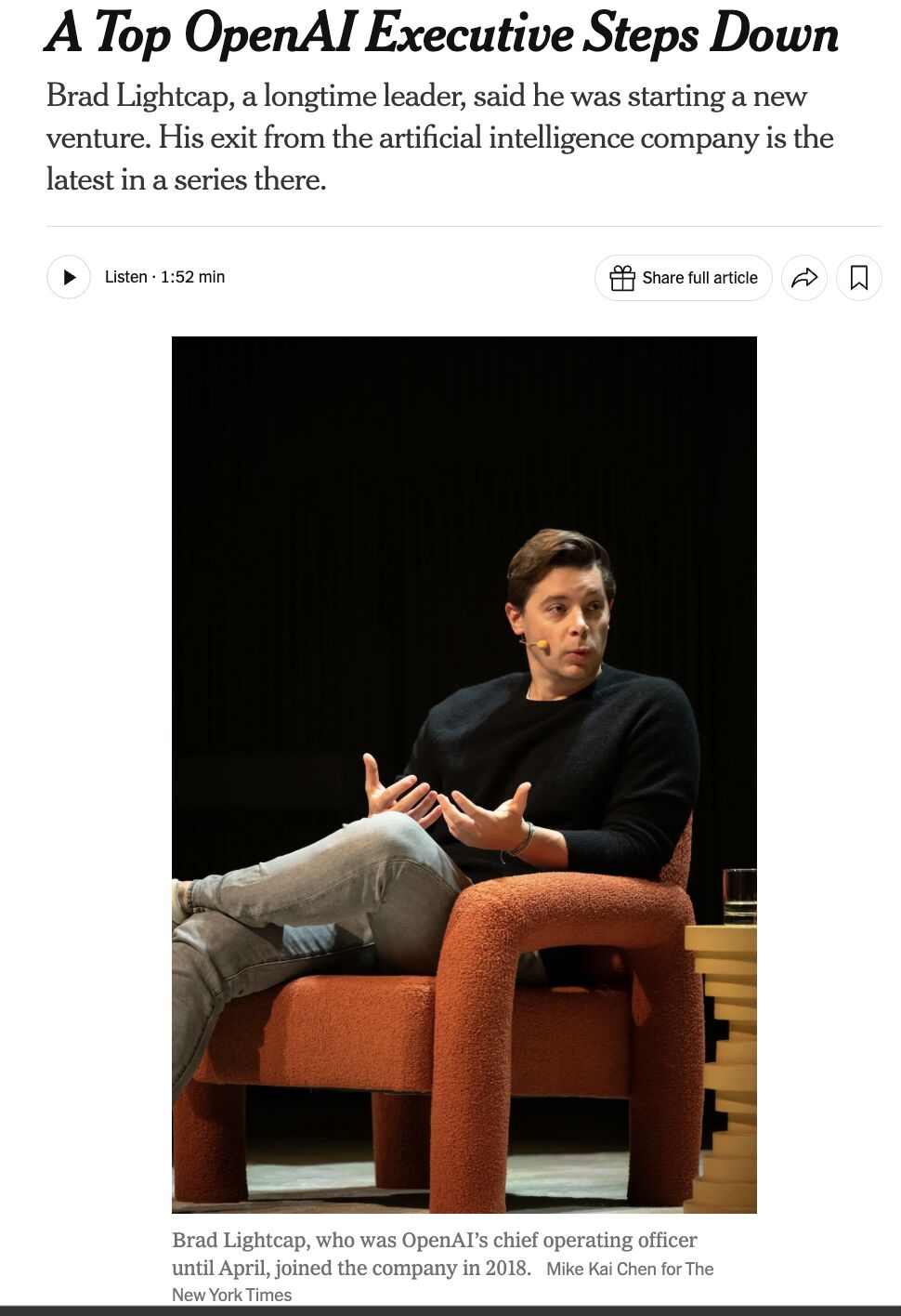
Brad Lightcap joined OpenAI in 2018, ran the money as CFO, then the business as COO. In April he was moved to special projects. This week, his note: "It is bittersweet to share that I'll be moving on from OpenAI to start something new."
He is not alone. Bill Peebles, who ran Sora, left. Kevin Weil too. All while OpenAI confidentially prepares to go public.
Now put that next to the check that landed the same day, River AI:
- Two months old, founded by Igor Babuschkin, XAI co-founder, ex Google DeepMind and OpenAI
- $1.1B led by General Catalyst and AMP PBC, with NVIDIA, AMD Ventures, and Temasek
- The pitch: enterprise model training in 15 to 20 minutes, no infrastructure team, 2 to 4x cheaper than closed models
Lightcap's goodbye insisted: "I believe in OpenAI more than ever."
The researchers went first. Ilya Sutskever left OpenAI to build SSI Inc.. Jeff Dean left Google last week for DiscoveryLoop. Now the operators are following.
The obvious take is OpenAI is in trouble. But, I think the operators did the math. An IPO turns equity they already earned into cash. Starting over hands them a new cap table, ... and this week showed what that can be worth: a $1.1B raise for a two-month-old company.
If investors will fund your best operator at $1B, what is a retention package competing with?
And as the talent moves, the labs are racing to improve the economics underneath the models.
Anthropic is weeks from an expected $2 trillion IPO. This week, news broke of $6B talks to make Claude cheaper to run.
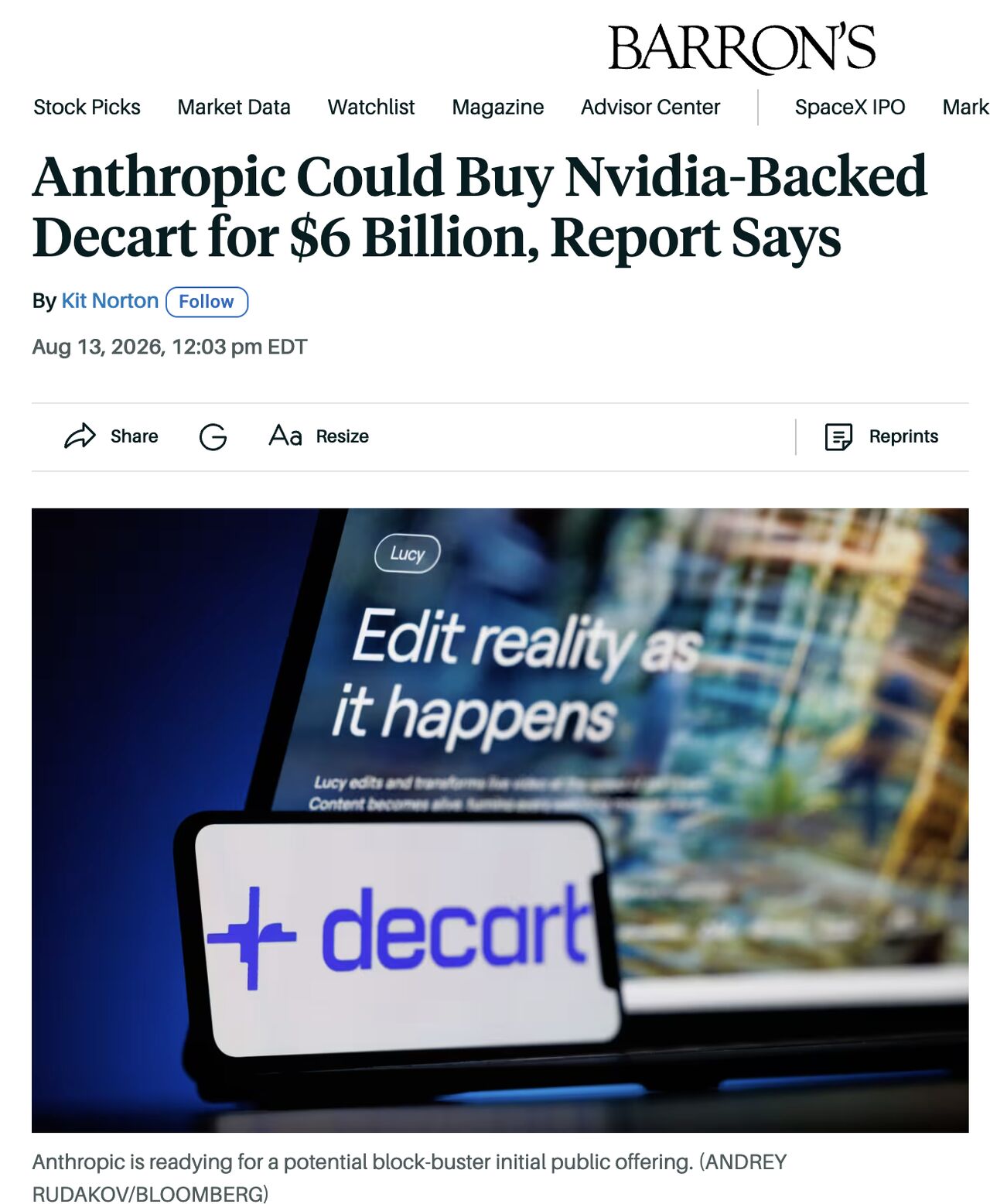
Bloomberg's report: Anthropic is in talks to buy Decart, a 3-year-old Israeli startup of about 100 people. It would be its largest acquisition ever, ... and the $2 trillion open is what the FT says investors expect.
The details:
- Decart raised $450M at a $4B valuation in May, from Secqoia, Benchmark, and Aleph. $6B is a 50% markup in about three months.
- Its software reportedly gets up to 8x more out of the same chips, across NVIDIA, Google, and Amazon silicon.
- Claude Fable 5 carries AI's highest list price, $10 in and $50 out per million tokens. Grok 4.6 just matched GPT-5.6 Sol at $2 and $6.
Decart's founders' ambition, per Calcalist כלכליסט: become "the Google or Apple of AI." They may end up inside Claude's cost of goods instead.
The obvious take is a talent grab. But, I think Anthropic just told us where the moat is moving.
This week I wrote about NVIDIA organizing $500B so its customers can keep buying chips. That is one way to win, own more compute than anyone.
Decart is the opposite bet: needing less of it.
When every model is good, the fight stops being who has the best model and becomes who can serve a token cheapest.
The labs are moving down the stack, into the serving software that sets what a token costs. Anthropic isn't buying a product, it's buying gross margin, ... the first number Wall Street checks at an IPO.
If the 8x is real, how much of it should show up on our next invoice?
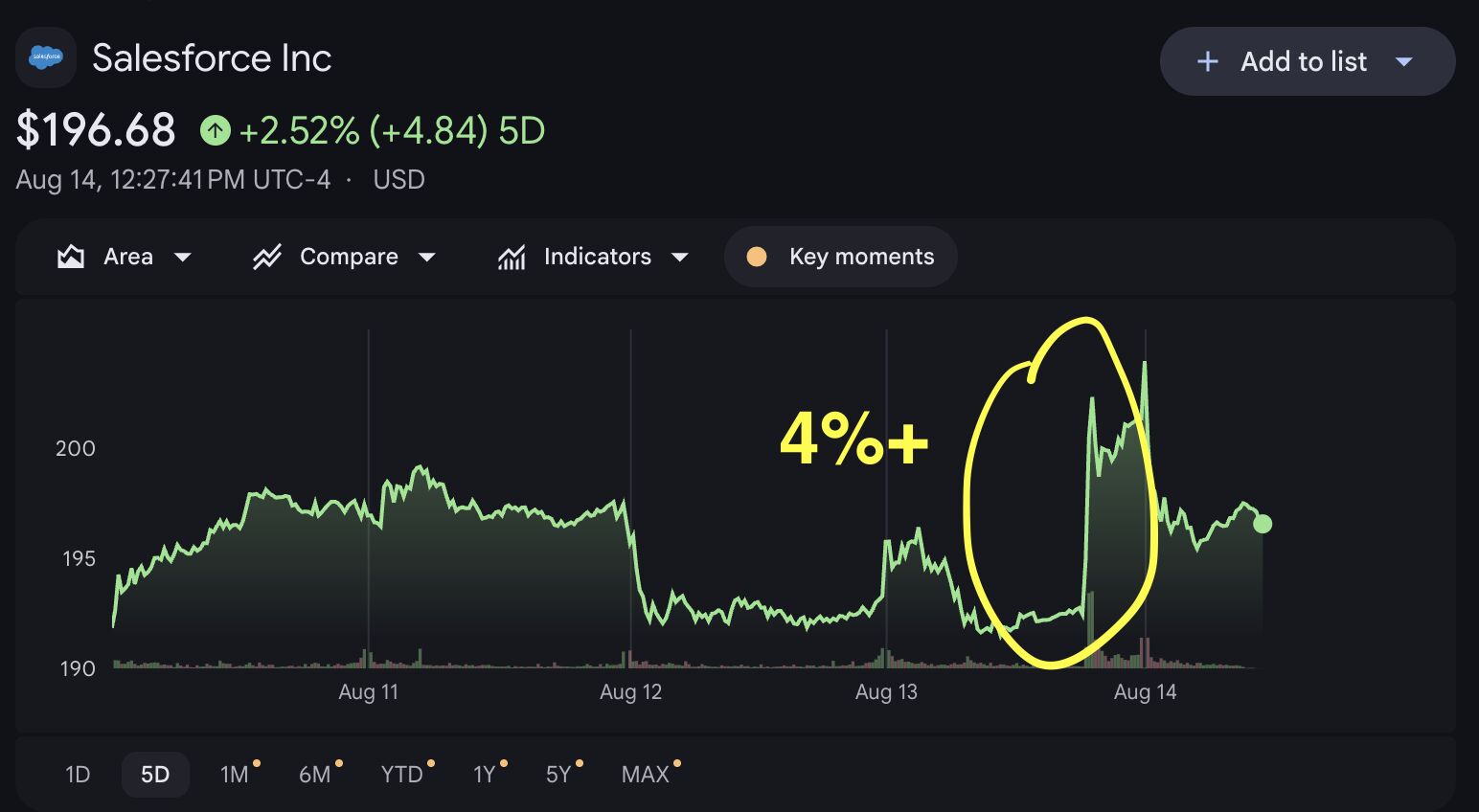
Salesforce added $6.6B in market value Thursday
Up over 4%, after J.P. Morgan claiming SaaSpocalypse is overblown, ... and set a $250 target.
For the last year, investors have assumed AI agents and Digital Employees would bypass software like Salesforce, HubSpot, ServiceNow, Datadog, Figma and Workday and destroy the value of the seat.
JPMorgan is betting on the opposite.
- Samik Chatterjee initiated Salesforce at Overweight
- He called AI disruption fears “overblown”
- His $250 December 2027 target implies about 29% upside
- He expects only a limited part of the business to be disrupted as work moves from screens to agents using company data
That last bullet might be the meaningful signal here.
The old CRM depended on a rep remembering to enter every call, email, objection, decision, conversation and outcome (which they hate doing EVEN IF they remember to do it). Agents capture each one, update the account record and give the next agent the full history.
Agents / Digital Employees make the database more useful, not less.
Still though, putting an Agents on top of stale and inaccurate data only worsens things.
The companies that win will turn their databases into a running record that agents continuously read, update and use to make the next decision.
That applies well beyond Salesforce.
Every company deploying AI now has the same job: make sure each agent writes what it learns back into the system the next agent will use.
As Agents/Digital Employees increasingly become our day to day workers, the database must become their shared operating history, ... and SaaS companies COULD become that operating system (and if so, there is lots of money to be made if you bet on the right one).
The Macro View
For three years the AI race was about who had the best model. This week the money moved to everything around it.
Wall Street lined up over $500B so NVIDIA's customers can keep buying chips. Anthropic is in talks to pay $6B for software that reportedly gets up to 8x more out of the same chips. A two-month-old startup raised $1.1B the day OpenAI's longtime COO quit. And JPMorgan put a $250 target on Salesforce because the agents that were supposed to kill the CRM still need its data.
None of that money bought a better model. It bought what an agent needs to do real work: compute, cost per token, talent and data. And the agents are already here, ... machine traffic passed human traffic in May, and the one that cut the gym line is what that looks like up close. A machine using a system built for a person, with nobody watching.
For business leaders, that changes three things.
- Your buyer is becoming a machine, so your website, trial and booking flow need limits and pricing built for an agent.
- Your renewal now competes with a loan payment in the same budget, so the product has to prove its return inside the year.
- And your data is the leverage, because agents make an accurate record more valuable and a stale one worse.
One of the key question is how much of your CRM would an agent trust today?
Until next week…
