
Something important and groundbreaking happened at CES that didn’t look "dramatic" on the surface.
Google didn’t show one big demo. It didn’t promise a breakthrough. It just showed up EVERYWHERE: Phones. TVs. Kitchens. Cars. Robots. Factories. Enterprise software.
This kind of underlining distribution is what changes markets and our lives.
The advantage in AI isn’t who has the best model. It’s who makes AI ubiquitous. Who turns it into the default layer underneath the tools and devices that run our lives. It's not about a prompt, Google's Gemini is powering EVERYTHING, in hundreds of millions of locations, in billions of our devices.
When that shift happens, things start to fail like homework, administrative medicine. It changes how companies measure productivity and how markets decide what’s real versus hype.
This shift isn’t about Google. It’s about what AI breaks when performs the easy parts of work.
And once it does, we are all being require to answer the same question:
"What ACTUALLY matters when these redundant and mundane parts of our jobs and lives are gone?"
What AI Exposed About Learning
Homework is dead. Not because students are lazy... they're not. Its because the education system confused output with learning, and AI has exposed it.
A few weeks ago I wrote: “AI isn’t destroying the university. It’s exposing it.”
And now The New York Times is basically documenting what “non-delusional” education systems do to address the AI-Education question:
Estonia + Iceland aren’t debating “ban vs allow.”
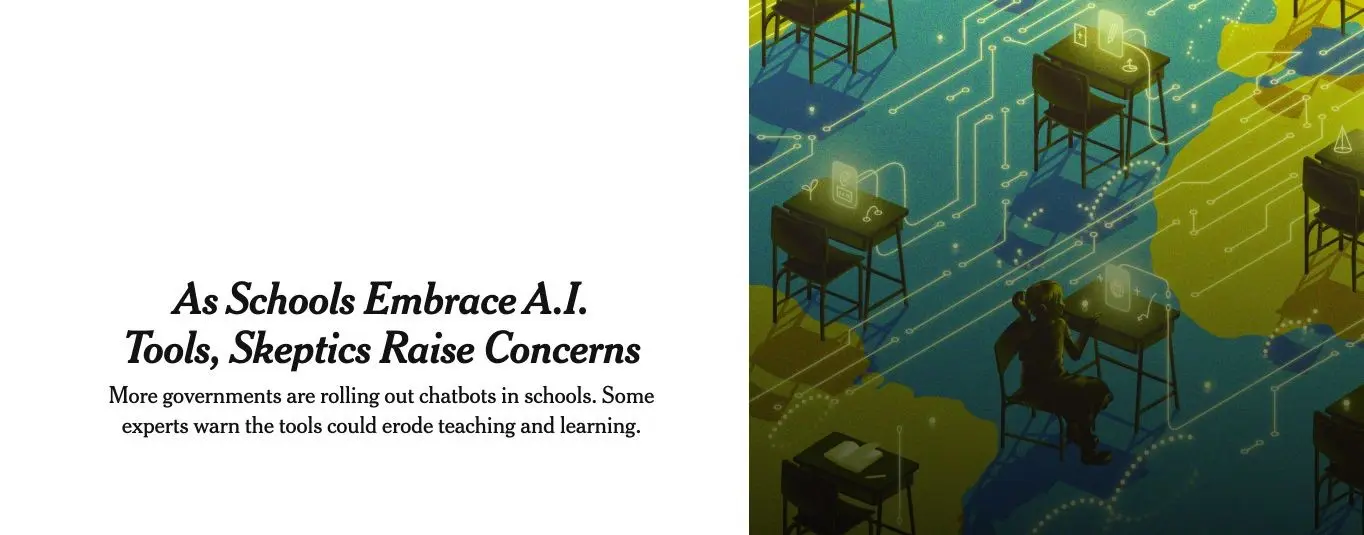
They’re redesigning school around the fact that AI is now baseline.
Estonia didn’t just drop chatbots into classrooms. They adjusted AI systems to asks students questions instead of handing over answers. It sounds subtle, but it’s a huge decision. It forces you to decide what you believe thinking really is.
Iceland went even slower. They paused student AI use entirely. Not because they’re anti-AI. Because they wanted to see which parts of teaching still matter when cognition is outsourced.
Meanwhile, much of the U.S. response is… embarrassing.
Here, we’re mostly arguing about cheating. We’re buying detection tools. We’re trying to protect assignments that fall apart the second a student opens a chatbot.
That should tell us something. AI isn’t breaking education. It’s revealing where learning was already fragile.
If an assignment becomes meaningless the moment AI shows up, it probably wasn’t measuring understanding in the first place. It was measuring whether someone followed instructions.
That’s a tough thing to sit with. This isn’t about AI at all. It forces us to ask what we actually mean when we say “learning.”
The countries getting this right aren’t obsessed with tools or features. They’re being very explicit about where human judgment still has to matter.
That’s the work ahead. Not banning AI. Not racing to adopt it. My advice for educators, administrators, and policymakers (even though no one is asking): You don’t need better AI policies. You need better definitions of thinking.
What is happening in education is not unique. It is just the first place where the definition collapsed completely. Once AI enters a system, it forces a very uncomfortable question. Which parts of this work actually require human judgment, and which parts were already procedural but protected by tradition.
Healthcare is now answering that question in public.
Medicine Is Being Unbundled in Public
Are doctors about to get fired? That’s the headline everyone wants. And it completely misses what just happened.
Here in my home state, Utah didn’t “approve AI in healthcare.” It approved something far more specific. An AI doctor can now handle routine prescription renewals, the refill work that clogs clinics and burns out staff without making patients healthier.
And predictably, the reaction is panic. Doctors are getting replaced. Medicine is over. AI is taking jobs.
That’s not what this is.
What Utah actually did was draw a boundary around a type of work and said, this part no longer requires a human. Not because humans aren’t capable, but because this work was already procedural. It already lived inside rules, guidelines, and checklists. AI didn’t change that. It just made it more obvious.
“Doctor” was never a single job. It was always a bundle. Some of that bundle is judgment, trust, and accountability. Some of it is protocol, documentation, inbox triage, and refills. For a long time, we kept those things glued together because there was no safe way to separate them.
Now there is.
Notice the guardrails though. This isn’t AI diagnosing new conditions or prescribing controlled substances. It’s renewals only. Prior prescriptions. Physician oversight. No treatment changes. The system is deliberately unsexy.
And that’s the point. This is more about delegation, not replacement.
The doctor doesn’t disappear here. The doctor changes. Less time spent doing administrative work that patients never see or value. More time spent on complex cases, ambiguous situations, real conversations, and the moments where human judgment actually matters. In other words, the part of the job people thought they were signing up for in the first place.
And once a licensed profession gets unbundled like this, it doesn’t stop with healthcare. The same logic applies to Accounting, Law, Insurance, Lending, Recruiting. Any role that mixes judgment with large amounts of repeatable, auditable process is exposed.
The role survives. The shape of the role doesn’t. This is what unbundling does. The role stays, but the filler work falls away. Knowledge work has lived on ambiguity for a long time. That protection is fading.
Activity Is No Longer the Job
Is Amazon forcing RTO and surveillance, ... maybe a little. But the real move is the redefinition of work.
What Amazon is actually doing is forcing people to explain their value in outcomes, not activity.
For years, knowledge work ran on proxies:
- Meetings attended
- Messages sent
- Hours logged
Now Amazon is asking a harder question: What actually changed because you were here? Three to five concrete accomplishments. Real impact.
That question matters more now because AI is absorbing a lot of the procedural, coordinative, and invisible work knowledge teams used to do. When that layer gets automated, effort stops being the unit of value. Delta does.
Office attendance dashboards are a blunt, transitional tool. They won’t last. Outcome measurement will.
As AI expands, the real pressure on humans won’t be where they sit. It will be whether they can clearly articulate how their decisions, judgment, and context actually moved something forward.
That’s a very different definition of productivity than most organizations are ready for. When activity stops being the unit of value, another pattern shows up quickly.
The companies winning with AI are not talking about it the most. They are embedding it where work already happens. CES made that obvious.
Google Dominated CES
Google just absolutely dominated CES, ... I'm not sure many noticed.
But I feel like Google won it the boring way: Partnerships that ship. While everyone else was showing a hype demo or what their AI widget could do… Google was expanding where Google Gemini will live:
- in phones
- in kitchens
- in TVs
- in cars
- in robots
- in the enterprise stack
Here is how it went down:
1 - Samsung said it will double “Galaxy AI” devices from 400M to 800M in 2026, ALL powered by Google Gemini. This is Gemini shipping by default at massive scale.
2 - Samsung announced an AI Refrigerator + AI Vision and an AI Wine Cellar, both built with Gemini AI Vision. Gemini isn’t just “an assistant.” It’s becoming the embedded intelligence inside consumer hardware.
3 - Gemini features are coming to Google TV across more brands and “surfaces like projectors.” Google is turning the TV into another Gemini front door.
4 - Epson announced select new Lifestudio projectors will integrate Google TV with Gemini, calling it one of the first projector lines to do it. “Gemini on TV” isn’t just TVs. It’s projectors, i.e., new rooms, new households, new usage.
5 - Qualcomm used CES to highlight an expanded relationship with Google. They are deploying the of next-gen AI agents with “Gemini Enterprise for automotive.” This is Google becoming the assistant layer in the car, not just Android on your phone.
6 - Boston Dynamics announced a partnership with Google DeepMind to integrate Gemini Robotics foundation models with its new Atlas robots, aimed at industrial tasks. This is their plan to put Gemini-class models into real robots doing real work on factory floors.
7 - Snowflake is bringing Gemini 3 into Cortex AI via deeper Google Cloud collaboration. This is google integrating Gemini into corporate data infrastructure platforms.
In 2026, the AI winners won’t be the loudest. They’ll be the most adopted. This is what real adoption looks like. Defaults. Distribution. Scale.
Which makes the constant AI bubble debate feel increasingly disconnected from reality.
The AI Bubble Debate Is Missing the Point
Going into 2026, there’s a lot of dialogue about an “AI bubble.”
Which is funny because the market is basically a multi-sector bubble sampler platter right now.
Yahoo Finance just ran “AI bubble vs pizza bubble"... literally comparing NVIDIA vs Domino’s. Because apparently the only way we can process valuation anxiety is through carbs.
Here’s the forward P/E reality check today:
- Costco Wholesale : 43x
- Walmart : 39x
- ServiceNow : 38x
- Broadcom : 33x
- Apple : 32x
- Amazon : 31x
- Microsoft : 28x
- NVIDIA: 26x
- Domino's: 22x
So if 27x is the “AI bubble”…
…what exactly are we calling 43x for bulk paper towels and rotisserie chickens?
The point isn’t “NVDA is cheap.” It’s not.
The point is: AI hype isn’t floating on vibes alone. In NVIDIA’s case, there are earnings behind the hype, and the multiple is actually lower than a bunch of the most “normal” companies in the world.
If we want to talk about real crazy P/E multiples:
Tesla: 226x ... What ??????
2026 takeaway: Don’t confuse “most talked about” with “most overvalued.” Sometimes the bubble is… pepperoni.
Zoom Out
Across education, healthcare, work, and markets, the same thing keeps happening. AI isn’t replacing people. It’s removing the fog around what work actually is.
When learning was really instruction-following, it shows. When jobs were bundles of judgment and paperwork, they separate. When productivity was motion, it gets exposed.
Going into 2026, the divide is simple. Some organizations are getting precise about thinking, judgment, and outcomes.
Others are still protecting activity. Only one of those survives with AI.
