
This week made the next phase of the AI race painfully clear: great models are becoming common. Distribution and the ability to pay for them are not.
Google’s first AI launch erased $100 billion in a day. Three years later, AI now appears in 43% of searches, Gemini is approaching 900 million monthly users, and nobody had to download a new product. Google simply placed AI inside the interface billions of people already use.
Meta showed the other side of the equation. Its AI is working. Impressions rose 14%, ad prices rose 12%, and their revenue grew 28%. But costs climbed a whopping 55%, margins fell 12 points, and Meta only kept just $784B of the $60.8B it generated.
Then the market graded four of the largest companies on earth:
- Microsoft and Amazon went up because they generated customer demand and revenue as they built out their AI infrastructure thereby not increasing CAPEX.
- Meta went down even though the technology is working. The problem is that they are not generating enough growth to pay for their AI infrastructure.
- Apple went down because the AI infrastructure boom is raising the cost of their key components that their existing business depends on.
The crazy thing is that the market is no longer asking whether these companies have good AI. They all do.
It's asking two much harder questions: Do they already own the interface where customers spend their time, and are customers paying for the AI infrastructure buildout at a rate equal to that same AI buildout spend?
Great models are becoming common. What is scarce is a built-in path to the customer and a business model strong enough to absorb the cost of putting AI there.
But distribution alone is not enough. Meta has more users than almost anyone and still had a $150B market loss because their AI costs are becoming impossible to ignore.
The AI race is moving beyond model quality. The companies winning own the (1) customer interface, (2) fund the infrastructure, and (3) show exactly how the spending turns into revenue quickly.
We all need to consider if are our customers are a distribution advantage, or just revenue that has not churned yet?
Google’s First AI Launch Was So Bad the Stock Lost $100B in a Day
In February 2023, Google’s first AI launch was so bad the stock lost $100B in a day. This morning, new data shows Google’s AI is now in 43% of searches.
Similarweb published the numbers today: up from 15% of all searches a year ago.
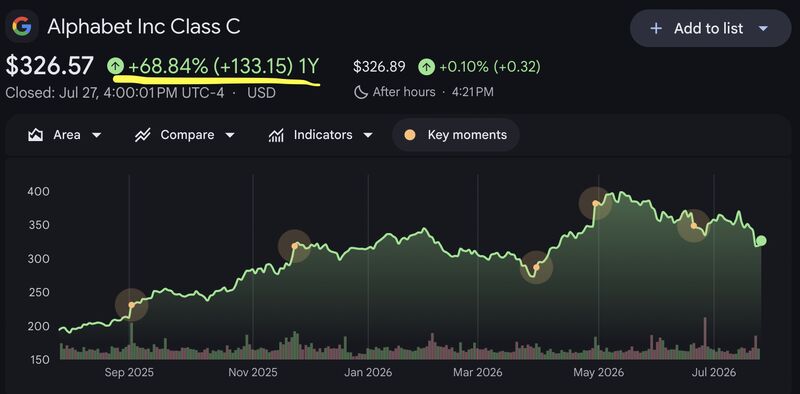
But just a year ago, everyone claimed Google was late. Now they are becoming the default, ... and nobody had to download or install anything.
Some of the interesting numbers:
- AI Mode visits: 126M last June → 279M in May
- Gemini: near 900M monthly users
- Alphabet Inc.: +$1.6T in market value, up nearly 70% in a year
- Q2: revenue +24%, Cloud +82%
- Conversely: HubSpot down 60%, monday.com down 75%, Zoom 85% off its peak
And yes, there is a catch. Google went $5.9B cash flow negative last quarter, plans to spend about $200B this year, and the stock is 20% off its high.
Still, great models are everywhere and distribution is not. And it’s turning out that a massive legacy user base is what matters.
Meta has WhatsApp. Microsoft has Office. Google has Search. The race really was never the best model. Instead, it’s who already owns the interface the customer lives in.
Interestingly, legacy SaaS has installed bases too. But Google monetizes attention and SaaS bills by the seat. AI grows one while it seems to kill the other.
A fundamental question we need to ask: Are our customers potential distribution, or just revenue that hasn’t churned yet?
Google shows why distribution matters. But owning the interface is only half the advantage.
You still have to pay for the intelligence you put inside it, and this week Meta showed how expensive that can get.
Meta Grew Revenue 28% Last Quarter
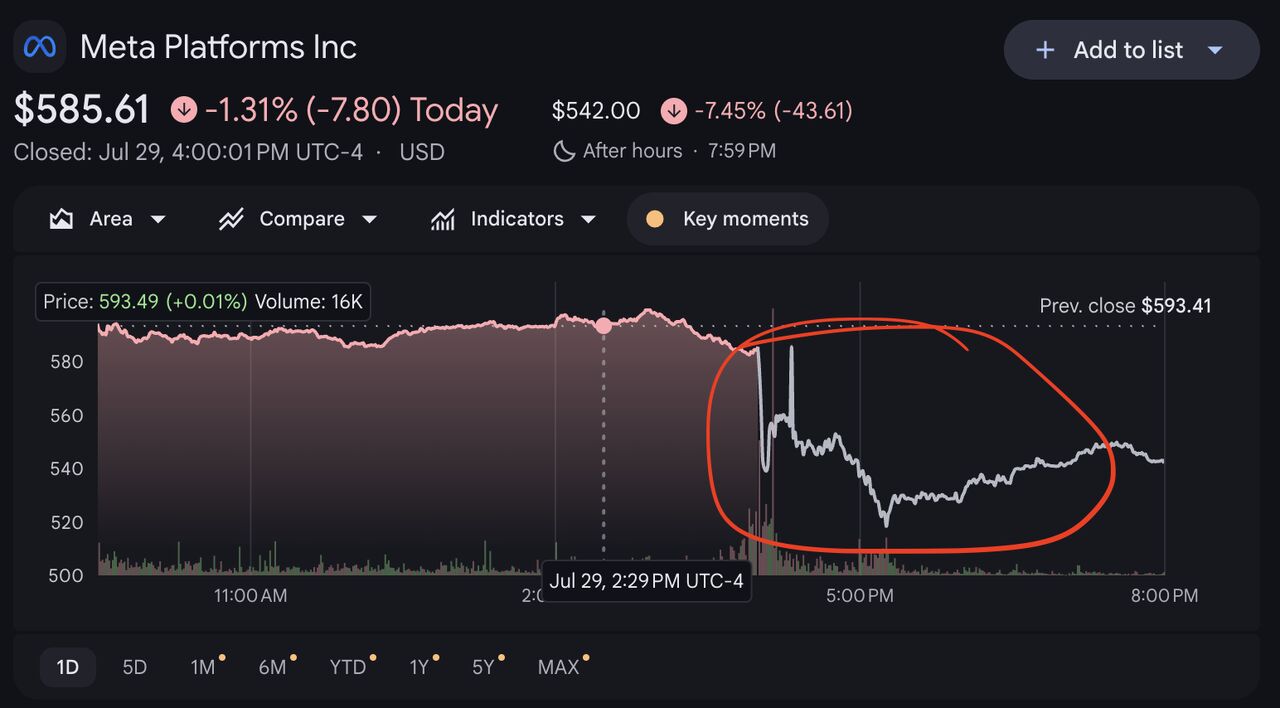
On Wednesday night it reported, and the stock fell 9% in after-hours, about $150B lost at the evening’s low.
The number that spooked the market: free cash flow. Meta collected $60.8B, ... and retained $784M of it as cash.
The strange part: the AI is working. Impressions were up 14% and price per ad was up 12%. That almost never happens.
From the release and the call:
- Costs hit $42B, up 55% against 28% revenue growth
- Operating margin went from 43% to 31% in a year
- Capex was $31.1B in 90 days, and the low end of 2026 guidance moved up to $130B
“We are now at a point where our investments in AI are accelerating every major part of our core business.”
Those are Zuckerberg’s words from the call.
The market is not doubting Meta’s AI. It is questioning what it’s costing Meta to pay for it. They still earn like a software company, but now spend like an infrastructure company.
Two weeks ago I wrote that Meta can win the price war because it funds models with ads while OpenAI and Anthropic fund them with model revenue. Last night we saw the cost: 12 points of margin and nearly all the cash.
Zuckerberg even floated “potentially selling compute directly,” ... renting out computing power may become Meta’s next business.
Still, I think Meta wins this one. 3.6B people open their apps every day, and AI ends up wherever the users already are. Great models are everywhere. Distribution is not.
Meta’s selloff was not an isolated reaction. By the end of the week, four of the largest companies on earth had reported, and the market had made its new grading rubric clear: AI spending is rewarded when customers are already paying for it. Everything else gets questioned.
Microsoft Just Had Its Best Day Since 2008. Apple Lost $390B in the Hour After Its Earnings Call.
Four of the biggest companies on earth reported this week. All four grew by double digits. The market split them anyway:
- Meta: Revenue up 28%. Closed down 9% Thursday, about $150B gone.
- Microsoft: Revenue up 18%. Up as much as 17% Thursday, roughly $480B added.
- Amazon: Revenue up 20%. Up 14% this morning.
- Apple: Revenue up 16%, its strongest June quarter ever. Down another 9% this morning.
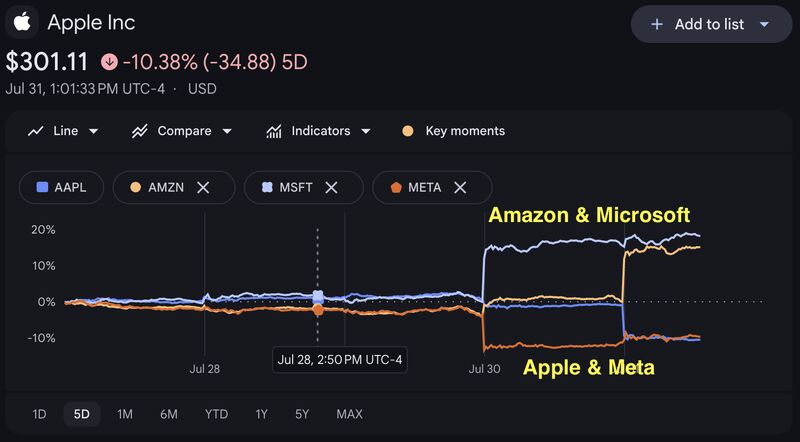
Growth was not the grading rubric. It all came down to AI spending.
Amazon raised its 2026 capex plan to $220B, the biggest of the four, and got the biggest reward.
Microsoft brought $678B in contracts for future work, up from $368B a year ago. Amazon had AWS growing 37%, its fastest in four years.
Meta attached $42B in quarterly costs, up 55%, and kept $784M of the $60.8B it collected. Apple attached a guidance cut because AI datacenters are buying up the memory iPhones need.
Tim Cook, on his final earnings call, called memory prices a “hundred year flood.”
Yesterday I wrote that Meta earns like a software company and spends like an infrastructure company.
This week the market asked all four the same question. The companies that could show who is paying for their AI went up. The ones that couldn’t went down.
The Macro View
The model is becoming the least differentiated part of the new AI business. The real advantages are owning the interface, controlling the distribution, and having an existing business large enough to fund the infrastructure underneath it.
But the bill is arriving faster than the revenue for some companies.
For business leaders, saying you are investing in AI is no longer enough. You need to know where it reaches the customer, which part of the business pays for it, and how the spending turns into revenue.
The companies that can answer all three are being rewarded. The ones that cannot are watching double-digit growth get erased in a single afternoon.
