
A busy week in AI but most companies are still framing AI as a productivity layer.
A tool that helps people move faster, automate small tasks, or reduce friction around the edges. It’s a comfortable way to think about it. But it doesn’t quite explain what we’re seeing.
AI isn’t just improving productivity as much as its starting to take ownership of work. And as that happens, the ripple effects don’t stay inside the product. They move into operating models, pricing, cost structures, and eventually org charts.
It doesn’t arrive with a dramatic announcement or a single defining moment. Instead, it surfaces gradually. You begin to see it in architecture decisions, in the way companies redefine how value is measured, and in how markets respond to a single well-timed demo. Over time, it even shapes the language CEOs use when they talk about headcount and leverage.
There is a sequence to how this unfolds. And if you’re looking for where we are in that sequence right now, start with architecture.
AI Just Became a Team Sport
Grok doesn’t answer your question anymore. It argues about it first. This week, xAI dropped Grok 4.20 and the architecture is different.
Instead of one model guessing and shipping, you get four specialized agents working in parallel. They disagree. They fact-check. They pressure-test. Then you get the consensus.
Meet the lineup:
- Grok: coordinator. Breaks down the problem, assigns tasks, resolves conflict, ships the final answer.
- Harper: researcher. Pulls live web data plus X’s firehose to verify claims fast.
- Benjamin: logician. Math, code, step-by-step reasoning. Stress-tests everyone else.
- Lucas: creative. Alternative angles, clarity, and the ideas the others miss.
This is peer review at machine speed. Early testing claims hallucinations dropped 65% because the system is built to catch confident errors before they reach you. That’s the real bet. Most labs still ship single-model inference with one brain and one answer. xAI is shipping a team.
And that maps cleanly to where companies are headed. For years, we optimized for individual productivity. Now the game is orchestration. Systems that challenge themselves before they act. Autonomous organizations will look like this:
- multiple agents
- distinct roles
- coordination layer
- internal debate
- one accountable output
Will the rest of the industry move from single intelligence to structured intelligence? I think so. The future isn’t a lone super brain. It’s aligned, adversarial, self-correcting teams of intelligence.
Grok’s multi-agent architecture isn’t just a technical curiosity. It’s a signal about where intelligence systems are headed. Coordination. Role specialization. Internal debate. One accountable output.
The technology is reorganizing itself. Most enterprises aren’t.
Why AI Still Hasn’t Rebuilt the Enterprise
AI is not working in the enterprise. I didn’t say it. The COO of OpenAI did.
This week at an AI summit in India, Brad Lightcap said: “We have not yet really seen AI penetrate enterprise business processes.”
Let that sink in. OpenAI I is touting:
- $20B+ in annualized revenue
- 100M+ weekly users in India alone
- Major partnerships with Boston Consulting Group (BCG), McKinsey & Company, Accenture, and Capgemini
And still… AI hasn’t truly penetrated enterprise workflows. And honestly? He’s right.
Enterprise work is messy. It’s not one smart model answering a prompt. It’s systems, approvals, handoffs, and politics.
Most companies did the easy thing. They gave employees AI.
There’s a massive difference between: 5,000 employees using ChatGPT to work a little faster and
- Identifying 5 core workflows that no longer need 200 people
- Rebuilding those workflows with a clear point of view
- Designing them around AI ownership, not human assistance
The first is a tooling decision. The second is an operating model decision that forces real change.
Right now AI is a co-pilot. It hasn’t become the system of execution. Until AI is implemented with a clear point of view and owns outcomes instead of assisting humans, it hasn’t penetrated the enterprise. And it won’t.
That’s exactly what we’re building at Atonom. Not AI as a tool. AI as a Cloud Employee that owns the workflow.
- With a strong point of view
- With embedded best practices
- With execution built in.
If you believe AI should run the job, not just assist it, start here.
If AI hasn’t penetrated enterprise workflows, it’s not because the models aren’t capable. It’s because most companies haven’t redesigned them. And when you redesign around AI, something else has to change: how you measure value.
The Market Repriced SaaS Overnight
I read the entire Salesforce earnings announcement. None of it stuck with me, except one metric. They stopped talking about tokens and they started talking about Agentic Work Units (AWU).
To me, thats the headline. For the last two years, AI companies have been flexing token counts.
- 19 trillion tokens
- 100 billion tokens
- 500 million daily tokens
Cool. Nobody in the enterprise cares. A token is a calorie, ... I guess? A CFO doesn’t want to know how many calories your AI burned. They want to know if the job got done. And that’s a big change.
The second you move from tokens to work, pricing changes, architecture changes, accountability changes. You are no longer selling intelligence. You are selling labor. That’s a completely different category.
At Atonom, we made this decision a year ago. We don’t price per seat. We don’t price per token. You hire a Cloud Employee. And each level comes with a defined amount of completed work. We measure units of work. We jokingly call them “Tolkiens.” Yes, really like J.R.R. Tolkien. I couldn’t resist.
But the point is simple.
- A resolved support ticket
- A completed outreach cycle
- A verified benefits check
Not: “AI ran 8,000 tokens.” But: “AI completed 42 workflows without human intervention.” That’s a completely different conversation with a CFO.
Once you move from selling tokens to selling completed work, the economic implications get real very quickly. When AI can own units of work, entire services categories start to compress. Cost structures that were built around human labor begin to collapse. And the public markets are paying attention.
$31.6 Billion Vanished in a Day
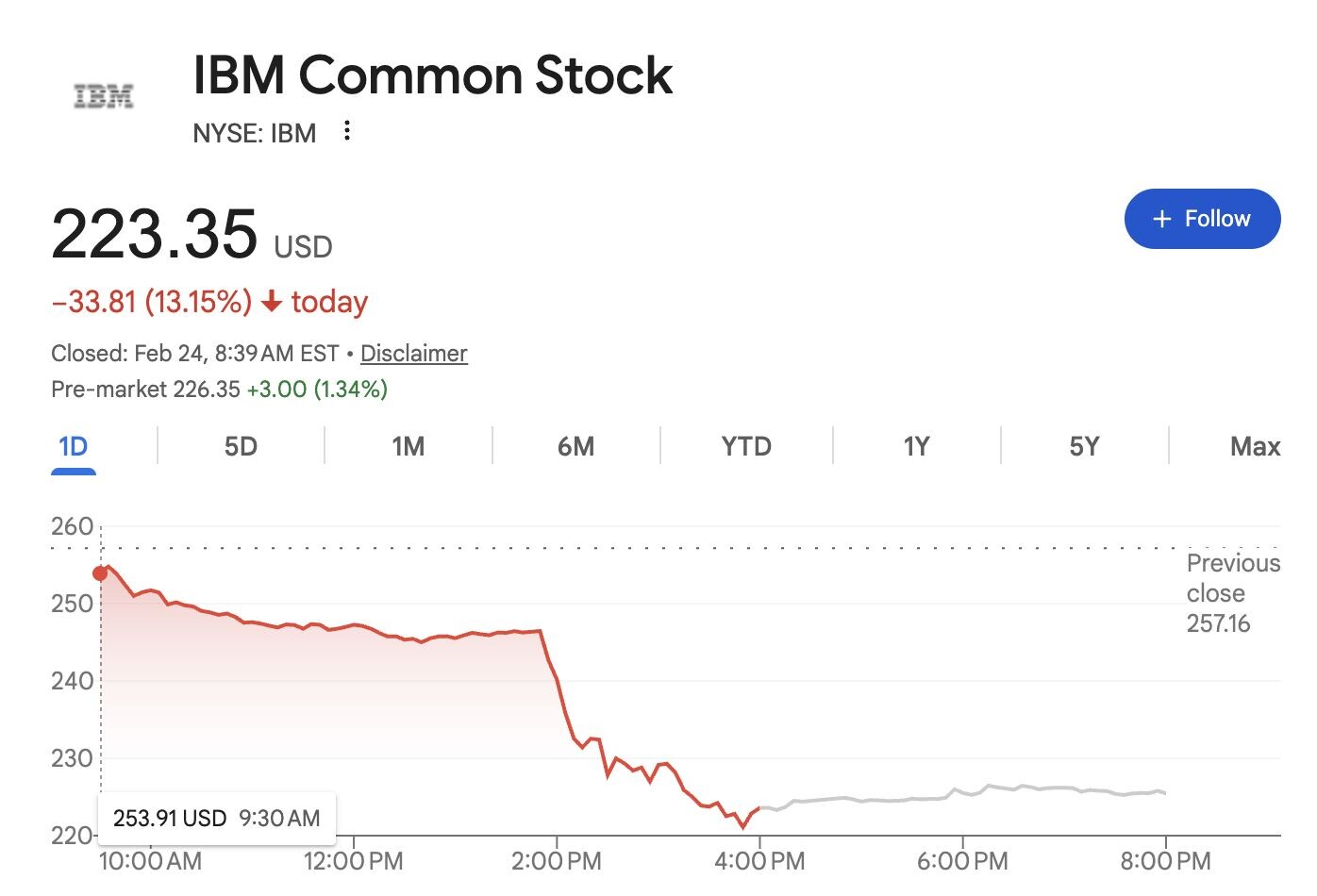
This week IBM lost $31.6B in market cap, their biggest drop since October 18, 2000 because of an Anthropic. Anthropic showed AI could modernize COBOL with a prompt, the market immediately cut 13.2% off IBM's stock.
COBOL is the programming language used on IBM mainframes across banking, insurance and government systems, pretty much since it was invented in the 1950s... and is used in nearly 95% of ATM transactions in the U.S.
“AI excels at streamlining the tasks that once made COBOL modernization cost-prohibitive.” Anthropic said in a blog post.
So, for as long as we can remember, legacy code modernization is a story of an armies of high cost consultants, multi-year roadmaps, and seven-figure transformation budgets. There are only around 24,000 COBOL programmers left in the US (average age between 45 and 55). Now a model strolls through the codebase like it owns the place, rewrites it, documents it, and finishes before the steering committee even schedules the kickoff meeting.
I don’t really care about COBOL (I really kind do love it 😉 for nerd reasons). But I care that this is another example of AI collapsing the cost structure behind human labor.
AI can:
- Read legacy systems
- Interpret business logic
- Generate modern equivalents
- Validate outputs
- Iterate in hours, not quarters
When this happens, the entire economic and social ecosystem around a infrastructure like COBOL falls apart (There are now ~34,000 “COBOL related" job listings worldwide). Consulting armies were once scaled by adding bodies and jobs, now AI scales by adding intelligence. Those are fundamentally different machines.
And the market just told you which one it believes in.
IBM is not weak. It is disciplined, global, embedded inside EVERY one of the largest enterprises on earth. If a company like that can lose billions on the perception that AI will shrink a services category, imagine what happens to firms whose entire revenue base is modernization labor.
At some point, leadership teams have to decide whether to proactively redesign the company, or wait for the market to force the redesign. Some are starting to choose.
Scale No Longer Means Headcount
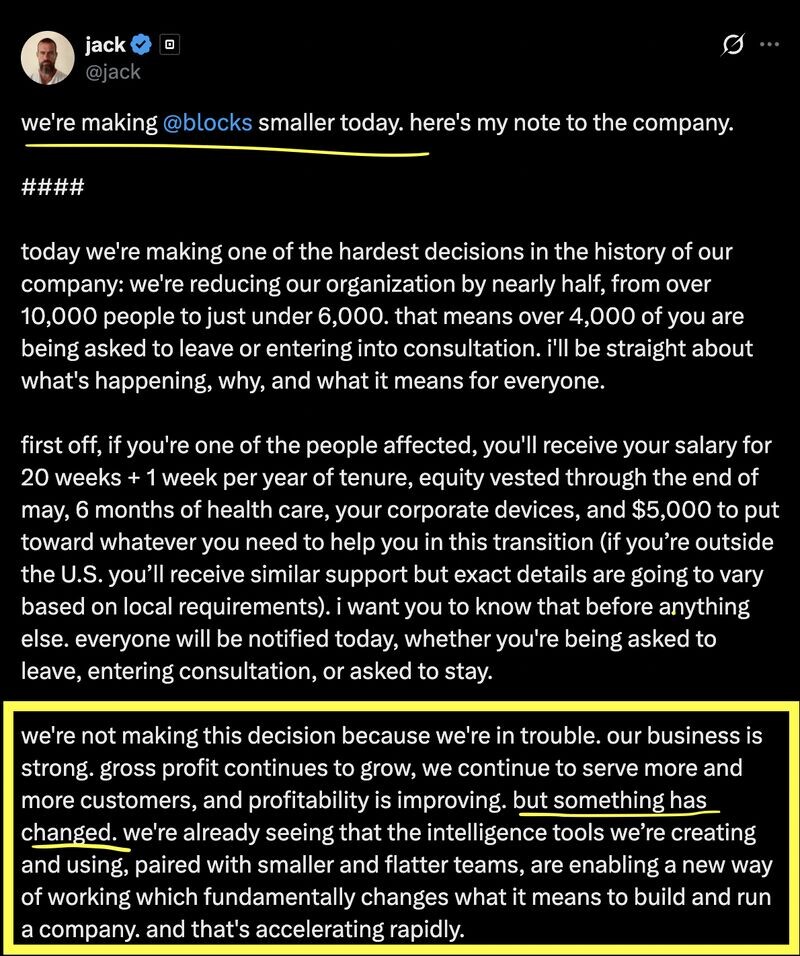
Block is slashing 4,000 jobs, cutting the company in half. The stock jumped as much as 24% adding over $9B this morning.
Wall Street didn’t punish the layoffs, it actually rewarded the redesign. This is not a “tough macro environment” story, or a “belt tightening” cycle, or even a temporary hiring reset. This is the first large public company saying: We don’t need that many humans to run the machine this way anymore.
Jack Dorsey, Block's co-founder said in a letter to the company "something has changed."
For 20 years, scale meant headcount.
- More customers → more support
- More volume → more ops
- More revenue → more managers
That model just broke. Dorsey didn’t say, “AI will assist our teams.” In a letter posted on X, he said "smaller and flatter teams are enabling a new way of working which fundamentally changes what it means to build and run a company."
“I don’t think we’re early to this realization,” he said in an interview with analysts. “I think most companies are late. Within the next year, I believe the majority of companies will reach the same conclusion and make similar structural changes.”
There is a fundamental shift happening in the world forcing a question on every company, leader and person with a job: Wait and be forced to make changes ... or, as Dorsey put it, "be honest about where we are and act on it now. i chose the latter."
Zoom Out
Put these together and the pattern is hard to ignore.
Model architecture is shifting from single intelligence to coordinated systems. Enterprises are being forced to move from AI as assistance to AI as execution. Pricing is evolving from tokens to units of completed work. Markets are rewarding companies that collapse labor costs and punishing those exposed to them. Org charts are flattening.
Let's call this what it is, a structural reset.
For founders, CROs, and operators, this comes down to design. Are you restructuring core workflows so AI owns execution, or are you inserting AI into a system that was built for human labor and expecting meaningful change?
The companies that understand this sequence will move early. The ones that don’t will be forced to.
