
This week felt like another death knell in the legacy SaaS era. For 25 years, we paid for seats and still did all the work. But the market has completely defunded this strategy and forced the laggard incumbent software giants to pivot.
From Oracle’s 30,000-person Human-to-Compute arbitrage to Salesforce officially killing the 'Log In' button, the legacy software disruption is well underway. The old guard is burning their crumbling foundations to fund a future they don't control anymore, and find themselves chasing the Native-AI emerging elite.
This week revealed the brutal mechanics of the SaaSpocalypse. We saw $400B in market value evaporate from Oracle and a 60% valuation collapse at HubSpot as Per-Seat pricing finally met its maker.
Apple made the AI model war almost meaningless, and the application layer is being gutted. Whether it’s Apple commoditizing the brain or Anthropic treating intelligence like a surge-priced utility, the interface is no longer the moat.
The winners are no longer building tools for humans to use. They are building agents and AI cloud employees to provide the outcomes humans used to manually orchestrate.
Welcome to the era of Intelligence as an Infrastructure. It’s faster, more scalable, and significantly more brutal for those still defending the legacy dashboard.
Apple Declared the Model Wars Irrelevant
Apple may have just ended the AI model war. Nobody cares which model you use anymore.
- Claude vs Gemini
- GPT vs Grok
- Apple vs Google
That’s honestly the wrong fight. Apple opening Siri to third-party AI assistants just made something brutally obvious: The model layer is becoming a commodity.
This is the AI version of what happened when the internet became infrastructure. Nobody won because they “had internet.” They won because they built Amazon, eBay, Google, and Salesforce on top of it.
Same thing now.
- No one is going to win because they picked the “best model.”
- Not in a world where Apple lets users swap the brain behind Siri.
- Not in a world where contacts, context, and models can move with the user.
- Not in a world where every major model is already good enough.
The real money is not in the hyperscaler, it’s in the application layer. More specifically: It’s in autonomous work, not prompts or copilots. Not another interface where humans still have to orchestrate every step. Real systems that wake up and do the work (aka OpenClaw and Atonom).
I don’t see this next era being defined by the companies with the loudest model opinions. It’s going to be defined by the ones shipping agents that drive revenue, margin, and real output.
We need to stop obsessing over the brain and start building the worker.
Once the underlying intelligence becomes basic infrastructure, the battleground for value moves directly to where that intelligence actually executes transactions.
Shopify is Building Doors While Amazon Builds Walls
Amazon just sued an AI startup for letting customers shop on Amazon.
Perplexity built an AI shopping agent called "Comet." It finds products on Amazon and buys them for you. Amazon's response? Sue them!!??? A federal judge blocked Comet on March 10.
The same week, Shopify did the exact opposite. Shopify turned on "Agentic Storefronts" for every merchant. Millions of stores can now sell directly inside ChatGPT, Google AI Mode, Microsoft Copilot, and Gemini. No extra apps. No extra fees. On by default.
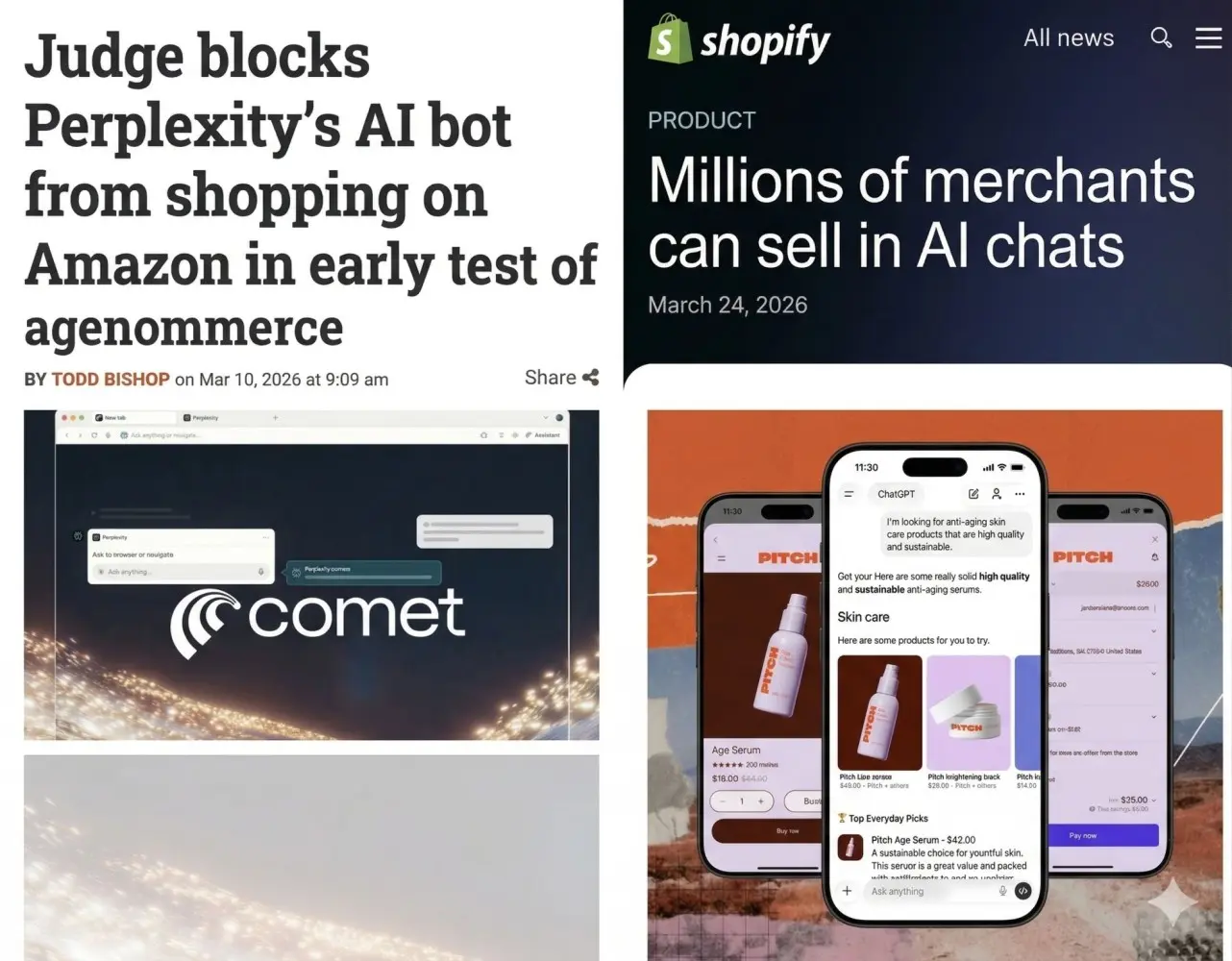
Two companies with totally opposite strategies. Amazon is building walls while Shopify is building doors.
And the early numbers tell you which side is winning:
- AI traffic to Shopify stores: up 15x since January 2025
- AI-attributed orders: up 11x
- AI traffic to US eCommerce overall: up 4,700%
- ChatGPT now drives referral traffic equal to 20% of Walmart's total visits
Amazon built the greatest marketplace in history... for humans. We browse and scroll. We click "Add to Cart." But the next generation of buyers aren't human. They're AI agents.
I believe this may be Amazon's Blockbuster moment.
The winners won't be the companies with the biggest walled gardens. They’ll be the ones who build the doors for AI agents to walk through.
As autonomous agents take over the buying process, the legacy software interfaces we used to manage that work are being gutted from the inside out.
Salesforce is Ending the "Log In" Button
Salesforce just made the biggest pivot in SaaS history: They are killing the "Log In" button.
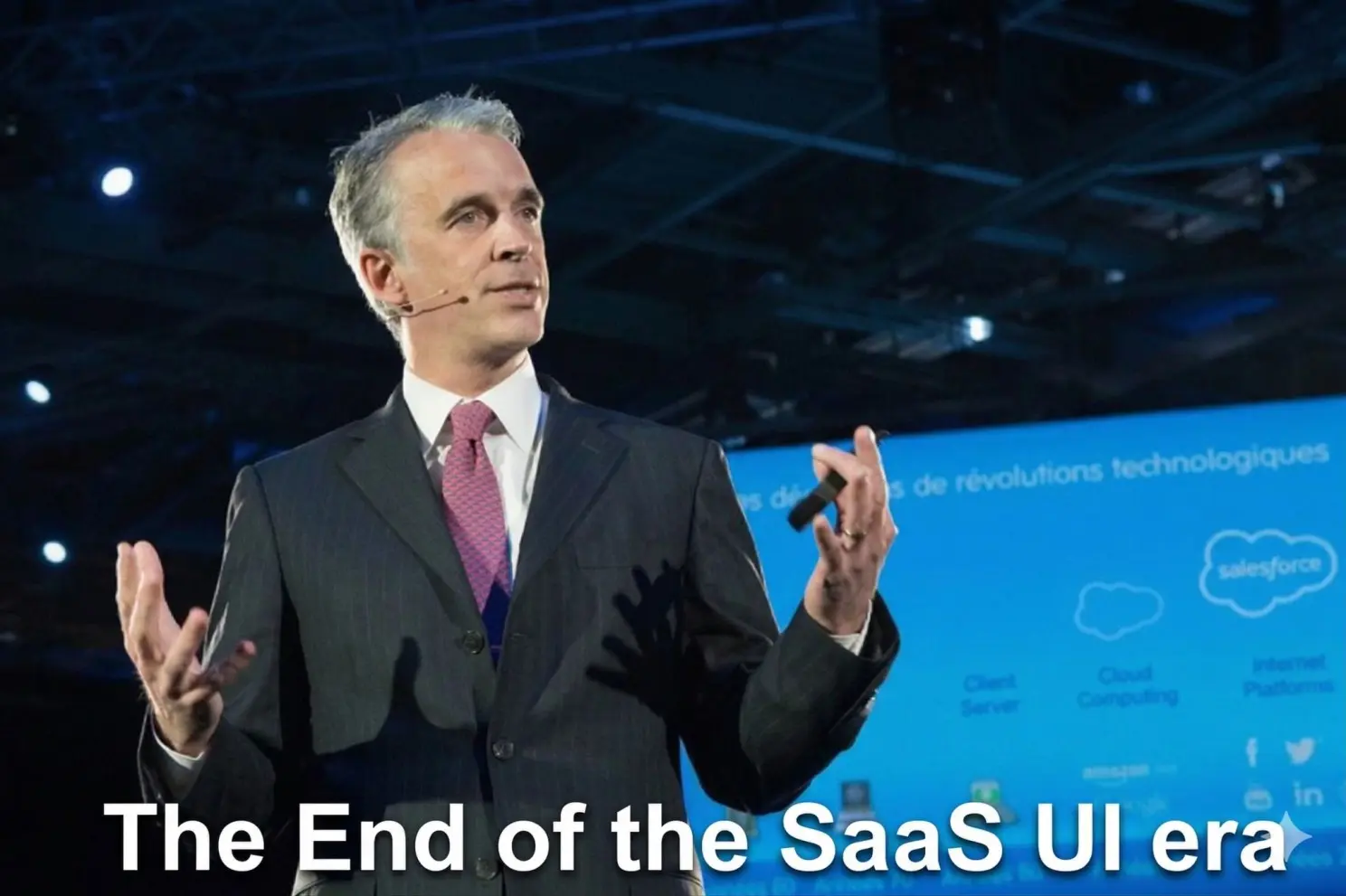
In a jarring move, Salesforce co-founder Parker Harris recently asked the industry: “Why should you ever log into Salesforce again?”
a.k.a., the "Log In" button is officially dead.
The urgency is written in the numbers:
- Salesforce stock slid 31% in just 90 days.
- Over $80B in market value vanished in the last 12 months.
- Salesforce is burning its legacy "Lightning UI."
- They are building an Agentic OS in Slack.
But I feel like the market cap crash is the least interesting part of this story. Salesforce is rebuilding for an era where humans no longer "use" software, we manage it.
By dropping 30+ AI features into Slack, they are turning a chat app into an autonomous digital coworker. This isn't a UI update; it’s a signal of the end of manual labor.
Developers are already voting with their code, showing 300% growth in custom AI agents on Slack in just eight weeks. Even here at Atonom we just released:
- An 'Ask me Anything' Slack bot
- A 'New Employee Onboarding' Slack bot
- A 'Sales Support' Slack bot
- A 'Project Management' Slack bot (integrating into Asana, ClickUp, monday.com)
The transition is now obvious:
- The Past (SaaS): Manual entry, complex dashboards, and "logging in."
- The Future (AI): API-driven orchestration and digital labor.
Salesforce is moving beyond the interface because the interface has become the bottleneck. We are witnessing the final days of the "Seat-Based" era. Salesforce is no longer a destination. It is becoming the infrastructure for digital labor.
When the manual interface disappears, the legacy software royalty are forced to kill their own business models before the market does it for them.
HubSpot Abandoned their Per-Seat Pricing for Outcomes
HubSpot just killed their per-seat model to in an attempt to survive the AI SaaS disruption.
In the last 12 months, HubSpot has lost over $17 Billion in market cap. Since April 2025, its value has plummeted nearly 60%, dropping from $30.4B to just $12.8B.
Yesterday, they officially pivoted: $0 per seat for AI agents, charging instead for "successful outcomes" ... OaaS (Outcome as a Service).
- $.50 per resolved customer conversation
- $1 per lead recommended for sales outreach
- $0 risk for "potential" that doesn't perform
This is another overt example that the old SaaS business model is fundamentally broken. Just a few days ago, Salesforce co-founder Parker Harris reinforced this point stating: “Why should you ever log into Salesforce again?” Meaning agents will do it all.
For me, the real question is: Can companies like Salesforce and HubSpot survive this disruption.
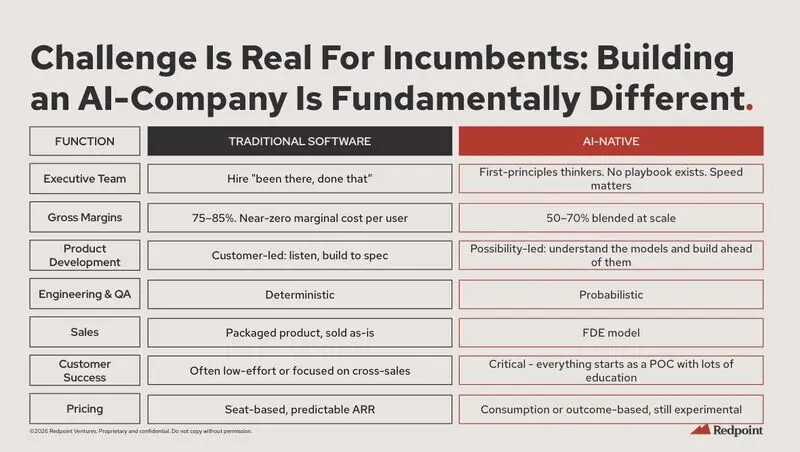
Redpoint just published an AMAZING "2026 Market Update" report where they explain that the core DNA of "Traditional SaaS Software" companies is fundamentally different than "AI-Native" companies.
"This isn't a mobile app launch. It's a re-founding. The companies that treat it as an incremental feature effort will lose to the ones that treat it as an architectural reset."
We have entered the Autonomous Agent Era, many of the legacy SaaS royalty may not make it.
As human labor is replaced by digital labor, the legacy workforce required to maintain those old systems is being liquidated to fund the next era of compute.
Oracle Swaps 30,000 Employees for H100s
Oracle is burning its legacy SaaS business to fund "Stargate" in a 30k person layoff trying to reverse a $400B market cap loss.
In an attempt to reverse a 6 month 50%, $400B market cap loss, they send a 6 AM email yesterday notifying 30k people that it was their last day.
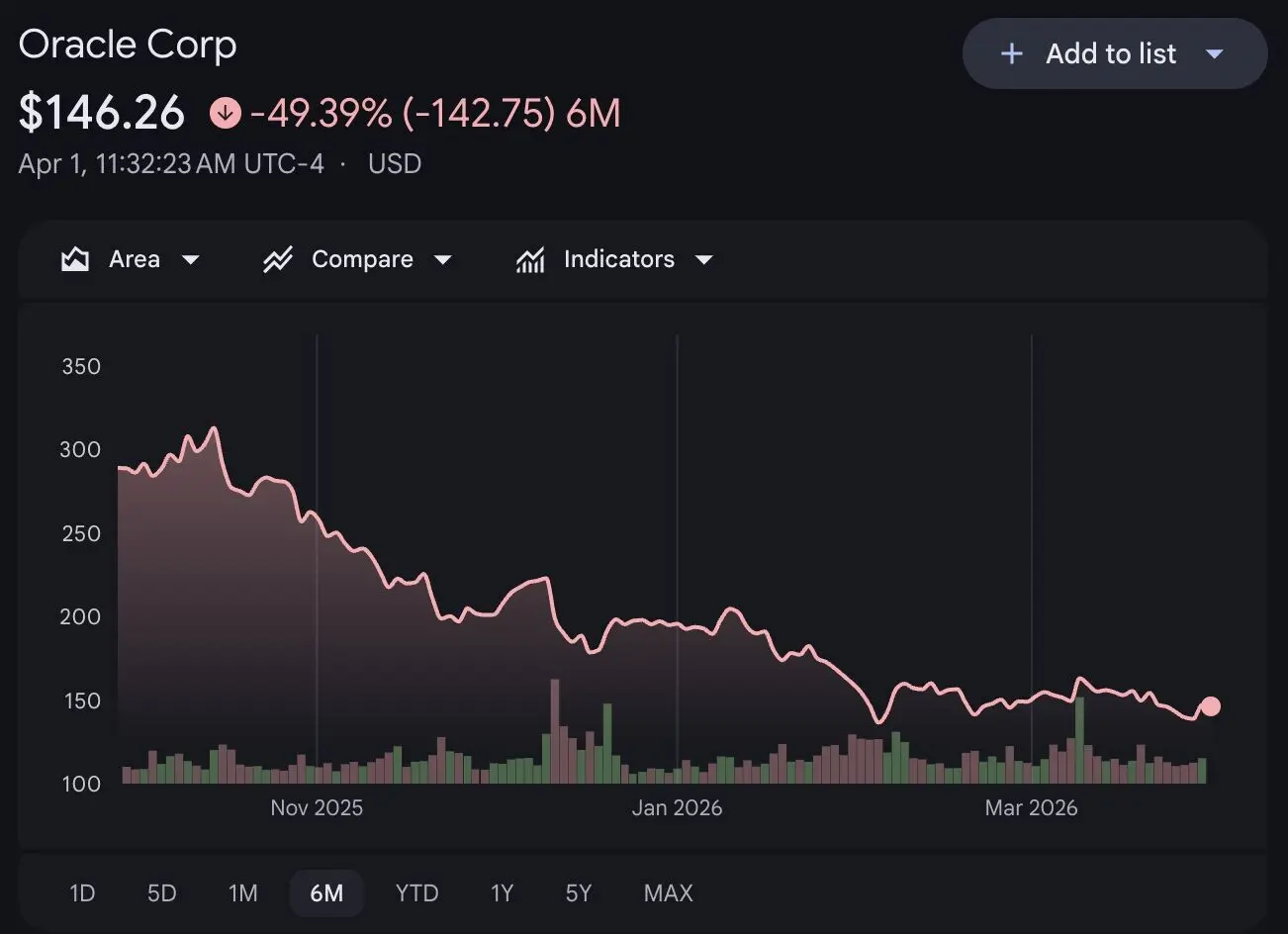
This is the largest AI layoff to date and an admission that the human-heavy SaaS model is incongruent with the AI "Infrastructure Race."
- 30,000 professionals terminated in a single 24-hour cycle.
- 18% of the global workforce wiped out to stop an $11.5B cash burn.
- $50B in capital redirected instantly to AI data centers.
The layoff is the most sobering and truly terrible part of a much larger story. This is the first overt "Human-to-Compute Arbitrage" of the Token Era.
Oracle has realized that the SaaS model is a liability in their war against autonomous AI agents. They are trading 30,000 salaries for 30,000 H100s to capture AI Mindshare.
- Oracle's Past (SaaS): 162,000 people managing "seats" and features. Growth was tied to headcount-driven sales and brittle human workflows.
- Oracle's Future (AI): The "AI Infrastructure Landlord" of 2026. Growth is tied to a $553B contractual backlog of AI Digital Labor and inference compute.
The "SaaSpocalypse" is no longer a prediction. Its playing out in front of the world live. Winners will aggressively pivot from managing human "seats" to orchestrating autonomous digital labor. Losers will attempt to defend the legacy SaaS model until their margins are entirely consumed by the competition.
It looks like the rise of the AI Cloud Employee is forcing a fundamental reset of our entire corporate structure.
When human labor is replaced by digital labor, the pricing models that relied on per seat licenses are forced to cannibalize themselves.
The Fixed-Rate AI Pricing just got "Uber-ed"
The $20/month AI Pricing model is officially dead. Anthropic just did to software what Uber did to transportation.
For 20 years, SaaS trained us to expect "The Flat Fee."
- $20 a month
- $100 a seat
- Unlimited access, whenever you want
That era is over. Anthropic is now "aggressively" rationing Claude Pro during peak hours. If demand spikes, your usage caps plummet. You’re paying the same price for less output. Call it whatever you want. They call it "demand management." I call it surge pricing .
This isn't just a technical glitch. It’s a fundamental shift in how the world buys technology.
AI is no longer behaving like software. It’s behaving like a utility.
- Like Uber (Surge pricing).
- Like Amazon Web Services (AWS) (Compute scaling).
- Like the Power Grid (Brownouts during a heatwave).
Here is the problem: Utilities require transparency. Right now, paying customers are furious because they bought a "seat" but received a "ration." You can’t treat your product like the power grid while charging for it like a Netflix sub.
My prediction: The next generation of software won't be priced by seats. It will be priced by urgency and demand.
- Need it now? Pay a premium.
- Can wait until 2 AM? It’s cheap.
- High-compute task? Watch the meter run.
The "Unlimited" pricing promise that built Silicon Valley is kind of unraveling into chaos. We are moving from the era of "Software as a Service" to "Intelligence as an Infrastructure." It’s going to be more efficient, more scalable, and I suspect a lot more expensive.
What Really Happened
The public narrative this week was all about strategic pivots and agentic storefronts, but the behind the scenes reality is a frantic scramble for survival. Apple didn’t open Siri because they believe in open ecosystems: they did it because their internal LLM project is reportedly a disaster and they need to offload the massive compute costs onto competitors while still taking a 30% cut of the subscriptions.
Similarly, Amazon’s lawsuit against Comet isn't about protecting customers: it's a desperate attempt to protect their ad revenue. If agents do the shopping, they don't click on sponsored products, and Amazon's highest margin business evaporates. While Shopify builds doors to capture new volume, Amazon is building a fortress because they know their browsing model is obsolete.
HubSpot's pivot to outcome based pricing is a confession that their software value has hit zero. They aren't being innovative: they are desperate to stop a $17B bleeding by charging for outcomes because they know nobody will pay for a seat to watch an agent work. They are admitting the software is a commodity and only the result matters.
Oracle's brutal Human to Compute Arbitrage isn't a bold new strategy: it's a desperate liquidation. They fired 30,000 people at 6 AM because they realized their legacy software isn't worth the human salaries required to sell it anymore. They are burning the UI because the UI is the only thing standing between their customers and the realization that the SaaS tax is over.
And Anthropic’s surge pricing? That’s just a polite way of saying their unit economics are currently in the trash. They are desperately trying to stop heavy users from costing them $40 for every $20 they collect. This Infrastructure shift isn't just progress: it's the first sign that the venture capital subsidy for AI is ending and the real bill is finally coming due.
