
Nobody announced a meaningfully better model this week.
The real moves were all about what surrounds them. The premium on raw intelligence is officially collapsing.
Look at the tape from the last few days:
made AI spend permanent.
They moved AI out of the discretionary "innovation" budget and into their core $19.8B "infrastructure" accounting line item.
raised a white flag.
They are paying Google $1B a year to run Siri. They gave up building the engine to maintain their unshakeable moat: distribution into 2 billion devices.
went public hitting $2 trillion.
Wall Street handed $75B to a company losing $4.9B because they control the physical and digital supply chain from orbit to earth.
started a token price war.
They are front-running
with preemptive price cuts. The enterprise message is that the model itself is now a commodity.
Gartner says enterprise AI spend will be $2.5 trillion next year. The money isn't slowing down. But the gap between capital deployed and actual business value extracted is widening.
Intelligence isn't the bottleneck anymore. Operationalizing it is.
If you can't map exactly how your human employees execute a workflow, you can't expect an AI agent to optimize it. The margin is moving away from the underlying engine. It is moving toward the companies that understand their work deeply enough to redesign it.
The strategic question for business leaders isn't build vs. buy anymore.
It's own vs. rent.
JPMorgan Reclassifies the AI Budget
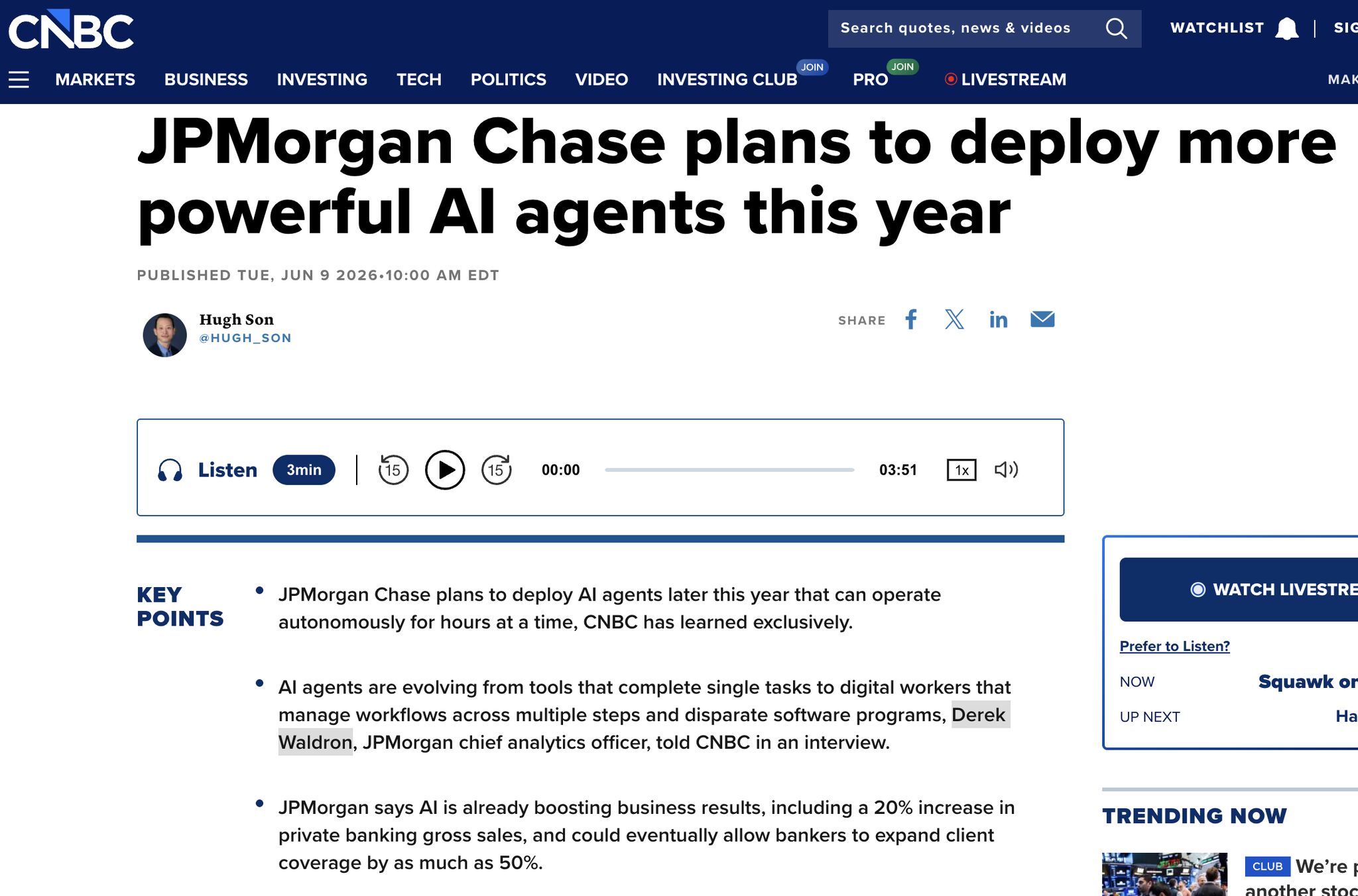
J.P. Morgan just made AI impossible to defund. It changed the budget code.
AI moved out of "innovation" and into "infrastructure." It's now the same category as data centers, payment systems, and risk controls and is inside a $19.8B technology budget. That is not a strategy update. It is actually an accounting decision, and it changes everything about how companies treat spending.
Innovation budgets get cut. They compete with every other initiative for funding every quarter. Infrastructure budgets don't. Cutting infrastructure requires board approval, regulatory review, and auditor sign-off.
J.P. Morgan just made AI as hard to defund as cybersecurity.
According to their disclosures and CNBC reporting:
- 250,000 employees on its AI platform
- Half of the employees use it daily
- Private banking gross sales up 20%
- Fraud costs per unit down 11%
- $2B investment already paid for itself
Jamie Dimon put it bluntly: "We will hire more AI people and probably less bankers in certain categories."
Goldman Sachs and Morgan Stanley are spending on AI too, but their AI budgets are still discretionary. Still cuttable. JPMorgan is the first to make it permanent. CNBC also reported JPMorgan is now deploying AI agents that run autonomously for hours. Their chief analytics officer, Derek Waldron, said those windows will stretch to "days, then weeks."
This is the signal every enterprise software company should watch. When a buyer reclassifies AI as infrastructure, the vendor bar changes overnight. Innovation gets debated. Infrastructure gets funded.
JPMorgan proves that enterprise AI is no longer a side project; it is foundational infrastructure. But as budgets balloon across the entire market, a gap is opening up between what companies spend and the actual business value they pull out of it.
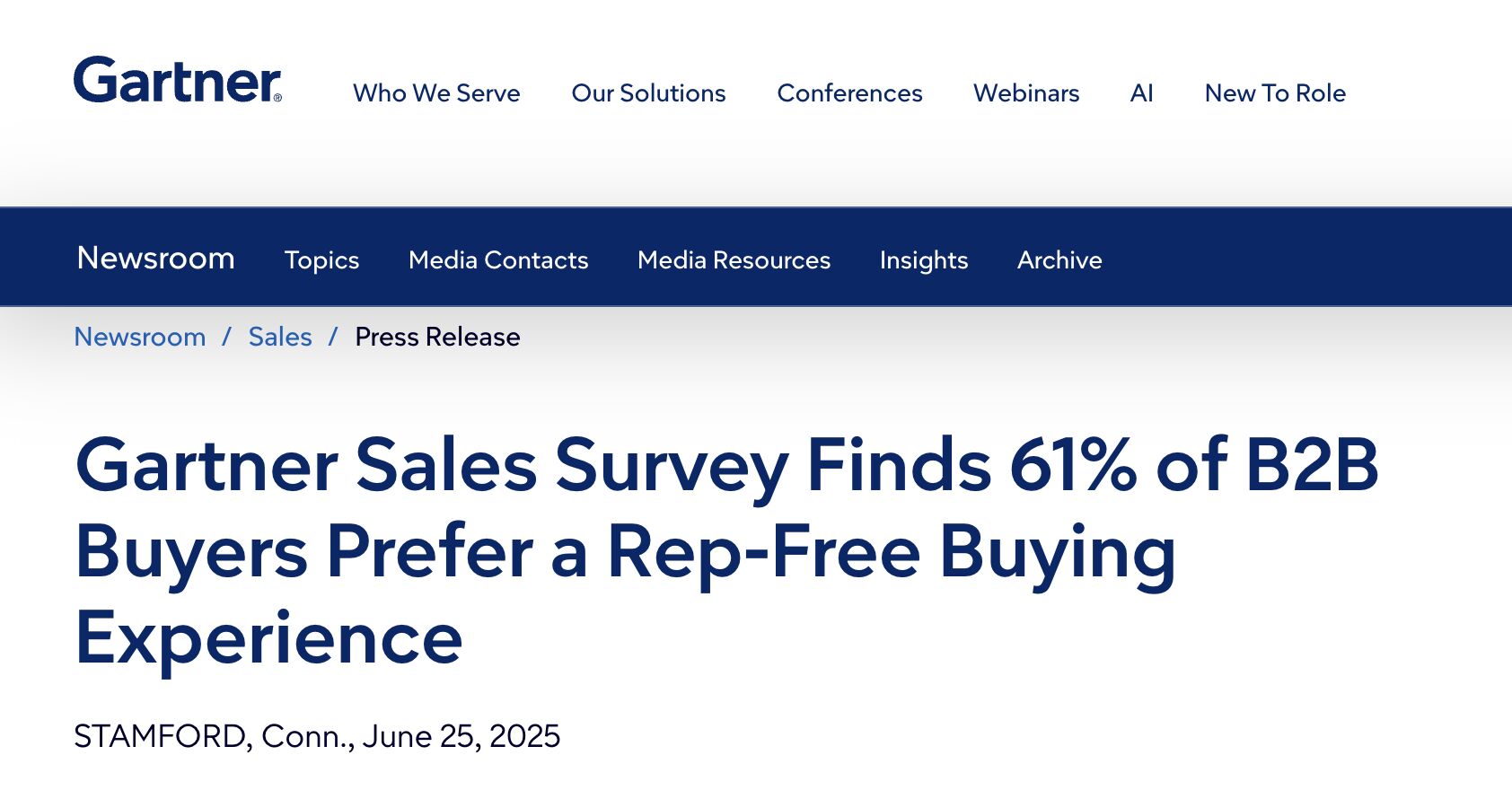
Gartner says companies will spend $2.5 trillion on AI next year, up 47% from 2025. The spending is exploding but the business value isn't.
We're entering a strange period where AI spending is becoming mandatory.
- Every board wants an AI strategy
- Every CEO wants AI initiatives
- Every software vendor is adding AI
Yet very few organizations can draw a straight line between AI investment and business outcomes. I don't think that's because the models aren't good enough. I think it's because most companies are trying to deploy AI into jobs they don't actually understand.
Consider asking a company these workflow questions:
- How does your SDR team work?
- How does customer support work?
- How does recruiting work?
Most can give you a rough answer, but very few can map the workflow, document the decisions, define the knowledge required, identify the tools involved, and explain how success is measured. If you can't explain how the work gets done by a human, why would you expect AI to do it successfully?
It's interesting, the market thinks we're in an AI race, but the more time I spend inside real deployments, the more I wonder if we're actually in an execution race. Intelligence isn't the bottleneck anymore, operationalizing it is. That's why every AI Cloud Employee deployment follows the same foundational framework:
PRISM:
- P = Process: What is the job? Map the workflow exactly as you would for a human employee.
- R = Resources: What tools would a human employee need? If a human needs it, the Cloud Employee probably needs it.
- I = Interaction: How would a top performer communicate? This isn't "how should AI communicate." It's "how would your best employee communicate."
- S = Skills: What would you teach a new hire? Everything a human needs to know a Cloud Employee needs to know.
- M = Metrics: How would you know they're doing a good job? Not AI metrics. Employee metrics tied to the outcomes the job is responsible for producing.
What I've learned from deploying AI is that technology matters. But execution matters as much if not more. The harder challenge is understanding the work well enough to redesign it. AI is forcing organizations to become much more explicit about how work gets done, why it gets done, and how success is measured. That may ultimately be where most of the value is created.
Operationalizing AI requires deep execution at the workflow layer. That is where the margin is heading, especially as the raw intelligence layer starts to eat its own margins in a race to the bottom.
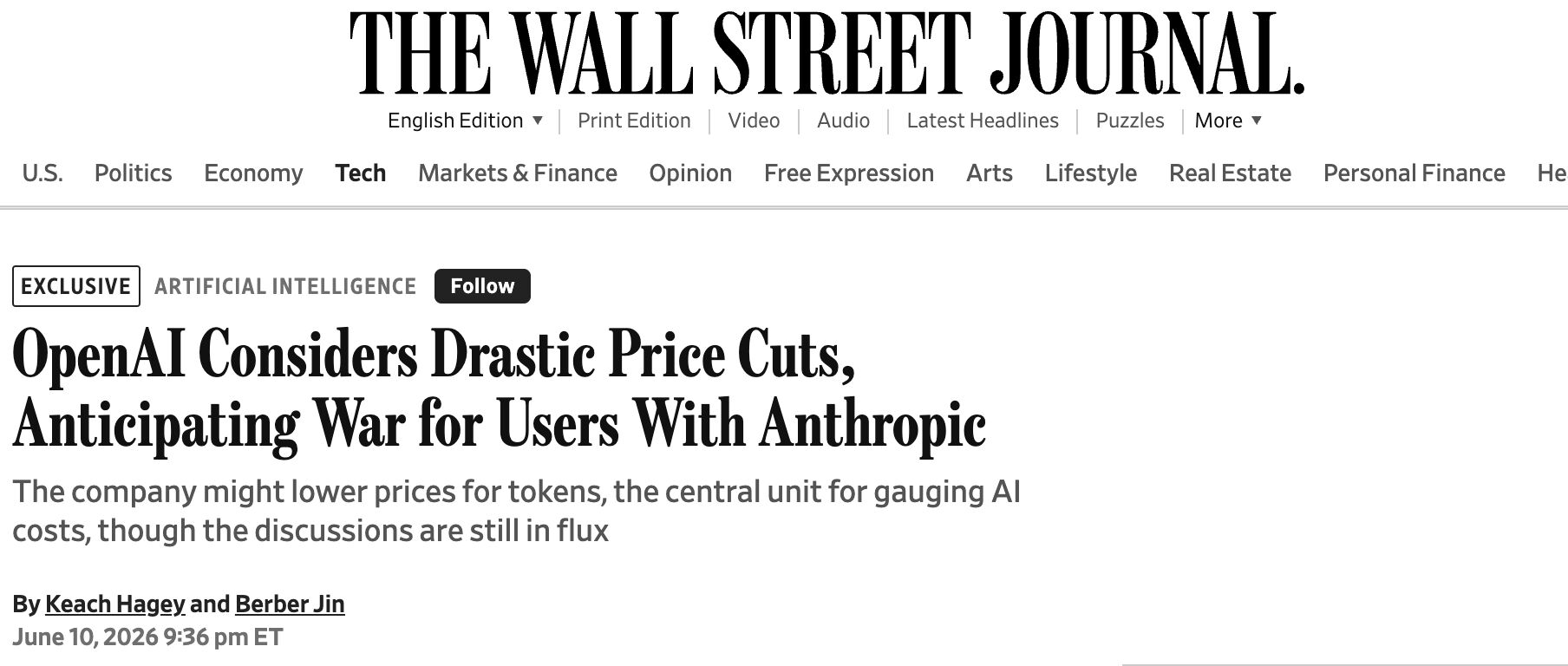
OpenAI just started a token price war over a cut that even hasn't happened yet.
Every board funding AI in 2027 should watch what's happening. The Wall Street Journal reported OpenAI is preparing drastic reductions to its token prices. The reason: it expects Anthropic to cut first, and it wants to get there before they do.
Here is the breakdown:
- Anthropic's revenue surged behind Claude Code passing OpenAI's valuation.
- OpenAI loses $1.22 for every $1 it earns.
- Google dropped its AI subscription to $4.99 a month.
- Uber says they already spent their entire 2026 agentic AI budget.
A lot of people will read it as two rivals fighting for share. I think it is the first crack in the intelligence premium. For two years, the labs had one enterprise pitch: our model is smarter, pay up. A preemptive cut tells every buyer the premium is negotiable. When the market leader drops prices before its rival even moves, model quality is no longer carrying the deal.
Compute, storage, and bandwidth ran this same course. The raw layer got cheap. Then the margin moved to whoever owned the workflow, the relationship, and the renewal. This is why OpenAI hired Colin Fleming out of ServiceNow and Denise Holland Dresser to run revenue. They weren't hired to win benchmarks. They were hired to win renewals.
The best model will not win this. The best go-to-market will.
As model prices plummet, the raw engine becomes a complete commodity. When the technology itself is table stakes, the world's largest tech giants are realizing that building the model matters far less than owning the distribution.
Tim Cook just gave his last keynote as Apple CEO after 15 years and having grown their market cap over 1900% and over $4 trillion.
And the biggest thing he announced was not a product, but a white flag. Apple is reportedly paying Google $1 billion a year to run the new Siri.
Bloomberg says Apple execs knew they were behind. Apple Intelligence launched to bad reviews. The company that built the iPhone couldn't crack a voice assistant. So they stopped trying.
What iOS 27 actually does:
- Users pick their default assistant (ChatGPT, Claude, Gemini, or Grok).
- Google's Gemini runs natively inside Siri.
- Apple gave up building and became a marketplace.
A $3 trillion company made a buy call, not build. Cook handed the CEO title to John Ternus, a hardware guy who led Apple in the M-chip revolution and drove the Vision Pro from prototype to launch. Interestingly, while every big tech company is racing to build models, Apple chose a successor who builds physical things. Clearly, Apple thinks its moat is devices, chips, and a supply chain with distribution into 2 billion active devices.
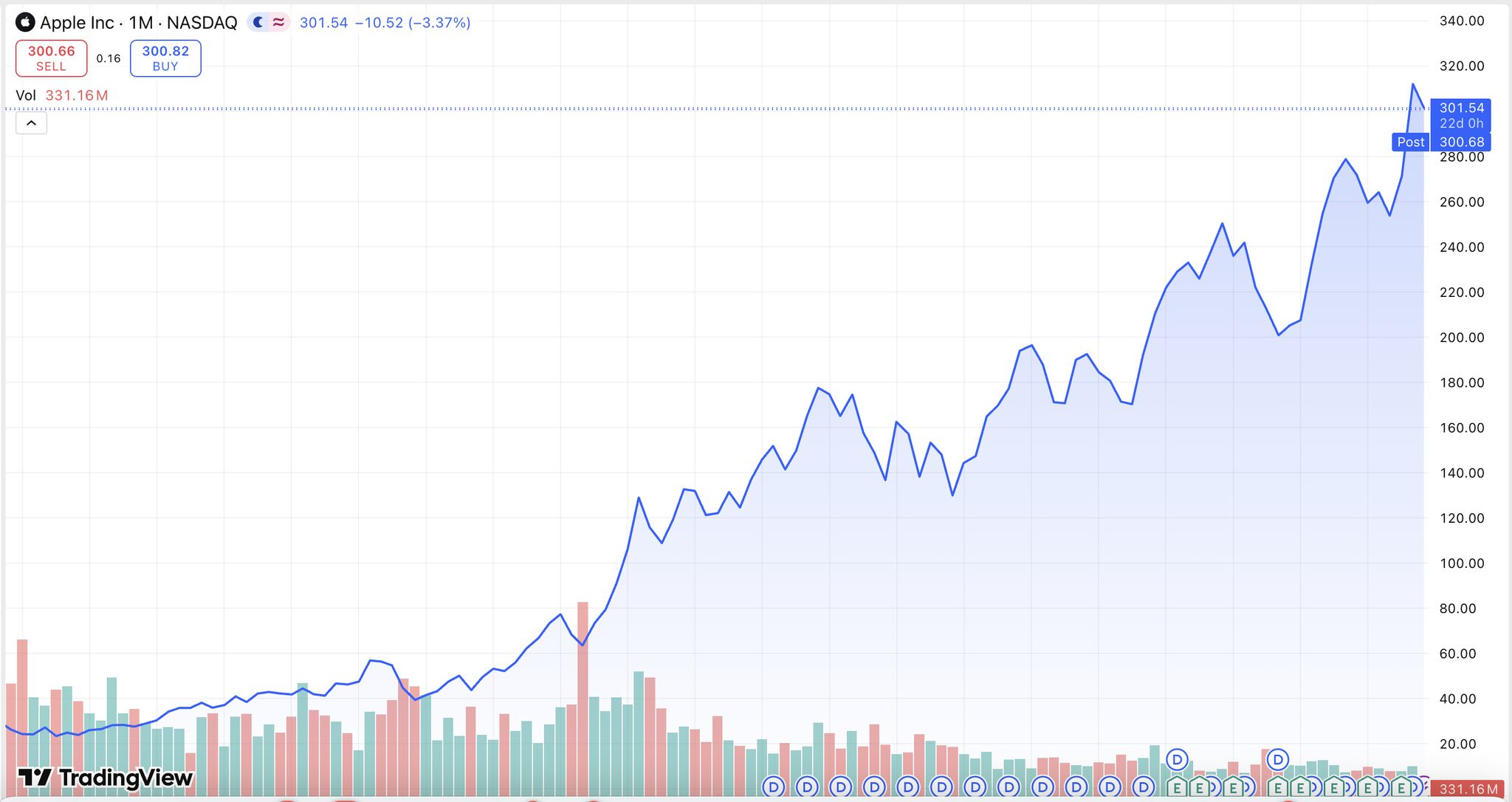
In this concession, there were several clear wins:
- Google got $1B/year and controls the intelligence layer.
- OpenAI, Anthropic, and xAI landed default spots on every iPhone.
- Apple keeps the margin and the customer.
Siri lost. Apple didn't. Cook didn't go out with a product launch. He went out with the biggest buy vs. build signal in tech. The AI engine is going commodity. Distribution never will.
Apple proved that distribution is an unshakeable moat. But while Apple is winning by controlling the end consumer device, another giant is playing a completely different game: winning by controlling the entire physical and digital supply chain from orbit to the earth.
SpaceX just raised $75B in the biggest IPO in history, and it lost $4.9B last year.
SpaceX just raised $75B in the biggest IPO in history, and it lost $4.9B last year.
The Debut:
- Priced at $135, opened at $150, and touched $176 by afternoon
- $75B raised (2.5x Saudi Aramco's record)
- $2 trillion market cap at the open, making it the 6th most valuable company in America
The Fundamentals:
- $18.7B in revenue
- $4.9B net loss
- $41.3B in accumulated losses since 2002
- STARLINK is the only division making money
The IPO prospectus claims a $28.5 trillion market. NYU's Aswath Damodaran said the number looked like Grok wrote it, called it "a hallucination," and capped his own bull case at $1.3 trillion. The market read the same filing and paid $2 trillion anyway.
Two days ago, Wall Street punished Oracle for guiding $70B of AI data center capex. The stock dropped 8.5%. Today the same investors handed Elon Musk $75B to build data centers in orbit.
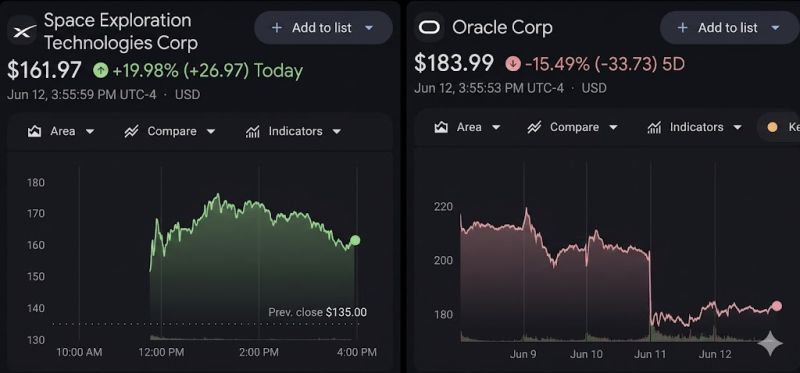
Same week. Same spend. Opposite verdicts.
Oracle rents GPUs and competes for customers. SpaceX owns the rockets, the satellites, the network, and after absorbing xAI, the models. One company buys from the supply chain. The other is the supply chain.
OpenAI and Anthropic filed to go public last week. They watched today's tape closer than anyone. The market doesn't price what you earn. It prices what you control.
The Macro View: The AI budget is no longer a strategy question. It's a capital allocation question.
The companies winning right now aren't the ones with the best models. They're the ones who figured out what they actually own, the distribution, supply chain and workflows. The intelligence layer is becoming a utility. What sits above it and below it is where the value is going.
For business leaders the decision in front of you isn't build vs buy anymore. It's own vs rent. And the window to answer that is getting shorter every week.
