
This week didn't feel like three separate AI stories. It felt like three chapters of the same one.
- monday.com cut 20% of its workforce while still growing more than 20%, showing that AI is forcing companies to redesign how they're organized, not just adopt new software.
- Reddit, Inc. challenged Google's AI licensing model, signaling that the economics of content and distribution are being renegotiated in the AI era.
- A record number of Americans are starting businesses, with AI helping founders build companies that would have required entire teams just a few years ago.
- Stripe may pay $10 billion for OpenRouter, a three-year-old company that gives developers one place to access hundreds of AI models. The company that once made incumbents look slow may now buy its way into the next platform shift.
Here is what gets me. Every one of these stories is about a company deciding that the old way is no longer fast enough.
Monday decided the organization built for its last chapter would not work for the next one. Reddit decided traffic may no longer be a fair exchange for its content. Founders decided they do not need to wait for a team before building. Stripe may decide that spending $10 billion is faster than trying to catch up internally.
For the last twenty years, software companies scaled by adding people, relying on established distribution, and building most of their strategic capabilities themselves.
That playbook is starting to break.
The AI story is no longer just about better models or new products. It is about what companies cut, what they protect, what they buy, and what they no longer need to build the old way.
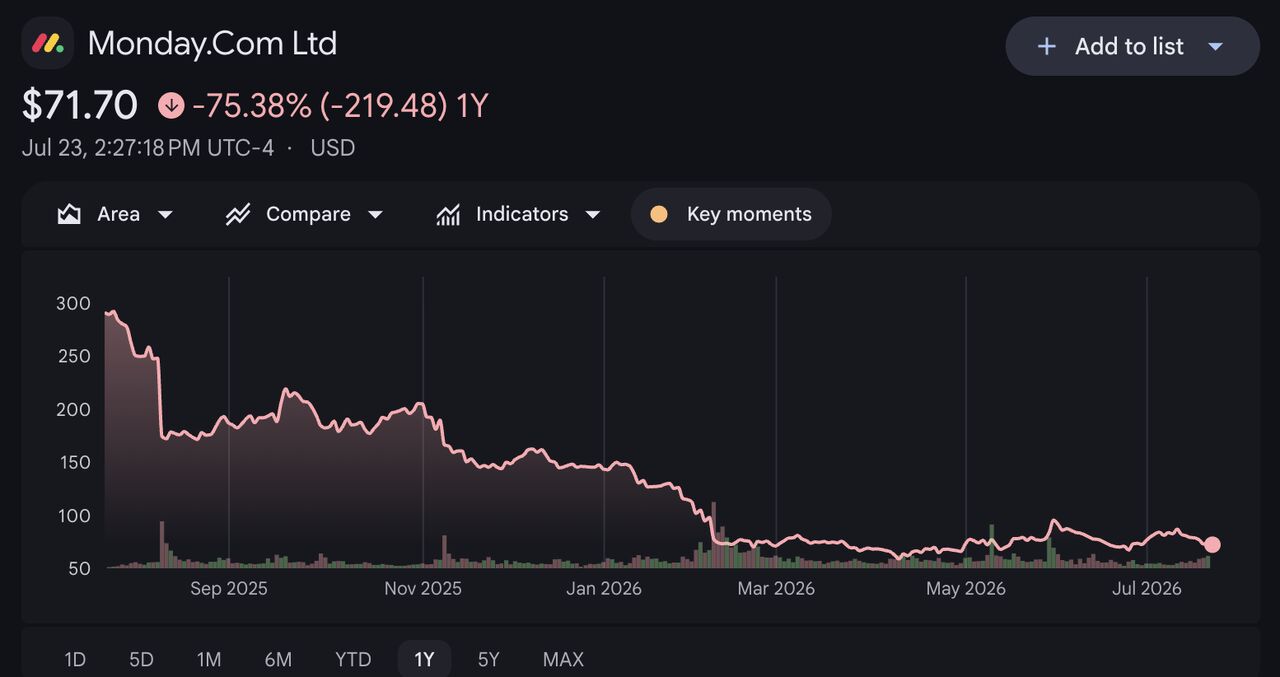
Monday.com grew revenue 25% last quarter. This week it cut 620 people
20% of the company, ... and the stock closed up on the day. Up 1.5%, and it broke a 6 day losing streak. It is giving some back today with the rest of tech, but a 20% cut did not scare anyone.
From the filing and the founders' memo:
- 620 roles and $55M in one-time costs
- Operating margin guidance raised from 13% to 15%
- Revenue guidance held at 20% growth
- Fewer management layers, smaller autonomous teams, an "AI Work Platform" where agents do the work instead of tracking it
"The organization we built for our previous chapter is not the organization that fits the new AI era."
Those are the founders' words from their memo to employees.
monday.com has lost roughly $11 billion in market value over the past 12 months, even while growing revenue more than 20%. Two weeks ago it was HubSpot, down 65% in a year while growing over 20% and raising guidance.
This is the same story across legacy SaaS. The disruption is not only the technology. The company org structure itself is being disrupted, and what replaces it is the new autonomous organization: small teams, few layers, agents doing the work. The cut is monday.com's attempt to get there, and the market recognized it.
I have been writing about the autonomous organization move for the past year. We say it early with Block, Spotify, Meta, Coinbase, GitLab, Shopify, etc. monday.com is the latest to attempt it, ... this time in an SEC filing.
This enterprise restructuring isn't happening in a vacuum. While software companies rewrite their internal org charts, the external distribution and data economics that powered SaaS for a decade are being completely redrawn.
Reddit, Inc. may walk away from its $60M AI deal with Google
It sank the stock nearly 9%, erasing $3 billion in market value. The Wall Street Journal reported that Reddit is weighing whether to block Google's AI from its content as their 2024 partnership comes up for renewal.
The contract is about 2.4% of Reddit's $2.47B trailing revenue. The obvious take is that Reddit is risking its biggest traffic source. But, I think they realized the real value of their content.
Two years ago, Google agreed to pay $60M a year for Reddit's posts. Reddit thinks AI answers make them worth far more now:
- Reddit wants to swap the flat fee for a meter: Google pays based on how often Reddit content shows up in its AI answers
- With an AI summary, only 8% of Google visits end in a click vs 15% without
- Google traffic decline: USA TODAY down 18%, POLITICO down 20%, Business Insider down 31%
- Reuters, The Economist, and People Inc. are reportedly weighing blocks too
Google's trite answer: "AI search features send billions of clicks to the web every week."
But there is a fundamental shift happening. The old deal was simple: give Google your content, get clicks back. Now AI answers kill the clicks, ... HubSpot alone lost 140M visits. So wisely Reddit wants to participate in the AI cash machine instead.
The world is splitting into content creators and content consumers. The economics are being redrawn. This Reddit/Google negation is one of the first content value pricing test of the AI era.
While companies restructure and fight over content value, a new class of builders isn't waiting around to join a legacy org chart or rely on old distribution models. They are building AI-native companies from day one.
Stripe just got rejected by PayPal on a $53B offer
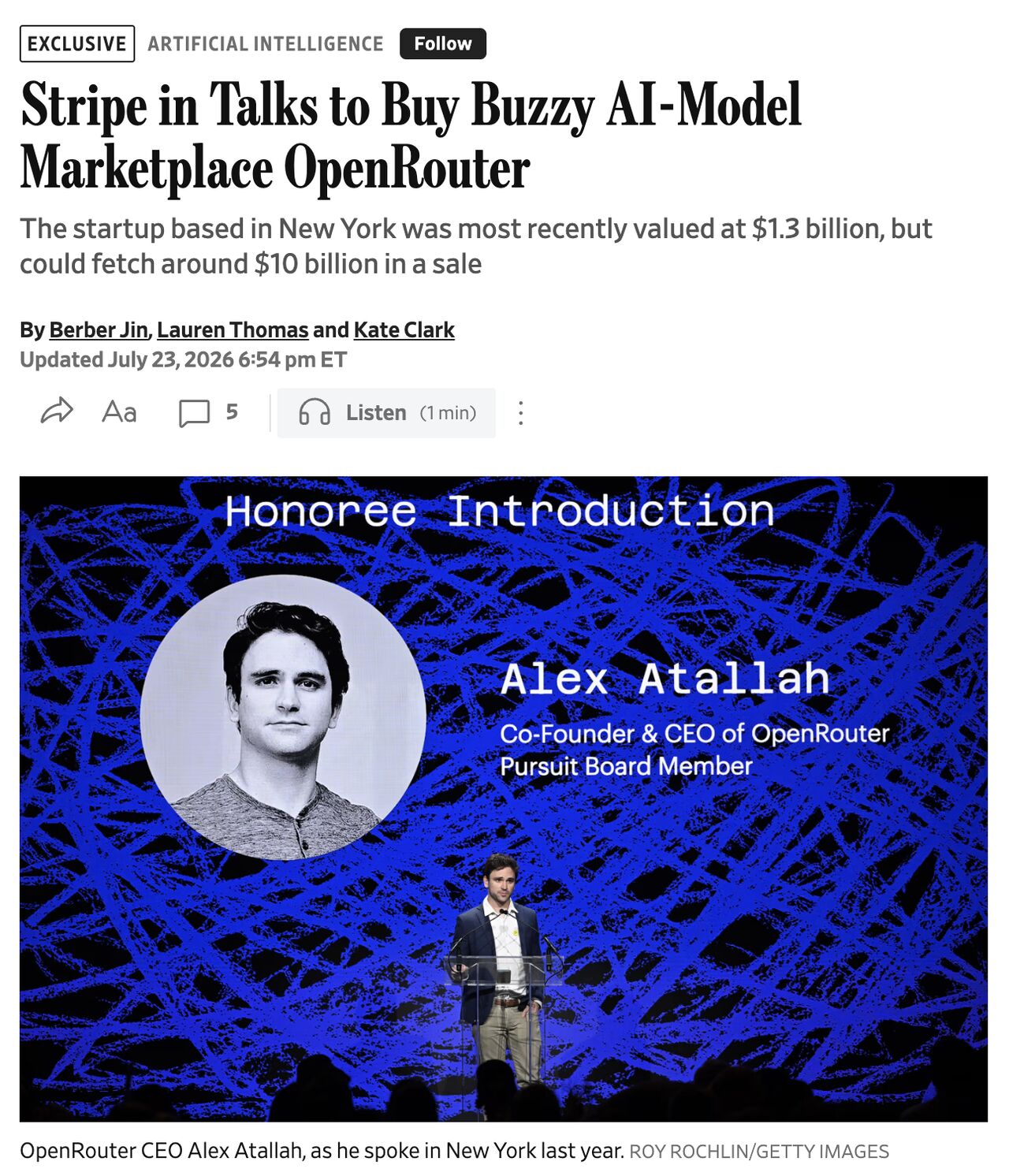
This week The Wall Street Journal reported its next target, ... a 3-year-old side project it may buy for about $10B.
The startup is OpenRouter. Alex Atallah, who co-founded OpenSea, built it in 2023. It is one API sitting in front of 400+ models from OpenAI, Anthropic, Google, and XAI. Developers use it to compare prices and switch models with one line of code.
The two sides of this deal:
Stripe:
- Valued at $159B earlier this year
- Rejected by PayPal's board last week
- Already processes OpenRouter's payments
OpenRouter:
- Raised at $1.3B eight weeks ago led by Alphabet Inc.'s fund CapitalG
- 25T tokens routed every week, up 5x in six months
- More than 5M developers
The WSJ says the talks could still fall apart or draw another buyer. And $10B would be a 7.7x jump in 58 days.
The interesting thing to me isn't the transaction, but the pattern we are seeing.
We keep watching this same play. Salesforce claimed Agentforce did it all, then paid $3.6B for Intercom to get Fin. Zoom owned the sales meeting itself, and still had to buy Common Room to understand the buyer. Now Stripe may pay $10 billion for its AI pivot instead of building it.
First you insist you are already an AI company. Then you buy one.
Stripe was the startup that made the incumbents look slow in 2010. Sixteen years later, it is the incumbent writing the check.
While companies restructure and fight over content value, a new class of builders isn't waiting around to join a legacy org chart or rely on old distribution models. They are building AI-native companies from day one.
Americans set an all-time record for starting new business last year
5.6M. This year is running 17% ahead of that pace. The strange part is that Pew Research Center says half of Americans are more concerned than excited about AI. Just 10% say the opposite.
Now look at who is filing:
- Nasdaq: solo-founder applications up 20%+ since early 2025 while multi-employee filings stayed flat.
- Nearly half the growth came from the highest AI-adoption sectors.
- Stripe: 2X as many solopreneurs cleared $1M in 2025 as in 2023.
- New businesses hit $1M in year one at 3x the 2019 rate. France, Finland, and Australia show the same curve.
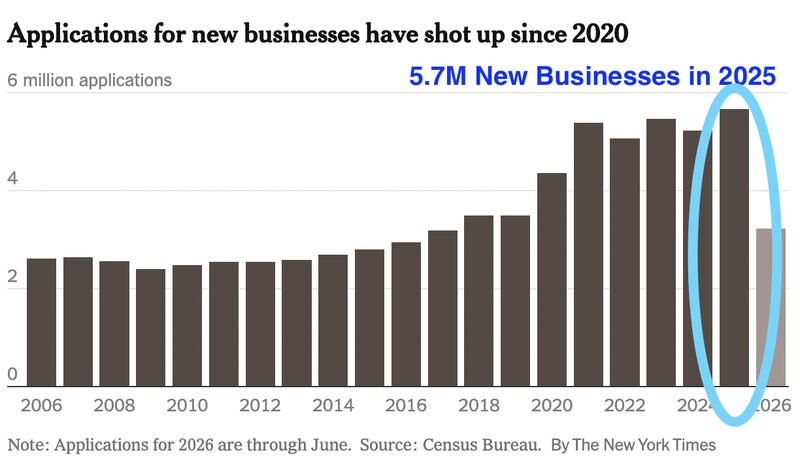
Nasdaq's chief economist calls it "a meaningful signal for where AI's economic impact may show up first."
Here is what gets me. Only 1 in 10 new businesses ever hires an employee, and never hiring was always considered failure. But in the last six months I've met founder after founder building alone what took a small team in 2023. None of them skipped the hire because they failed. They just didn't need it.
Everyone keeps scoring AI by the jobs it takes. I think 5.6M new business filings are Americans deciding not to wait around, ... they are filing for independence.
There is a lot of fear out there. The numbers say people are building anyway. What are you seeing, ... which hires are founders skipping: engineering, marketing, sales, or ops?
The Marco View
AI is collapsing the cost of execution, but it is not making everything cheaper.
Coordination-heavy organizations are becoming harder to justify. Proprietary data and content are becoming more valuable. And small teams can now build businesses that once required millions in capital and dozens of employees.
That changes what leaders should protect, what they should stop paying for, and where they should place their next bet.
The biggest risk is not moving too slowly on AI. It is continuing to allocate people, capital, and attention as if the economics of the business have not already changed.
