

The era of AI experimentation is over. We have entered a period of brutal, high-stakes repricing for the entire global economy. This isn't just about better chatbots or faster code: it is a change in how value is created, how labor is priced, and how software is delivered. While most companies are still stuck in executive theater and endless meetings about strategy, the market has already moved. From the $5 trillion milestone of NVIDIA to the collapse of the per-seat model, the old rules of SaaS and GTM are being dismantled by those who actually build. This is the industrialization phase of intelligence.
In this issue of Autonomous, we break down:
- Market Repricing: NVIDIA’s $5T milestone signals a massive AI recovery, not a bubble. It is a fundamental revaluation of the global economy based on compute and digital labor.
- Death of the Seat: Legacy SaaS pricing is broken. Giants like HubSpot and Atlassian are pivoting to charge for work performed rather than user access.
- Capex Realities: The Google-Meta earnings gap reveals that renting infrastructure is a guaranteed win today, while monetizing consumer usage remains a future-facing bet.
- Workflow Capture: Microsoft turned an $11B startup into a Word feature. This proves that owning distribution is the ultimate weapon against innovation.
- Physical Evolution: OpenAI is building hardware to kill the App Store. This is a direct attack on the $1.3 trillion market to own the physical interface between humans and agents.
Everything begins with where the capital is flowing. This is not just a tech trend: it is a global economic shift that is redefining the value of software and labor.
To understand this, you have to look at the sheer volume of capital moving through the system.
NVIDIA just crossed $5 trillion.
And people are still debating whether AI is real.
The S&P 500 has erased the Iran War drawdown and is back at record highs. But this is not a normal market recovery. It is an AI recovery.
The Wall Street Journal reported that of the 82 stocks up more than 10%, almost all are tied to AI. Without the Mag 7 plus Broadcom, the S&P 500 is still down year to date. That is the entire story.
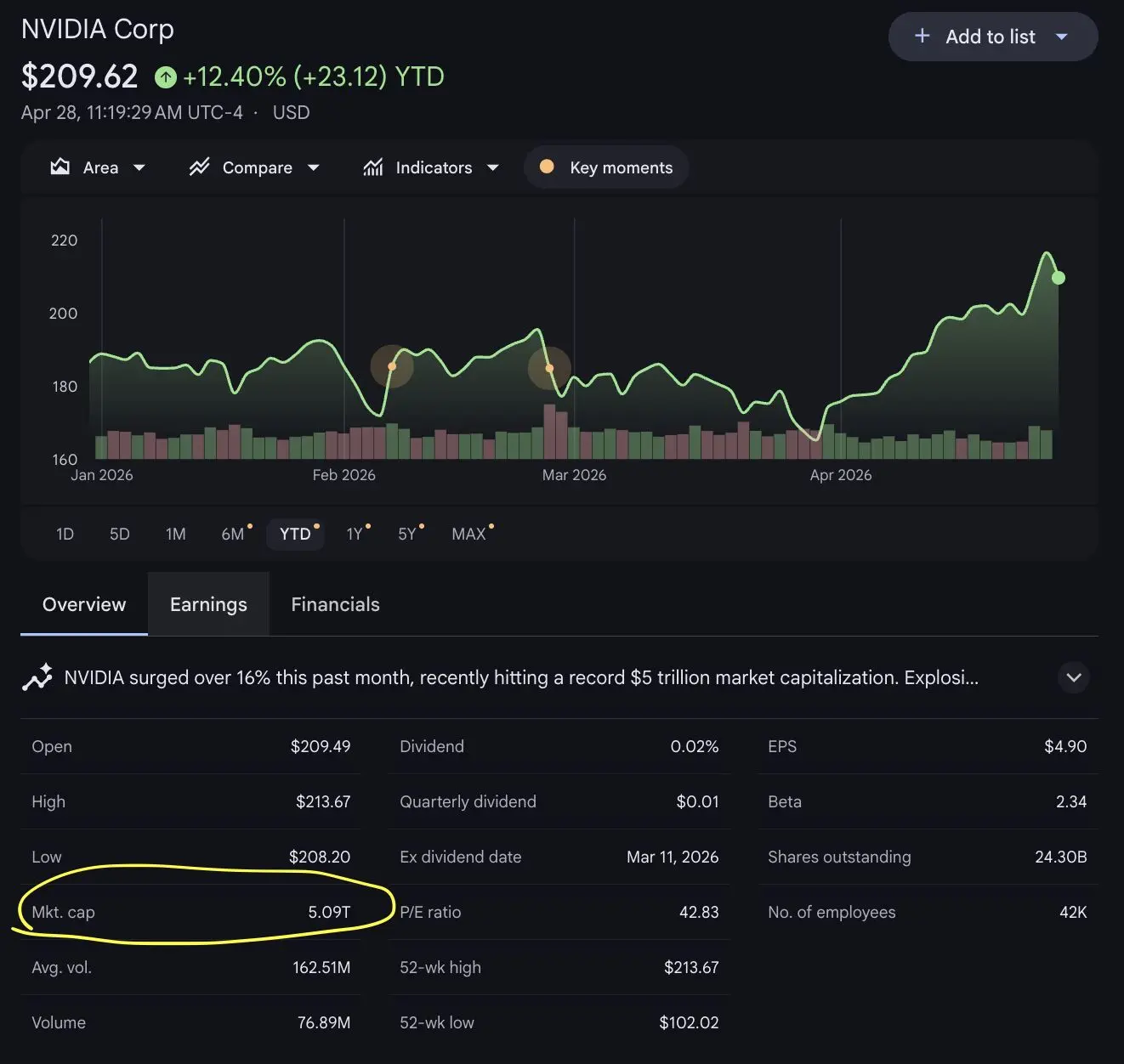
AI is not just lifting tech stocks. It is carrying the entire market. Even Cisco, the company everyone uses as the cautionary tale from the dot-com bubble, finally hit a new all-time high after 26 years.
Why? Data center demand.
The punchline is incredible. The old symbol of internet excess is now being resurrected by AI infrastructure. That is why the “bubble” conversation feels too simplistic. The dot-com bubble was built on future promises.
The AI buildout is being built on actual capex, actual chips, actual power, actual data centers, actual enterprise demand, and actual earnings. NVIDIA becoming the first $5 trillion company is not just a stock market milestone. It is a market signal.
Capital is moving toward the companies building the next operating layer of the global economy:
- Compute.
- Data centers.
- Networking.
- Power.
- Memory.
- Agents.
- Automation.
- Digital labor.
Each of these bullets are entire sectors of our economy that are booming. Everyone keeps asking: “What if AI is a bubble?”
What if it isn’t?
Because if AI is not a bubble, then this is not the end of the cycle. It is the beginning of a much larger repricing. Not of software. Not of semiconductors. Of the entire economy.
When the underlying infrastructure is revalued this aggressively, the way we charge for the software sitting on top of it has to change.
Collapse of the SaaS Seat Model
Public SaaS companies continue to show the per-seat pricing model is dead. Atlassian and HubSpot are actively abandoning flat-fee AI subscriptions.
They are replacing them with credit-metered, outcome-based pricing. And in no uncertain terms, they are being forced to make these changes with their stock prices in the ditch (HubSpot down 44% and Atlassian down 55%)
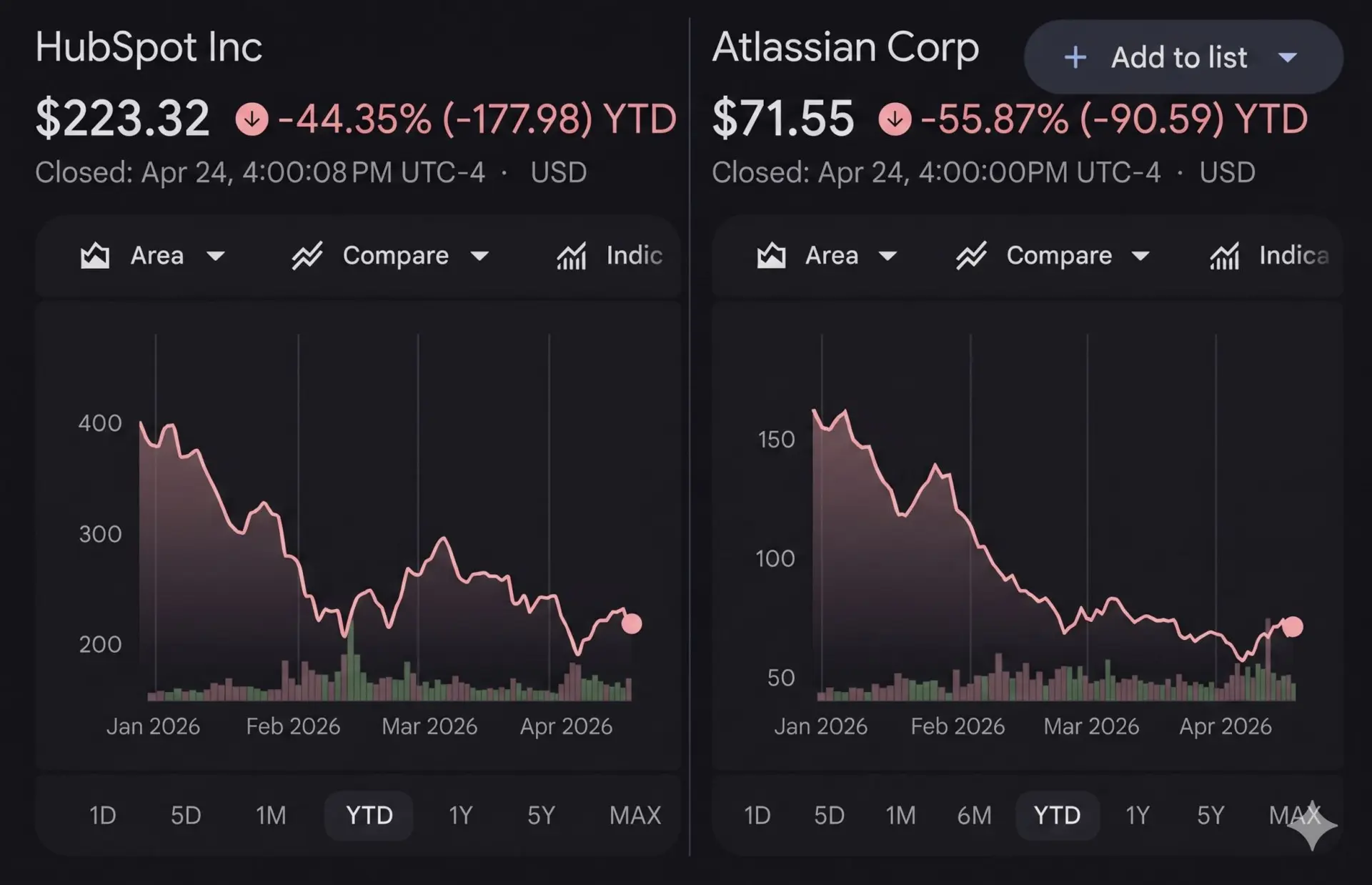
But, this matters beyond two companies updating their pricing pages.
This is the public SaaS market admitting that AI has fundamentally breaks their legacy pricing model (even though they publicly deny the AI disruption).
For a decade, traditional SaaS worked because marginal usage was basically free. You paid for a seat. Whether a user clicked 10 times or 10,000 times, the vendor's cost was near zero. AI is different. Every agentic action, model calls, reasoning loops, context windows, retrieval, all have a real compute cost.
Under a flat AI fee model, the customer who gets the most value quickly becomes your least profitable account. That is why the market is scrambling to shift from "Pay us for access" to "Pay us for work performed."
Look at the whiplash we are seeing right now:
- HubSpot is charging for tasks completed via Breeze AI credits.
- Atlassian is metering Rovo AI usage in pooled credits with overage billing.
- Salesforce is experimenting with "headless" Agentforce access without human licenses.
- ServiceNow is openly touting non-seat revenue.
This is a massive shift. Nearly 80 of the top 500 SaaS companies have already started charging for AI usage, more than double the figure from last year.
When AI agents replace human software usage, the old growth math, more employees equals more seats equals more ARR, stops making sense.
The core unit of SaaS value is no longer the user. It is the work.
Pricing for work requires a factory to produce that work, which is why the infrastructure landlords are currently pulling ahead of the tenants.
Wall Street Declared Google as the AI Winner
Google, Amazon, Microsoft and Meta all beat earnings and Wall Street picked its clear AI winner...Google... and NOT Meta.
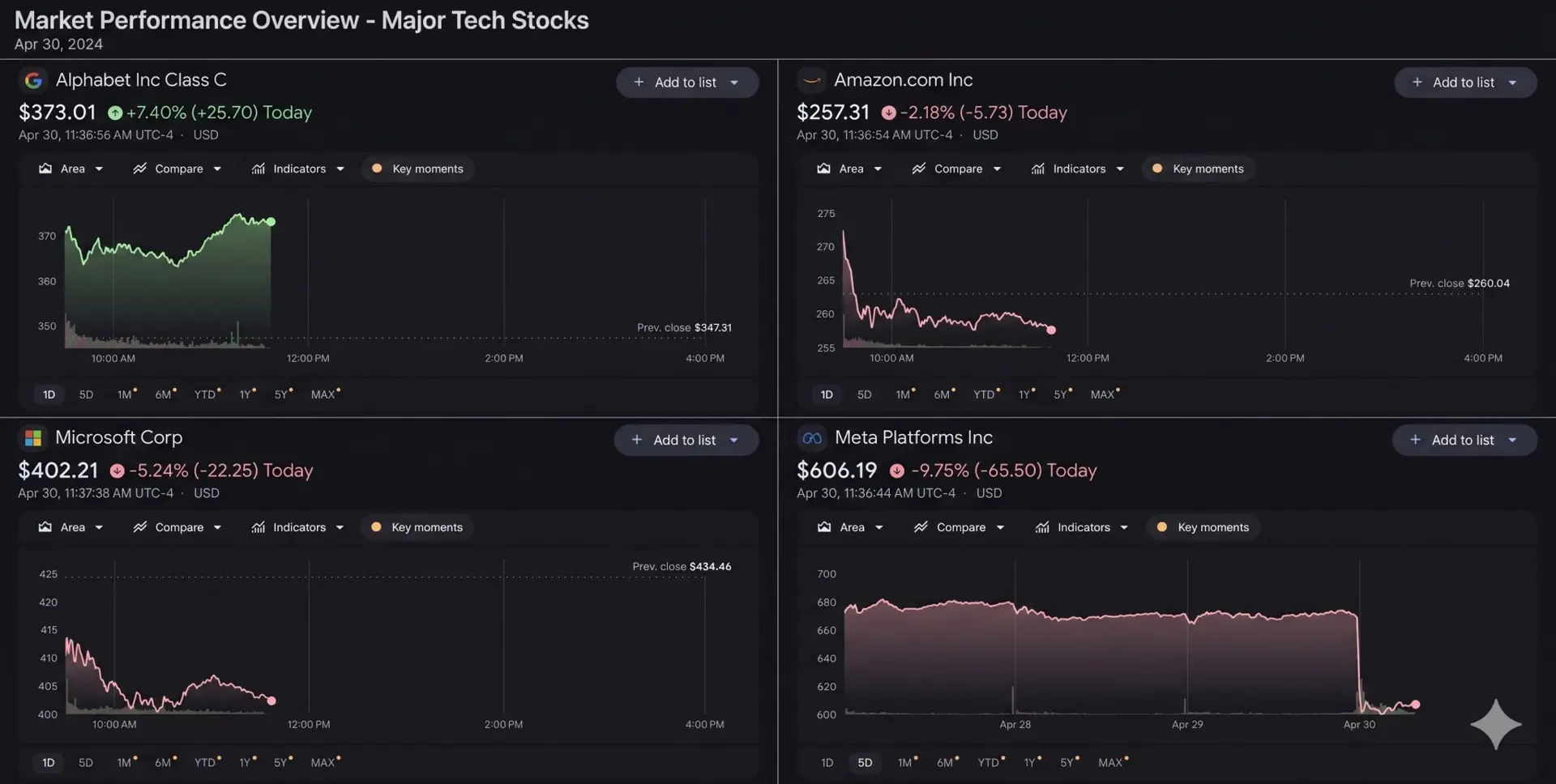
Both companies are spending staggering amounts on AI infrastructure.
- Google raised its 2026 capex guidance to $190B.
- Meta raised its 2026 capex guidance to $145B.
But investors treated them completely differently. Google got rewarded. Meta got hit.
Why? Google can monetize AI infrastructure directly. Meta cannot.
Google Cloud grew a staggering 63% to $20B in the quarter and its backlog nearly doubled to more than $460B. Google is not just building AI for its own products. It is selling AI infrastructure to the rest of the world.
- More data centers means more AI capacity.
- More AI capacity means more enterprise demand.
- More enterprise demand means more cloud revenue.
Google is charging rent on the AI boom. Meta is in a harder position. They are spending like a hyperscaler, but monetizing like an advertising company.
This is the key difference.
Yes, Meta’s core business is still strong.
- Revenue grew 33%.
- Ad impressions were up 19%.
- Average price per ad was up 12%.
But investors are asking a different question: Where is the direct AI revenue engine?
Meta’s answer is still future-facing: Better ads, Better engagement, AI agents, Smart glasses, Consumer AI. This all might work, but it might not.
Google Cloud is value today. They won this round because it is not just spending on AI. It is monetizing compute. Meta lost this round because it is still trying to prove a return.
Owning the compute is the foundation, but owning the specific workflow where users spend their day is how you weaponize that power against competitors.
Microsoft turned an $11B startup into a Word feature
Microsoft just turned an $11 billion startup into a Word feature. In March, Harvey raised at an $11B valuation on a massive bet: that legal AI is its own distinct platform.
Big firms happily paid $1,200 a month per seat because it was the only tool that worked.
This week, Microsoft blew that bet wide open. They officially stapled an AI legal agent directly inside Microsoft Word. It's a $30/seat Copilot subscription that law firms already pay for.
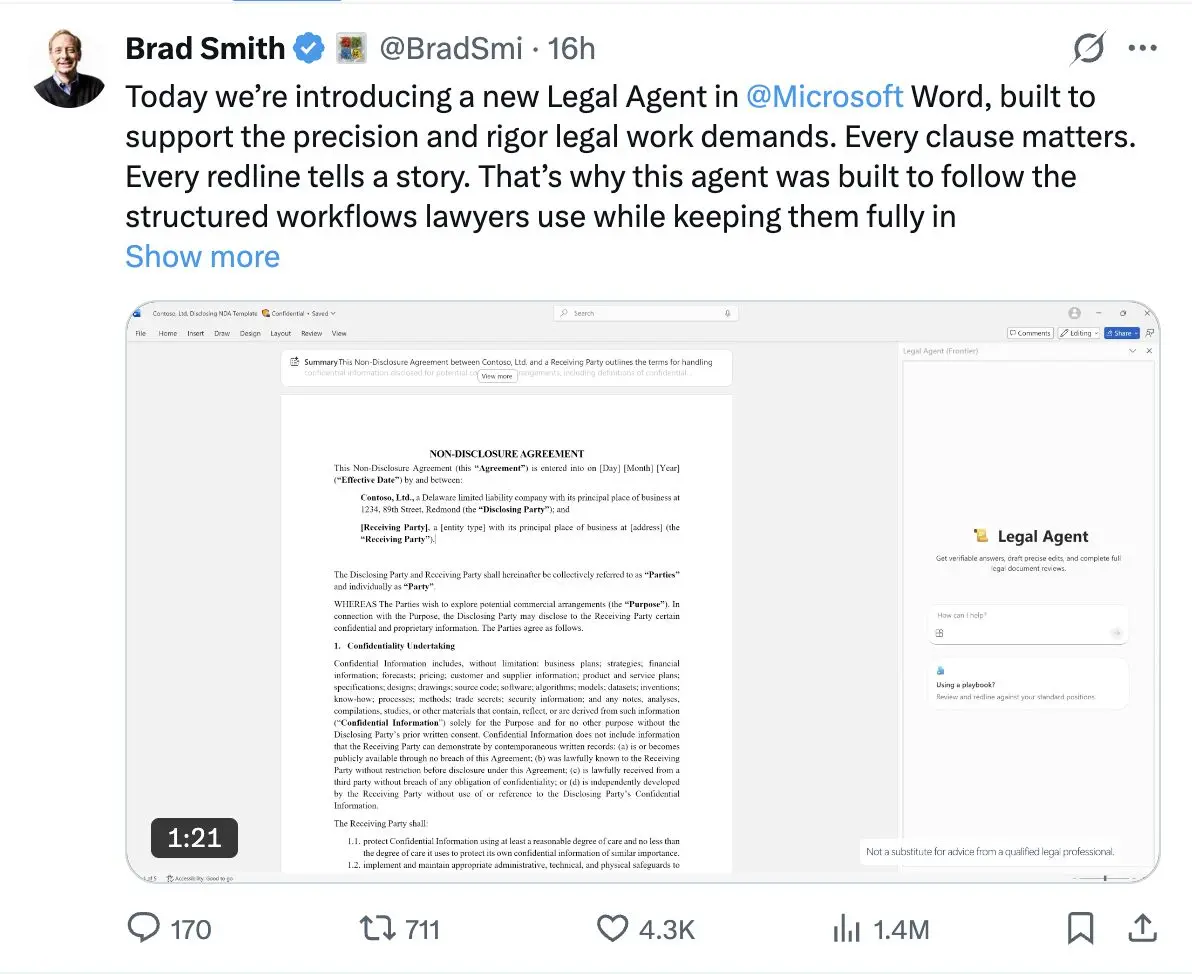
Same interface every lawyer already drafts in. Same .docx that gets sent and redlined. No second login. No procurement cycle. The price gap? Roughly 40x.
Distribution was always the constraint in legal tech. Lawyers don't switch tools. Whichever AI lives natively inside that .docx file wins the default workflow, and Microsoft just walked through the door uncontested.
The irony is that Microsoft built this with legal AI talent from Robin AI, a startup that recently went under. The expertise that struggled to survive as a standalone company became far more dangerous once plugged into Microsoft’s distribution machine.
Harvey still has a real moat in complex $1,500/hour litigation. But the millions of everyday lawyers drafting NDAs and redlining vendor contracts? Microsoft just claimed them.
Harvey's $11B valuation pays out only if legal AI work moves into their interface. But Microsoft already owns the industry interface.
Even if you own the desktop workflow, the ultimate threat is a total bypass of the screen as intelligence moves into the physical world.
OpenAI Declared War on Apps
OpenAI just declared war on the App Store. TechCrunch just leaked that OpenAI is building an AI-native phone where agents replace apps.
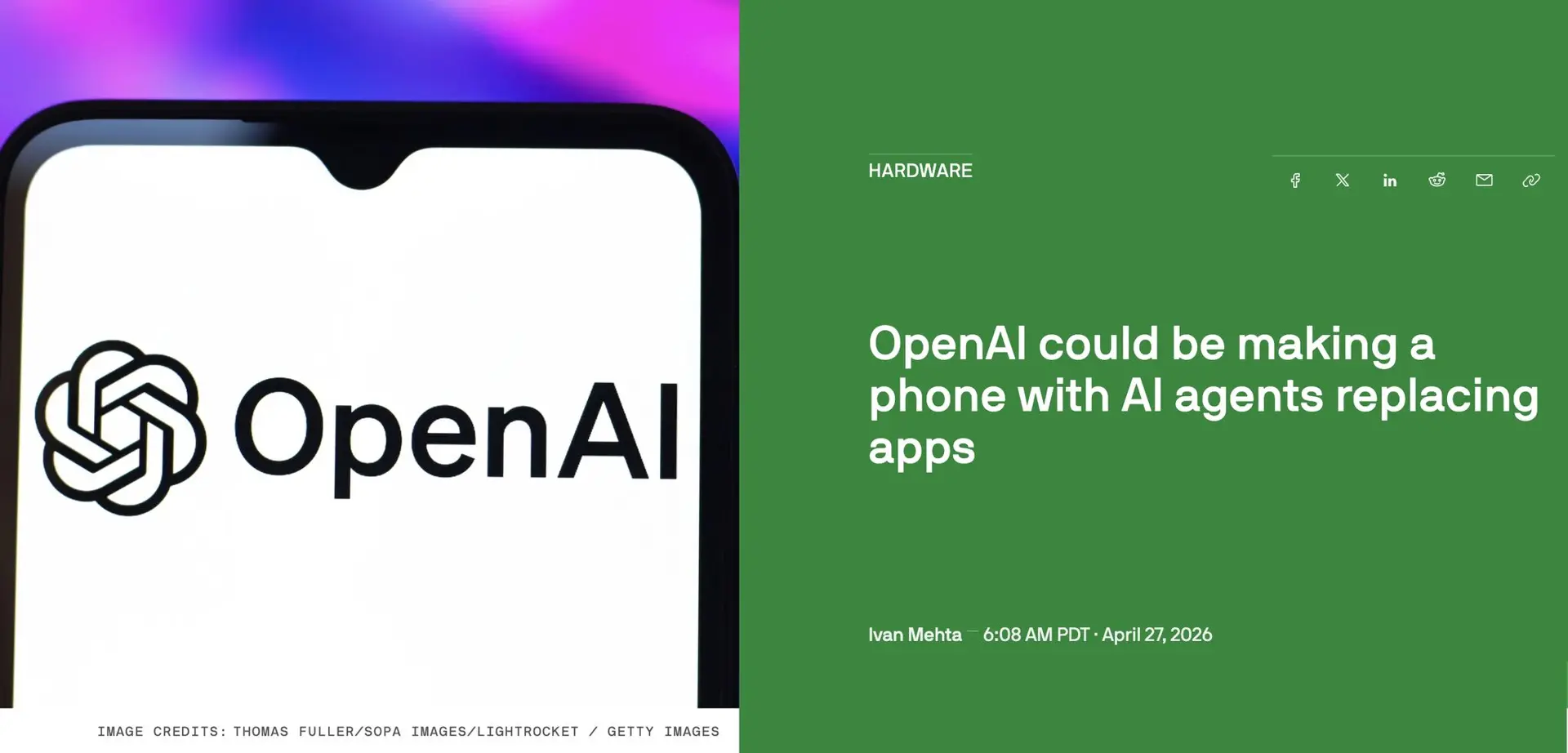
That sounds like a phone story. It is not. It’s a direct attack on the $1.3 trillion app economy.
For the last 15 years, Apple and Google controlled the front door to the internet.
- Apps were the interface.
- The App Store was the distribution layer.
- The screen was the operating system.
That era is ending. OpenAI now has nearly 1 billion weekly ChatGPT users that they want to convert into physical AI endpoints. It is the entire reason they spent $6.5 billion to acquire Jony Ive’s io startup (Apple's former industrial design wizard).
Meta’s Ray-Ban are already proving that AI is moving to our faces.
Just last week, Apple's new CEO John Ternus, just announced 10 new physical AI products including:
- AI Glasses
- Smart Home Hub
- Tabletop Robot
- AI AirPods
- AI Pendant
- Augmented Reality Glasses
This is not a gadget trend. It is the beginning of the Physical AI Era. The real shift here is that AI is moving from software you open to intelligence that surrounds you.
- Your phone.
- Your glasses.
- Your earbuds.
- Your car.
- Your home.
Every surface becomes an interface for agents. Instead of using Apps that were built for people staring at screens. Agents will be built for people living their lives.
Even here at Atonom we will be introducing our Physical AI device in June that will give you anytime access to your Cloud Assistants and Employees.
The next platform war will not be about who owns the best model. It will be about who owns the interface between humans and the physical world.
The Macro View: When you look at these five shifts together, the picture is clear: we are swapping out the operating system of the global economy. In the old world, growth was linear and tied to headcount. In this new world, growth is agentic and tied to compute.
If you are a leader or an operator, your survival depends on how quickly you internalize three realities:
- Charge for work, not seats. Selling access while paying for compute is a losing trade. Pivot to outcome-based pricing now to protect your margins.
- Own the native interface. Microsoft proves that a better model loses to a native workflow. Control the window where work happens or face commoditization.
- Monetize the infrastructure. Renting the factory is the safest play. Reorganize your company so AI performs high-volume labor, removing human bottlenecks.
The trillion-dollar infrastructure is being laid down as we speak. The game has moved from "what can the model do" to "how much work can the agent execute."
The shift is violent and it is happening in real time. Stop the executive theater. Focus on the builders.
Until next week…
