
For a long time, software got paid for being busy. If a product created more steps, more dashboards, more reviews, it felt valuable. If it justified headcount and process, it stuck around. Nobody asked too many questions as long as the system looked active and the numbers kept moving.
That’s starting to break.
Not because AI is flashy, but because it’s cheap at the exact things we used to staff for. Moving information. Reconciling records. Making sure the next step happened. The kind of work that never showed up as strategy but quietly consumed time and money everywhere.
You can see the effects without looking at a model release. In how long deals take now. In which SaaS categories are getting pressure. In why security and responsibility come up earlier than features in buying conversations.
This isn’t about smarter tools. It’s about software no longer being paid to organize people. And once that changes, the economics of a lot of businesses start to look very different.
AI Impact on Big Pharma
Big Pharma didn’t use AI to invent miracle drugs. They used it to kill paperwork.

Drug development wasn’t stuck because the science was broken. It was buried under coordination work that had nothing to do with discovery.
- Weeks lost to site selection
- Months spent reconciling regulatory documents across countries
- Enrollment delays
- Reporting churn that swallowed entire teams
None of it made a better drug. It just stretched timelines and burned capital. So that’s where AI went first. Not into the science. Into the waiting.
One company took a trial setup that usually drags on for six weeks and finished it in a single two-hour meeting. Nothing about the science changed.
That pattern should feel familiar. AI’s first real impact isn’t creativity. It’s eliminating the coordination tax we’ve been calling “work” for decades.
You see it everywhere:
- Sales teams stuck in handoffs and follow-ups.
- Support buried in queues and routing.
- Hiring slowed by scheduling and screening.
- Finance buried under reconciliation.
- Software teams shipping tools to manage work that shouldn’t exist.
The expertise was never the bottleneck. The process around it was. Pharma didn’t debate that. They didn’t rename it. They just removed pieces that weren’t earning their keep.
A lot of software companies are still selling tools that make these layers easier to operate, instead of asking why they’re there at all. That’s been a comfortable business for a long time. It’s starting to look less comfortable now.
The Market is Rethinking Software
ServiceNow is down 50% in a year. Read that again.
- This is after beating earnings.
- After buybacks.
- After doing everything CNBC tells CEOs to do.
Still wrecked.
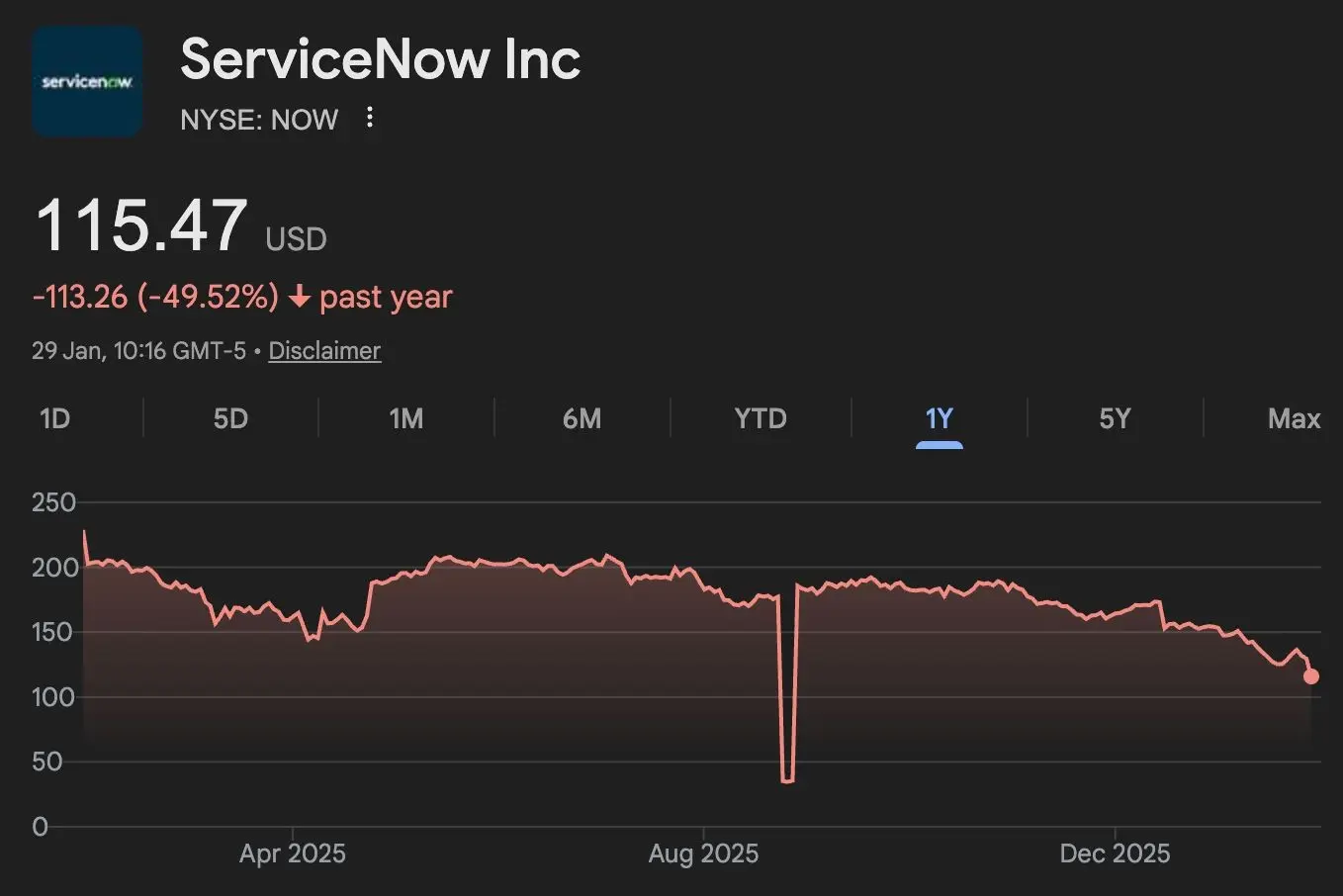
People keep saying “multiple compression” like that explains anything. It doesn’t. It’s a label you reach for when you don’t want to talk about why the math underneath the business feels different than it used to.
The market isn’t punishing ServiceNow. It’s the market rethinking a whole generation of software that made its money organizing people.
- Tickets
- Workflows
- Dashboards
- Approvals
All of it priced on the idea that humans would always sit in the middle, moving things along, justifying seats, keeping the system running.
AI didn’t blow up the earnings line. It made that assumption harder to believe. When fewer people are expected to be in the loop, coordinating them stops feeling like something you pay a premium for.
You can call it P/E compression like Jim Cramer does if that helps. The chart doesn’t seem to care what you call it.
Software that depends on humans sticking around starts to feel heavy. Software that actually replaces work doesn’t. And once investors start thinking that way, they don’t unthink it.
The Era of Surface Level Innovation is Over
Public SaaS benchmarks are what happens when the story stops working.
For a decade, growth covered up bad businesses:
- Hiring ahead of real demand and calling it investment
- Spending ahead of revenue and calling it confidence
- Selling something vague to a broad audience and calling it scale
- Watching the numbers go up and calling it proof
What made that possible:
- Cheap money
- Forgiving investors
- The comfort of calling yourself “horizontal”
- Headcount growth that felt like momentum
2021 was the peak of the illusion. 20x revenue valuations priced companies for perfection they never built.
When growth slowed, the response was predictable. Cut costs. Celebrate margin gains that came from doing less. Ignore the fact that creating new revenue kept getting more expensive. GTM efficiency didn’t bend, it broke.
This is the part everyone dances around. When it costs more than $2 to generate $1 of new ARR, the market didn’t suddenly break. The machine only worked when money was cheap.
That’s basically how it went off the rails. It wasn’t the macro. It wasn’t rates. It wasn’t AI.
A lot of SaaS businesses only worked as long as things kept speeding up. When growth slowed, the economics stopped holding together. What the data shows now isn’t broad failure. It’s who survived that moment and who didn’t. Vertical businesses did. Higher-ACV motions did. Security did. Same buyers. Same budgets. Execution wasn’t the separator. It was focus.
- If your product is for everyone, your CAC never really settles. If your GTM depends on volume, efficiency only looks real when growth is fast. If the plan needs constant acceleration to make sense, it isn’t a plan.
AI doesn’t change this. It removes the slack. The scoreboard hasn’t changed. ARR. Retention. Cash. Efficiency. From here on out, it’s pretty simple. Either the business works on its own, or it doesn’t.
Security Needs to be the Focus
I sat in a room with a couple dozen AI vendors and asked a simple question. “What’s the question you get asked most by buyers?”
Everyone smiled like they already knew the answer. Features. Performance. Price. The usual stuff people rehearse for. That isn’t what they said.
They all said security.
Every one of them. Sometimes bluntly, sometimes sideways, but it always showed up early. Often before the product even made sense.
It’s hard to overstate how much that question matters. Innovation and features get all the attention, and sure, they matter. But the moment security feels uncertain, the rest of it stops counting. The work can be impressive. The idea can be right, and still it never becomes something anyone is willing to be responsible for.
Security questions are really responsibility questions. They are a signal that software is no longer judged only on what it can do, but on what happens when it gets it wrong.
That’s where the conversation finally gets uncomfortable.
Trust Comes From Ownership
At the World Economic Forum in Davos last year, Salesforce CEO Marc Benioff accused AI models of becoming “suicide coaches.”
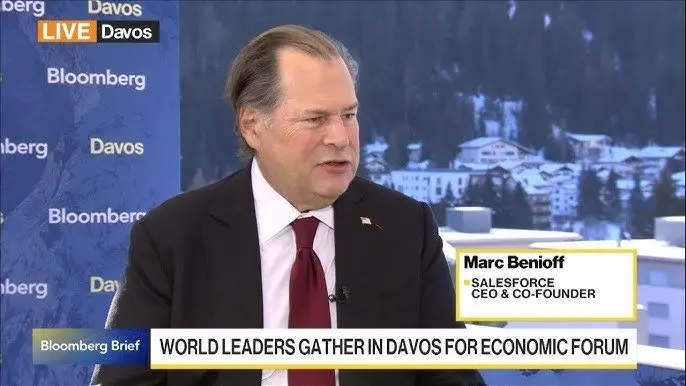
This wasn’t a backroom comment or a social post meant to get a reaction. He said it in Davos, on CNBC, as the CEO of a company that sells into some of the most regulated, risk-sensitive organizations in the world. People who know what words cost when they’re spoken out loud.
He was pointing at something the industry keeps stepping around. These systems already live inside people’s lives, not clean workflows or controlled environments. When they fail, they don’t fail like enterprise software. There’s no ticket or rollback. The consequence lands on a person, often in moments of isolation or stress.
The reaction from AI leaders has followed a familiar script. Warnings about slowing innovation. Anxiety about accountability. We've seen this before. Social platforms ran the same cycle for years before admitting some of the damage couldn’t be blamed on users.
What’s different now is scale. These systems reach more people, more often, and the failures that matter are coming from consumer systems that keep talking and nudging, without anyone clearly owning what happens next.
Once you accept that, the conversation gets practical. Standing behind model behavior means shipping costs more. Oversight matters. Risk stops being cosmetic. Some business models start to look thinner than advertised.
You can keep talking about upside. That’s the easy part. Trust doesn’t show up because we say it will. It shows up when someone is willing to own consequences they’d rather avoid.
Zoom Out
AI isn’t raising the ceiling on what software can do. It’s lowering the price of work we used to build companies around. Coordination, routing, review, reconciliation. Once those costs fall, the software and orgs designed to support them get reevaluated whether they’re ready or not.
That’s why the pressure is showing up in markets, in buying behavior, and in uncomfortable questions about risk and responsibility. The system isn’t broken. It’s being repriced.
From here, outcomes get simpler. Businesses either produce value that holds up when the work is gone, or they spend their time defending why that work still needs to exist.
