

Welcome back to Autonomous.
If you look at the headlines this week. Get ready for record-breaking valuations, surprise megadeals, legacy pivots, and executive shakeups. It might just look like more of the usual AI chaos. But when you step back and connect the dots across Cursor, xAI, Adobe, and Apple, a unified, massive macro trend emerges:
The model war is no longer the main event. The war for distribution and the interface has officially begun.
For the last two years, the enterprise obsessed over who was building the smartest frontier model. But as intelligence rapidly commoditizes and becomes table stakes, this week’s market signals prove that the real value is shifting to where that intelligence actually meets the user.
Here is what you need to understand about the market this week:
- Software Development is the Enterprise Canary: The astronomical valuations in AI coding aren't just about developers. Coding is simply the first knowledge work function to feel the full leverage of AI. What is happening there today is exactly what sales, marketing, and operations will experience in the next 12 to 18 months.
- Frontier Labs are Buying Workflows: xAI’s massive move for Cursor is a masterclass in buying distribution. Great models without access are useless. The giants are now fighting to own the default interface where the actual work gets done.
- Legacy Incumbents are Scrambling: Adobe's sudden pivot to an AI orchestration layer is a warning shot to every SaaS giant of the last decade. The market is moving at a speed that breaks traditional moats, forcing incumbents to fundamentally rewrite their architecture or face irrelevance.
- Hardware is the Ultimate "Last Mile": Apple’s leadership shift proves you don't need to win the loudest cloud LLM race to win AI. By doubling down on chips and devices, Apple is betting that the ultimate moat is controlling the physical intersection between intelligence and daily human life.
The takeaway for B2B and Go-To-Market leaders: It is no longer enough to just build a smart tool or integrate a model. To survive this next wave, you have to own the workflow. You have to capture the seat.
Let’s dive into what this week's signals mean for the future of your organization.
The AI Boom Is Still Early and Accelerating
If anyone still thinks the AI boom is cooling off, they are ignoring the market.
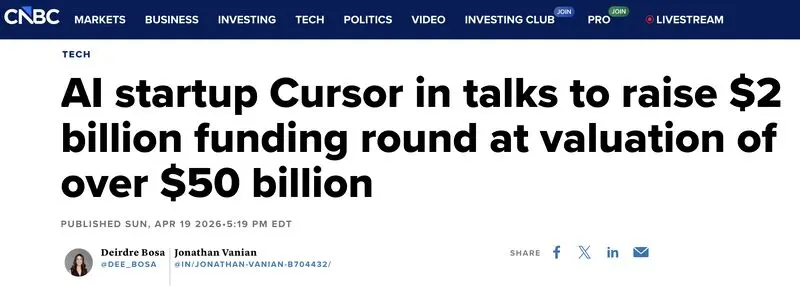
Cursor looks to be raising $2B at around a $50B valuation.
Last November they announced a $29.3B valuation. That is about 70% growth in five months, or roughly a 260% CAGR.
That is what frenetic demand looks like when capital is chasing the category that is already proving real value. And the round looks to be backed by highly sophisticated capital: Andreessen Horowitz, NVIDIA and Thrive Capital, after already having received investment from Accel, DST Global, Coatue Management and Google.
But more importantly, software development is the signal for what comes next. AI coding is the canary for the rest of the enterprise.
Why?
Because coding is one of the first major knowledge work functions where AI already delivers outcomes people can feel immediately:
- More output
- Faster shipping
- Shorter iteration cycles
- And more leverage per employee.
So of course the coding layer is getting the attention first. But this is bigger than code.
Engineering is just ahead of everyone else.
What you are seeing in software development today is what sales, support, marketing, finance, recruiting, and operations will feel over the next 12 to 18 months. We are already seeing it at Sierra, Intercom and what we are building at Atonom.
Cursor is not just another startup funding headline. It is a market signal.
- The market is telling you that AI adoption is still accelerating.
- The market is telling you that demand is still compounding.
- The market is telling you that the enterprise rewrite is still in the early innings.
Coding went first. The rest of the org chart is next.
Signal matters, but control matters more. That is why we are seeing a war for the actual seat where the work happens.
It is no longer enough to build a tool: you have to own the default interface where builders spend their day.
xAI’s Shortcut to the Developer
xAI finally just had its DeepSeek AI moment.
And it may have just changed the entire frontier lab race.
Yesterday, SpaceX / xAI secured the option to buy Cursor for $60 Billion.
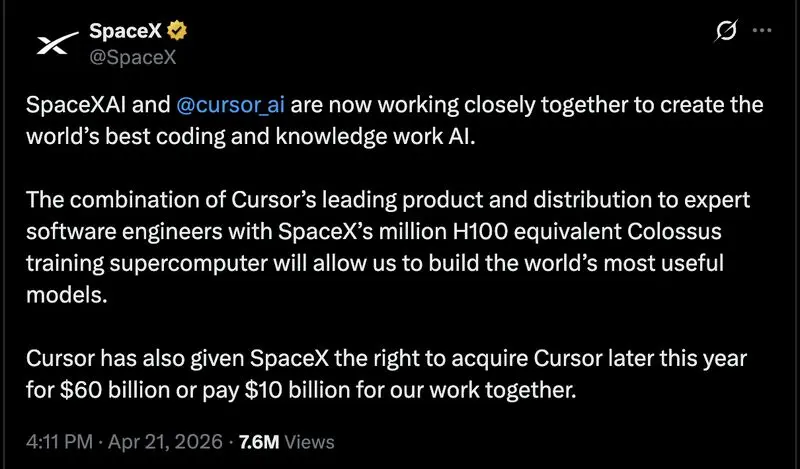
This is not just a deal for an AI coding startup. It is a deal for distribution. A lot of people have been treating xAI like it was drifting behind OpenAI, Anthropic, and Google. The problem was not necessarily model quality. The problem was access.
Having a great model without distribution is like building a rocket with nowhere to launch it. Now that changes.
Here is what xAI gets access to through Cursor:
- 1M daily active developers
- 2M total users
- 1M paying users
- 50,000+ businesses
- More than half of the Fortune 500
xAI just found a shortcut into the daily workflow of the modern developer.
- OpenAI has Codex.
- Anthropic has Claude Code.
- Google has Antigravity.
- Now xAI has Cursor.
And that instantly puts them back in the center of the AI coding war. xAI is no longer just building models. They are building distribution. And in this market, that may be the more important asset.
When the frontier labs start buying up distribution, the legacy giants of the last software era are forced to make a choice. They have to evolve their entire architecture or risk becoming a footnote in the agentic revolution.
Adobe’s Scramble for Relevance
Adobe just admitted they are fighting for their life.
Today they launched CX Enterprise, rebuilding their platform specifically for AI agents.
The creative software giant is officially pivoting into an AI orchestration layer.
That matters far beyond Adobe.

This is about a legacy giant scrambling to survive the fastest-changing market in history.
Look at the whiplash we have seen just recently:
- Anthropic moved into digital design with Claude Design.
- Canva pushed further into AI-native creative workflows.
- OpenAI abruptly pulled back and shut down Sora.
- Google expanding with AI creative studio called Flow.
This +$100B market is moving at a speed that breaks incumbents.
Every AI lab, Google, Netflix, The Walt Disney Company, and every legacy creative and movie production org on earth is aggressively chasing it.
But they have already lost nearly 30% of their market cap and are actively navigating a CEO exit transition.
The companies that survive this next decade won't be the ones clinging to the past. They will be the ones bold enough to pivot into our future.
While software giants scramble to stay relevant in the cloud, one company is ignoring the model race entirely. They understand that as intelligence becomes a commodity, the only moat left is the hardware that manages it.
Apple Wants to Own the Last Mile of Intelligence
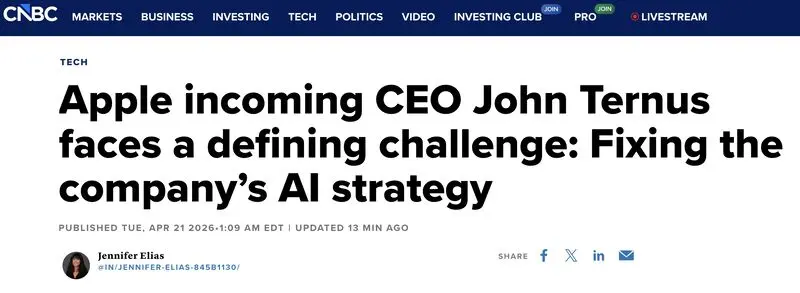
Apple just made its biggest AI move yet. And it wasn’t a model. It was a CEO. John Ternus, Apple’s hardware chief, is taking over.
This tells you everything.
While the market is obsessing over chatbots, token pricing, and who has the loudest frontier model, Apple is making a much more focused bet:
- They're bypassing the multi-billion dollar LLM arms race.
- They're doubling down on their chips.
- They're leveraging 2.5B devices to dominate "Physical AI".
They are betting that AI value won't be captured only by the companies that generate intelligence, but by companies that control where intelligence actually interfaces with humans:
- The device.
- The chip.
- The operating system.
- The physical interface between AI and real life.
This is clearly Apple’s play.
So no, Apple does not need to win the noisy model race to matter in AI, they aren't trying to outshout Google, Meta or even Anthropic and OpenAI.
Instead, they are making sure that when AI leaves the browser and enters everyday life, it runs through Apple.
Apple is trying to own the last mile of AI. And in every platform shift, the last mile is where the money goes.
For the last year, Apple looked late. Now it looks like it may have been just choosing their battlefield.
Not pure cloud intelligence, but tightly integrated AI experiences delivered through the devices people already trust.
That is a much more dangerous strategy than most people realize.
The AI race is not just about who builds the smartest model. It is about who owns the interface where intelligence becomes action.
The Big Picture: The End of Software as We Know It
When you step back from this week’s news, its clear we are witnessing the end of the traditional SaaS era and the beginning of the great interface consolidation.
For twenty years, the B2B playbook was simple: build a cloud-based point solution and sell "seats" to humans. That model is breaking in real-time. As intelligence becomes an invisible, commoditized layer, value is migrating to the edges, the foundational hardware (Apple) and the dominant daily workflows (Cursor).
If you are a B2B or Go-To-Market leader, the macro takeaway is this: You are no longer selling software to help people work. You are selling the orchestration layer where the work happens autonomously.
- For startups: Your absolute priority is capturing the daily workflow. If you aren't the default interface, you are just an API call waiting to be replaced.
- For incumbents: You are on the clock. You must transition from a static tool to an agentic platform before a frontier lab bypasses you entirely.
The first phase of the AI boom was about building the intelligence. This new phase is about ruthless execution. The battle is no longer about who makes the smartest model, it’s about who holds the remote control.
