
AI impact in the last 7 days has been eventful and a little turbulent.
Society experienced a fundamentally disruptive "OpenClaw Moment." OpenClaw is an open-source autonomous AI agent. This week seemed to be the moment we understood the next wave of AI is on our computers, autonomous and always working. AI changed from being a co-pilot into a digital assistant with access to our files, tools, passwords and computers.
This new realization didn't just impact our understanding, but every AI company is pivoting to become the default operating system for this new way of using AI: Meta / Manus AI, Anthropic, Perplexity, NVIDIA, OpenAI (just to name a small fraction of companies chasing this vision) are all building some variation of an "Open Claw" autonomous assistant.
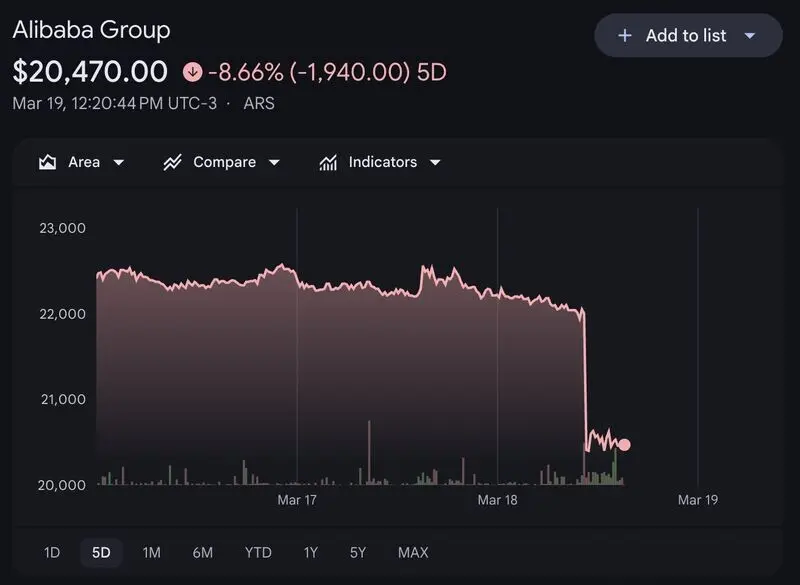
China, while also experiencing its own massive "OpenClaw craze", may have just changed the global AI token price paradigm when Alibaba Group just raised AI prices by 34% and Z.ai introduced its new faster model tuned for OpenClaw-style tasks, but closed sourced it.
The downstream effect of all of this is the impact on the broader software industry. Microsoft's CEO, Satya Nadella declared his version of a "Code Red" (clearly loosing to Google ) by reshuffling their AI structure, demoting Mustafa Suleyman (the Microsoft AI CEO), and having the most of the AI team report directly into him personally.
The rest of the industry is in full reset mode. After Block and CEO Jack Dorsey announced 40% layoffs, SaaS royalty Atlassian cut 10% of its workforce, and ofter loosing $80B in market value over the last year Adobe's CEO stepped down. Then Meta experienced the industry cornerstones shifting and announced that they my 20% of its workforce.
Lastly, the this week has shown that its not just companies that are experiencing change, but the entire workforce, starting with college grads. ServiceNow's CEO, Bill McDermott told CNBC that college grad unemployment could hit the mid-30%. And, AI expert Andrej Karpathy's AI jobs chart shows the lowest-risk and bak to blue collar.
Hiring More People Isn’t Fixing Anything
Meta may cut 20% of its workforce.
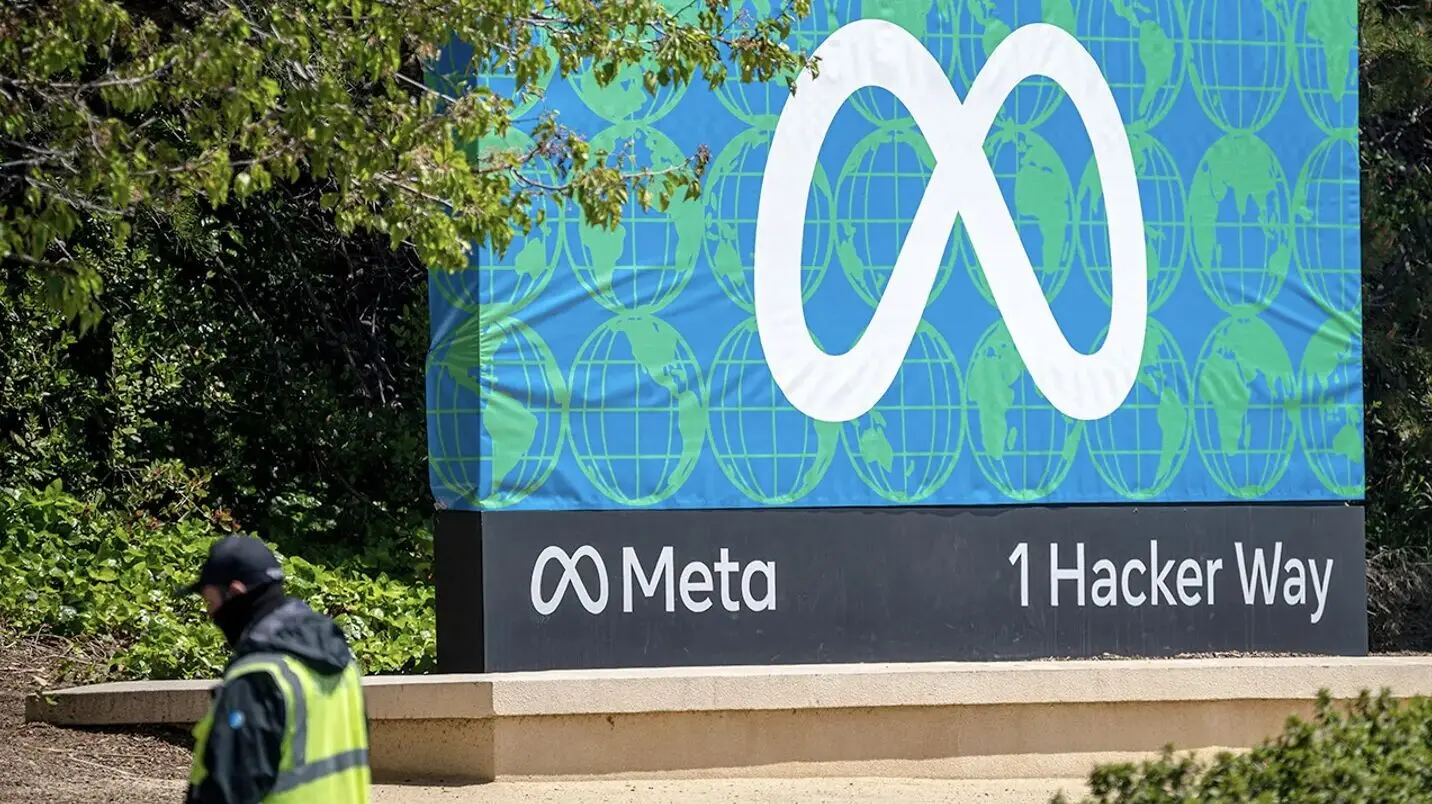
If that happens, this will be the third major tech company this week alone to publicly signal that AI is not just about changing products. It's about changing workforce math, leadership expectations, and organizational strategy.
- Atlassian cut 10% of its workforce
- Adobe lost roughly $80B in value over the last year and its CEO stepped down
- Now Meta may make its biggest workforce reset since the 2022–2023 “Year of Efficiency.”
This seems like a cost savings exercise, but look at the other Meta signals. Earlier this week Meta acquired Moltbook , a social networking platform for AI agents. They also recently announced spending $2B to buy Chinese AI startup Manus AI and are investing $600B to build AI data centers by 2028.
To me this all feels bigger than “another layoff story.”
Reuters reported that around $1 trillion got wiped from the S&P 500 software and services index since January 28. The market is not just punishing weak companies. It is repricing an old assumption: For 20 years, software scaled by adding seats, managers, software layers, and human coordination.
AI may scale by reducing all four. This is not a feature shift. This is a fundamental business model disruption, and the public markets seem to see it clearly. SaaS Capital's pure-play B2B SaaS multiples over the last year show it:
- 3.7x as of Feb. 28, 2026 vs 7.0x at the start of 2025
That is about 47% lower in 1 year. The companies willing to rebuild AI NATIVELY around outcomes, orchestration, and digital labor / Cloud Employees seem likely to be the winners.
That is the question behind Meta. And increasingly, it is the question behind this entire market.
Markets are reacting to something, not guessing. If you want to understand why this is happening, you have to look at how the work itself is starting to get done differently.
Welcome to the new Era of AI, Autonomous Workers
The world just had an OpenClaw moment. And now every major AI company is racing toward the same thing: not another chatbot, but an agent with access to all of your tools.
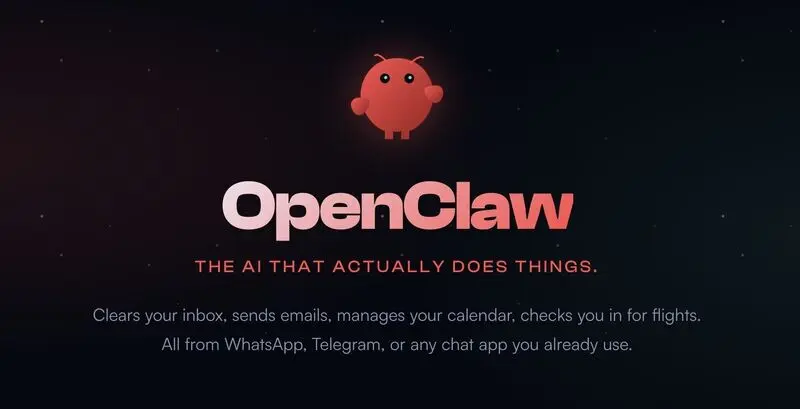
An assistant runs on your computer, accesses your tools, uses your files, works across your browser and apps, and does the job for you. That is the shift. Agents are moving off the demo page and onto the machine.
They can:
- see your screens
- click the buttons
- use the software
- pull from your files
- work across the messy stack you already have
Meta / Manus AI. Anthropic. Perplexity. NVIDIA. Different packaging. Same race.
The next big interface is not an app. It's an agent that uses all your apps for you. For 20 years, software won by being where work happened. Now the winner will be the thing that does the work on your behalf.
This isn’t theoretical. It’s already showing up in how the biggest companies are competing.
Microsoft Is Chasing. Google Is Winning.
Microsoft is in a AI free fall... Now they’re chasing Google
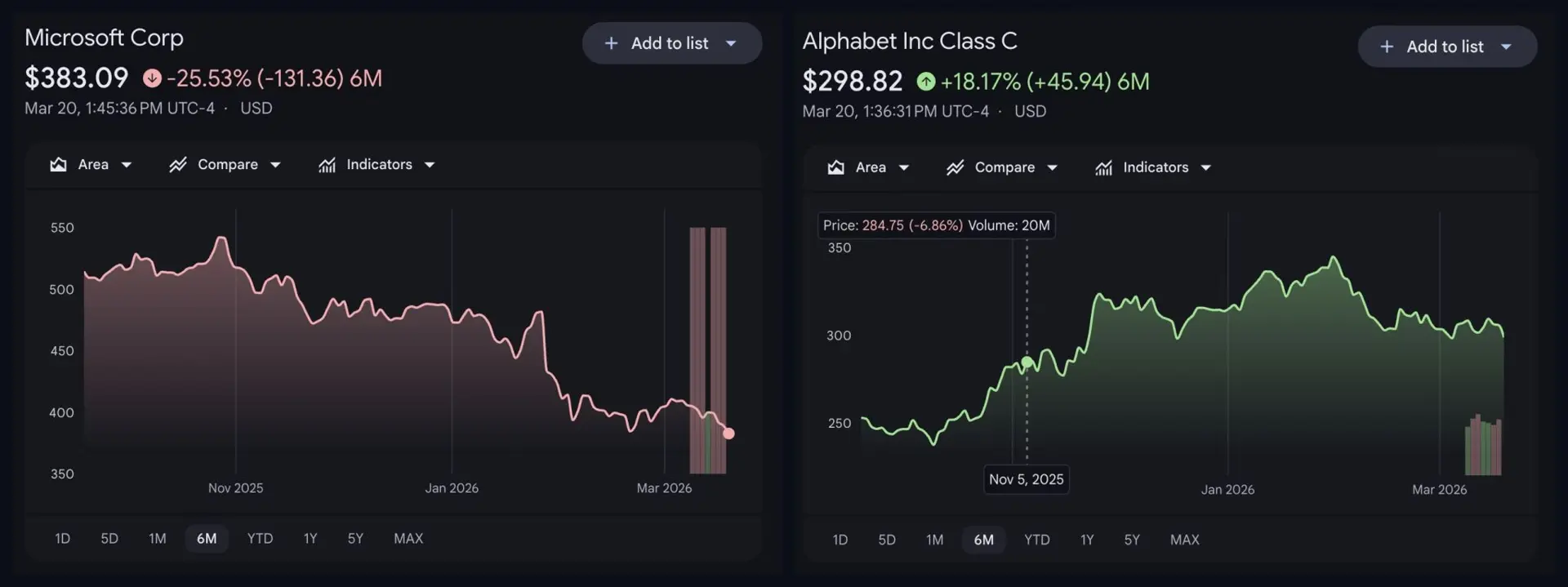
In the last 6 months, Microsoft has lost 25% of its market-cap, while Google has gained over 18%.
Thats a MSFT loss of over $900B vs a gain of GOOG gain of $626B, ... So in absolute terms, Google outperformed Microsoft by about $1.5 trillion.
Whats crazy is that Microsoft was in the founding 3 of the new AI era (OpenAI, NVIDIA and Microsoft).
The market just made something super clear: Owning the past doesn’t guarantee your future.
Microsoft owns the enterprise with Office, Outlook, Teams, and Azure. And still… Copilot isn’t breaking through.
Developers are choosing tools like Cursor … built on Microsoft’s own stack. They own the platform but they don’t own the mindshare.
At the same time Google pivoted. One year ago they were behind. By November they released Gemini, then:
- Gemini in Docs / Sheets / Slides / Drive
- Personal Intelligence
- Gmail Gemini integration
- Chrome auto browse + side panel
Then you see the org change announced by Microsoft yesterday. Mustafa Suleyman (Microsoft AI CEO) was pulled off Copilot and everything AI now rolls up to Satya Nadella. It's right right move but let's be real, it's a reset.
This can't be a feature race, it has to be a platform war.
And right now, Google looks like they understand the game and Microsoft looks like they’re still trying to add features.
But winning this won’t come down to features or distribution. It comes down to economics.
AI Just Got More Expensive
The cheap AI token era looks to be ending. Alibaba Group just raised AI prices by 34% their AI APIs.
Then it reported revenue growth of only 2%, profit down 66%, and the stock plummeted. Similarly, another Chinese AI model maker Z.ai introduced GLM-5-Turbo positioning it as a faster model tuned for OpenClaw-style tasks, but closed sourced it.
For the last year, the AI market has been built on an assumption: tokens only get cheaper.
- Cheaper models.
- Cheaper APIs.
- Open-weight pressure.
- More capability for less money.
That was great for the startups and getting us addicted.
- Great for experimentation.
- Great for adoption.
But, these low prices were in no small part driven down by the supply of cheap/free Chinese AI models. Last fall's news revealed that most silicon valley AI startups were running DeepSeek AI ’s R1 and Alibaba Group’s Qwen.
China has been one of the biggest deflationary forces in AI. As that force starts weakening, the global AI pricing umbrella moves up. And once that happens, a lot of companies will find out they were not selling a business. They were selling "venture backed" subsidized intelligence.
Tokens are the wrong thing to obsess over. A token is not value. It is cost. A CFO does not want to buy calories. A CFO wants completed work. I believe the next winners in AI will not just have the best models. They will have the best economics, workflows and pricing models as intelligence stops getting cheaper.
And when the cost and structure of work changes, companies don’t absorb that quietly. They don’t need the same people anymore.
We’re Training Students For Jobs That Won’t Exist
ServiceNow's CEO, Bill McDermott told CNBC that college grad unemployment could hit the mid-30% in the next couple of years. Not 10%. Not 15%. The mid-30s.
The current rate is about 5.7%. Underemployment is already at 42.5%, the highest since 2020. And McDermott isn't some random pundit. He ran SAP . He runs a $200B+ enterprise software company. He is not guessing. He is watching it happen inside his own customer base.
ServiceNow claims that they have already eliminated 90% of the use cases that previously relied on humans in customer service.
This is the same week where:
- Block cut 40% of its workforce. Stock jumped 24%.
- Atlassian cut 10%. The market rewarded the move.
- Amazon may be lining up another 14,000 cuts on top of 16,000 already made.
And yet nobody is talking about the institution most responsible for what happens next.
Universities. Fashion design programs still teach students how to pitch a collection to a buyer. Music programs still teach students how to get signed. Business programs still teach students how to build a team by hiring people. Law schools teach students to research cases the way humans have done it for 200 years.
The curriculum has not moved. The economy has. The entry-level job, the one where you learn, make mistakes, build your craft, and figure out who you are professionally, is disappearing faster than any accreditation board has noticed.
We are charging students $50,000 a year to prepare them for roles that are being automated away in real time, leaving them with 100's of thousands in debt with no way to get a return.
This is not a workforce problem. This seems like an institutional failure. Universities were built to prepare people for the world as it exists. Right now, most of them are preparing students for a world that is already gone.
They need to stop teaching students how to do the work. They need to teach them how to direct it. How to think in systems. How to lead agents. How to create things and make judgments that only humans can make.
We are sending an entire generation into a workforce that has already moved on. McDermott's number, mid-30% unemployment for college grads does not seem just a forecast. It felt more like a warning. And it is addressed to every university president, every dean, every curriculum committee that hasn't fundamentally rethought what they are selling.
This is bigger than fewer jobs. It’s about which jobs survive, and the answer is not what most people expected.
White Collar Work Is In Trouble
Roofers may be more future-proof than knowledge workers. That sounds counter intuitive. But it may also be true. That was my biggest takeaway from an analysis performed by Andrej Karpathy on AI job risk.
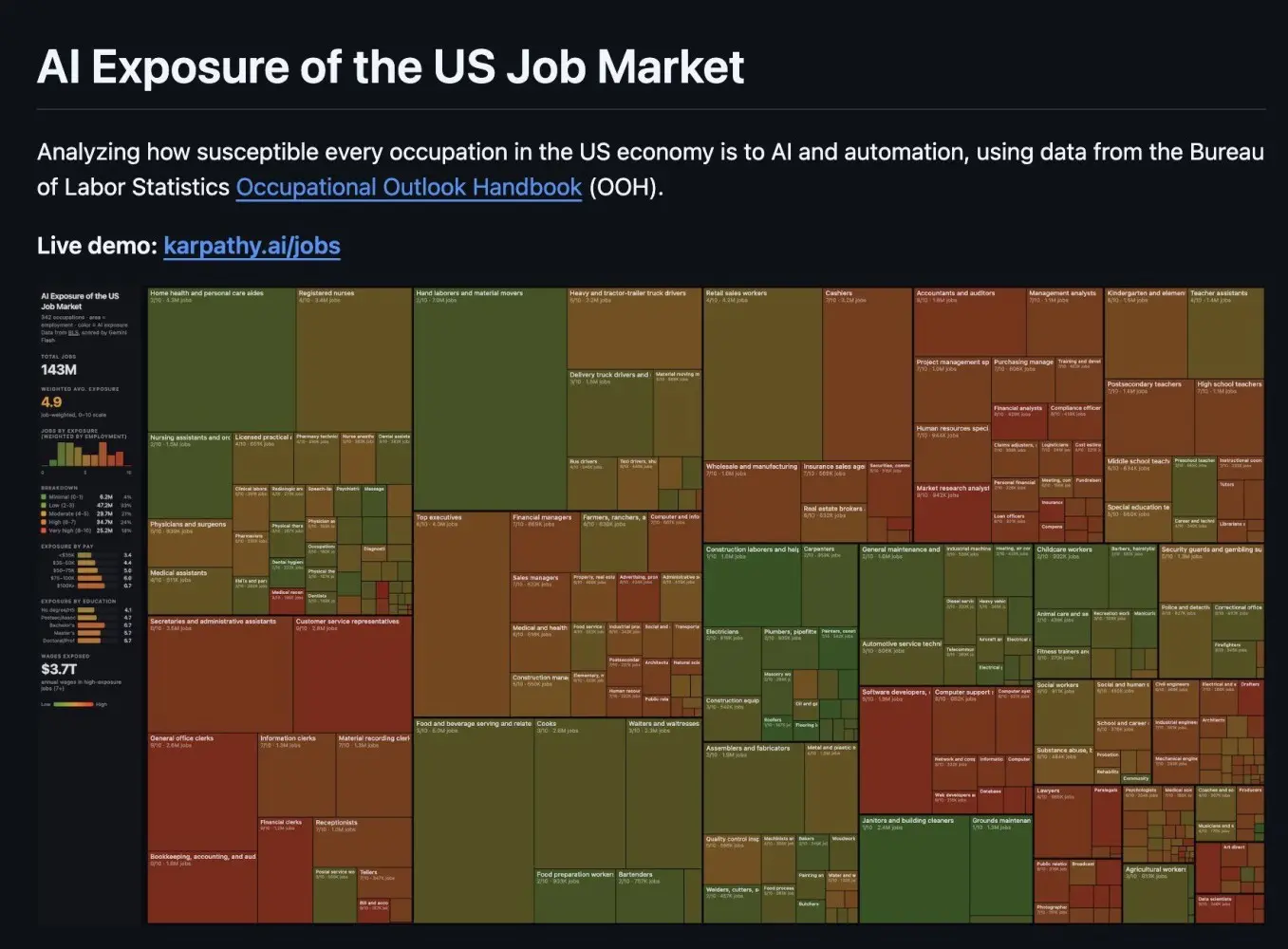
And this is not coming from a random commentator. Karpathy is one of the most credible operators in AI: OpenAI founding team, former AI lead at Tesla , and the architect of Stanford University ’s CS231n.
In this project, he used BLS occupation data and an LLM scoring pipeline to map which parts of the labor market are most exposed to AI. Karpathy’s AI jobs chart shows some of the lowest-risk jobs are:
- Roofers
- Janitors and cleaners
- Grounds maintenance workers
- Construction laborers / painters
That is a brutal inversion. For 20 years, we told people the safe path was:
- degree
- laptop
- office
- screen
AI may be flipping that logic. The work most exposed now is the work that lives on a screen. The work most protected is the work that happens in the messy, physical, unpredictable real world.
AI is replacing digital labor first. And that may become one of the biggest status reversals of the next decade. Ladders may turn out to be safer than laptops.
The signal is pretty clear at this point. What’s less clear is why most of the industry is still behaving like none of this is happening.
Don’t Pretend This Isn’t Happening
Most AI sales events are a waste of time.
- A moderator asking soft, pre-arranged questions
- Five vendors (paying)
- Three analysts (paid)
And everyone pretending the “future of sales” hasn’t already started. It’s a joke. While people sit on panels debating AI… other companies are already augmenting entire SDR functions with it.
- Voice agents calling leads in seconds
- AI running inbound qualification
- Follow ups happening automatically across email, SMS, and chat.
Pipeline is getting created without adding headcount. And yet the industry is still pretending AI is just a productivity tool for SDRs. Most of the sales tech industry does not want this conversation to move forward. Because if AI can actually execute the work, a lot of categories disappear (know as the SaaSpocalypse).
- Fewer tools
- Fewer seats
- Less software tax
That is exactly why we are hosting the AI SDR Summit.
- No sponsors
- No paid speakers
- No vendor pitch decks.
Just builders showing what they actually deployed. What worked, what failed, and what actually produces pipeline.The future isn't going to be better sales tools, it is autonomous revenue systems.
Sign up here.
Zoom Out
The software industry is in full reset mode.
This week made it clear that AI is moving beyond copilots and into autonomous work. Not just helping us use software, but increasingly operating software and do our work for us.
That shift is forcing every major player to reposition fast. Pricing is changing. Org charts are changing. Leadership teams are changing. Jobs are changing.
This is no longer just an AI product story.
This is not a normal cycle.
It is a reset.
