
It’s a new year, and the AI conversation keeps doing what it always does. Every week there’s a new thing to obsess over. New agents. New models. New benchmarks. New promises about speed, leverage, and how everything is about to change. You’ve seen it.
But underneath all that noise, something else is happening. The companies that are actually making progress are not arguing about features anymore. They are pulling apart how work gets done inside their business and asking a harder question first.
Who owns the work now?
Once that answer changes, everything else starts to wobble. How software is built, sold, priced, and what “using” a product even means.
That’s the shift worth paying attention to. And it’s already starting to show up.
SaaS Didn’t Evolve. It Changed Who Does the Work.
I’ve been thinking about where SaaS is actually headed, and I don’t think the usual answers really explain what’s happening.
We keep talking about AI features, copilots, and agents. But that feels like the surface. The bigger play has always been about something else. Who does the work.
-
1990s: On-Prem Software
- Early software was something you installed and maintained. IT controlled it. Innovation moved slowly because infrastructure moved slowly. Software was powerful, but it was heavy. And it was always something humans had to operate directly.
-
2000s: Cloud SaaS
- Then SaaS moved software to the cloud and made access easy. Log in. Subscribe. Work from anywhere. That was a real unlock. But the model didn’t change ownership of work. Humans still did everything. Software just made it possible.
-
2010s: Platforms & Ecosystems
- The platform era pushed things further. Integrations multiplied. Ecosystems grew. Tools connected to tools. Teams moved faster, but complexity quietly increased. More software. More orchestration. More humans in the middle making it all work.
-
2020s: AI Inside SaaS
- When AI arrived, it felt like the breakthrough. Automation improved. Copilots showed up. Software could assist, suggest, and summarize. But responsibility didn’t change. Humans still owned outcomes. AI just helped them move faster.
-
Now: Digital Workers (Cloud Employees)
- What’s interesting now is that assumption is starting to break. We’re seeing software that can actually run work. Research. Outreach. Support. Recruiting. Not perfectly. Not autonomously in every case. But enough that ownership is shifting.
At that point, calling it a tool feels wrong. If software can take responsibility for outcomes, “platform” starts to sound outdated. Seats and licenses matter less. Results matter more. Software begins to look less like something you use and more like someone you work with.
This feels like a structural shift in how work gets done. Maybe the next era of SaaS isn’t really SaaS at all. Maybe it’s the moment software stops waiting for instructions and starts showing up like a teammate.
The team wrote a longer breakdown on this here.
Once software starts taking responsibility for outcomes instead of just assisting humans, it is only a matter of time before the pressure shows up where outcomes are measured most directly. Revenue teams feel it first.
Your GTM Playbook Has Expired
Your GTM playbook just expired. Not because AI can write emails ... Because AI hit GTM twice. This came out of an interview with Craig Rosenberg, co-founder of TOPO (acquired by Gartner), former Distinguished VP at Gartner, and now Chief Platform Officer at Scale Venture Partners. He’s spent a decade watching what actually works inside the best revenue orgs.
Craig calls it the "Double Disruption"
- Internal disruption: how you sell is being rebuilt. AI isn’t “making reps faster.”
It’s changing the operating model:
- work breaks into tasks
- agents execute the tasks
- humans shift to orchestration + judgment + closing
The bottleneck moves from “more activity” → taste, sequencing, narrative, deal design.
- External disruption: how buyers buy is changing even faster.
Buyers are overwhelmed and skeptical. They’re not asking, “Can you demo it?” They’re asking:
- “What’s real vs hype?”
- “Should we just build this?”
- “How do I justify this internally without getting burned?”
Most companies aren’t losing to competitors as much as they’re losing to uncertainty.
Craig’s strategy is the flip most GTM teams won’t make: Stop optimizing SELLING. Start optimizing BUYING.
Build “decision infrastructure”:
- micro-segment until the message feels written for them
- publish POV that reduces confusion (not marketing fluff)
- demo for ONE “aha,” not 40 features
- make internal approval stupidly easy
In 2026, the job isn’t persuasion, it's going to be about clarity. The deeper shift underneath all of this: SaaS → Outcomes-as-a-Service. Here’s how we are seeing things:
- Seats are dying. Outcomes are the product.
- Buyers don’t want your platform. They want:
- pipeline created
- tickets resolved
- onboarding finished
- churn reduced
- time-to-value compressed
When agents do the work, the tool disappears. What’s left is the result.
So if you’re still selling “features” and “licenses" and your buyer is shopping for outcomes, you’re about to feel Craig's double disruption the hard way. And this is where most teams misdiagnose the problem.
They assume they need better tools, when what they are missing is clarity about the work AI is supposed to own.
AI Isn’t Buy vs Build. It’s Job vs Chaos
AI isn’t “buy vs build.”
It’s: do you even know what job you’re hiring it for? Because that's what it is, you use AI to do jobs, like humans. Most companies don’t really know what they are "hiring" AI for.
They say, “We want AI for sales” or “AI for support” but what they really mean is, “We’re frustrated and hoping this fixes it.” It usually doesn’t. AI doesn’t fix broken processes. It takes whatever you already have and turns the volume all the way up.
If your system is clear, it scales clarity. If it’s messy, it scales the mess. That’s why so many AI pilots look impressive and quietly fail. No one owns the work. No one defines success.
Everyone treats it like software when it’s really closer to hiring a person. And hiring a person without a job description is how you waste a lot of money. The teams I’m seeing win with AI aren’t chasing tools. They’re slowing down, redesigning the work, and then deciding who or what should do it.
That order matters. Because if you skip the work of redesigning the job, the work itself does not disappear. It just concentrates on the people and systems that are left.
And over time, that concentration shows up in places you wouldn't expect.
The AI Layoff Regret Is Already Here
55% of companies now regret laying people off because of AI according to Forrester. Not because AI failed. But because the rollout did.
Yes, you can replace certain roles with AI. That part isn’t controversial anymore. What’s becoming obvious is that a lot of companies went there way too fast, without really thinking through how the work actually gets done.
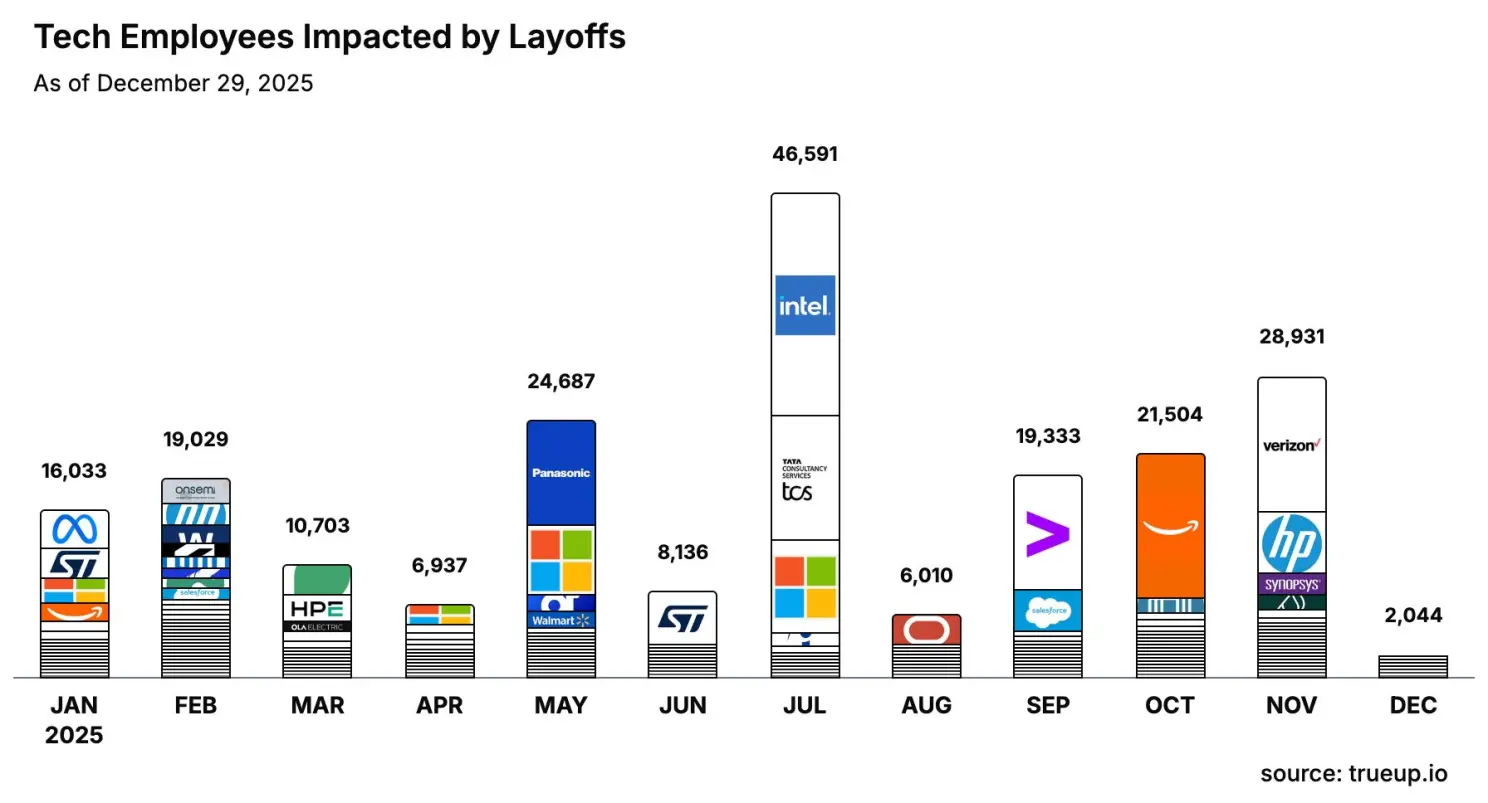
According to TrueUp, so far in 2025, there have been 720 layoffs at tech companies alone, with 209,938 people impacted (578 people per day).
Klarna is a good example.
They cut 700 customer support reps in one move, leaned hard into automation, and then watched customer satisfaction drop. Now they’re rehiring. Not because humans are better at everything, but because they skipped the steps. They didn't look and where humans are better and where AI is more effective.
You don’t replace an entire team overnight. You start small, test and experiment. After-hours support. Overflow tickets. The repetitive, low-risk stuff. You watch how customers respond. You see where AI works and where it clearly doesn’t. Then you expand from there.
AI isn’t a layoff button, it’s more of an operating decision. Used well, it absolutely drives efficiency and lowers cost. Used poorly, it creates churn, rework, and trust issues you end up paying for later.
Most of the companies rehiring right now didn’t “get AI wrong.” They just moved faster than their understanding of the work.
AI rewards judgment, not impatience. What makes this harder to see is that early AI usage can look healthy on the surface.
The numbers feel validating at first. Until they stop behaving like real revenue.
Most AI ARR Is Just Curiosity Spend
I think Kyle Poyar just put numbers behind something a lot of people have felt but haven’t really wanted to admit.
A lot of what we’re calling AI ARR… isn’t actually recurring. It’s experimentation or curiosity spend. It’s teams swiping a card to see what’s possible, not committing to something they plan to run the business on.
And the retention tells the story. The median AI-native company is retaining less than half its revenue year over year. Around 40% gross retention. Under 50% net retention.
That doesn’t mean the products are bad. It means customers didn’t decide this was foundational. They decided to try it.
And what’s interesting is where the line shows up. AI products under $50 a month see retention in the 20–25% range. Cross $250 a month, and suddenly retention starts to look like real B2B SaaS again.
Same technology but different intent. Below that line, people aren’t buying software, they’re renting a lesson.
- Easy to buy
- Easy to try
- Easy to cancel
That kind of revenue looks great early on. It even feels validating. It just doesn’t mean what we’ve trained ourselves to think it means.
And over time, the difference between “interesting” and “essential” shows up in the numbers whether you want it to or not.
At the other end of the spectrum, something very different is happening inside mature enterprises.
The Most Important AI Story Nobody Talked About
This is one of those stories that’s easy to scroll past. Salesforce added 6,000 enterprise customers in a single quarter to Agentforce.
And almost no one noticed.
Which actually makes sense. When AI starts working, it stops being interesting. That’s usually how real enterprise change happens.
The loud phase is experimentation. The quiet phase is dependency and we're moving into the quiet phase now.
Under the surface, the scale is already there.
- Agentforce crossed $540M in ARR
- 18,500 enterprise customers
- 3 billion workflows a month
- 3 trillion tokens processed
This is AI being allowed to touch real systems without constant supervision.
- Customer data
- Operational workflows
- Decisions that used to require humans in the loop
That shift creates confidence. And confidence is what unlocks scale.
So if you’re still waiting for some dramatic “AI moment,” you’re probably late. The moment already happened. It just looked like another quarter of usage going up and incidents staying flat.
When nobody’s talking about it anymore, but everyone’s relying on it, that’s when AI actually wins. Once AI becomes dependable, the next competitive advantage is not the model itself.
It's where that capability shows up, and how close it is to the work people are already doing.
AI Didn’t Win on Models. It Won on Distribution.
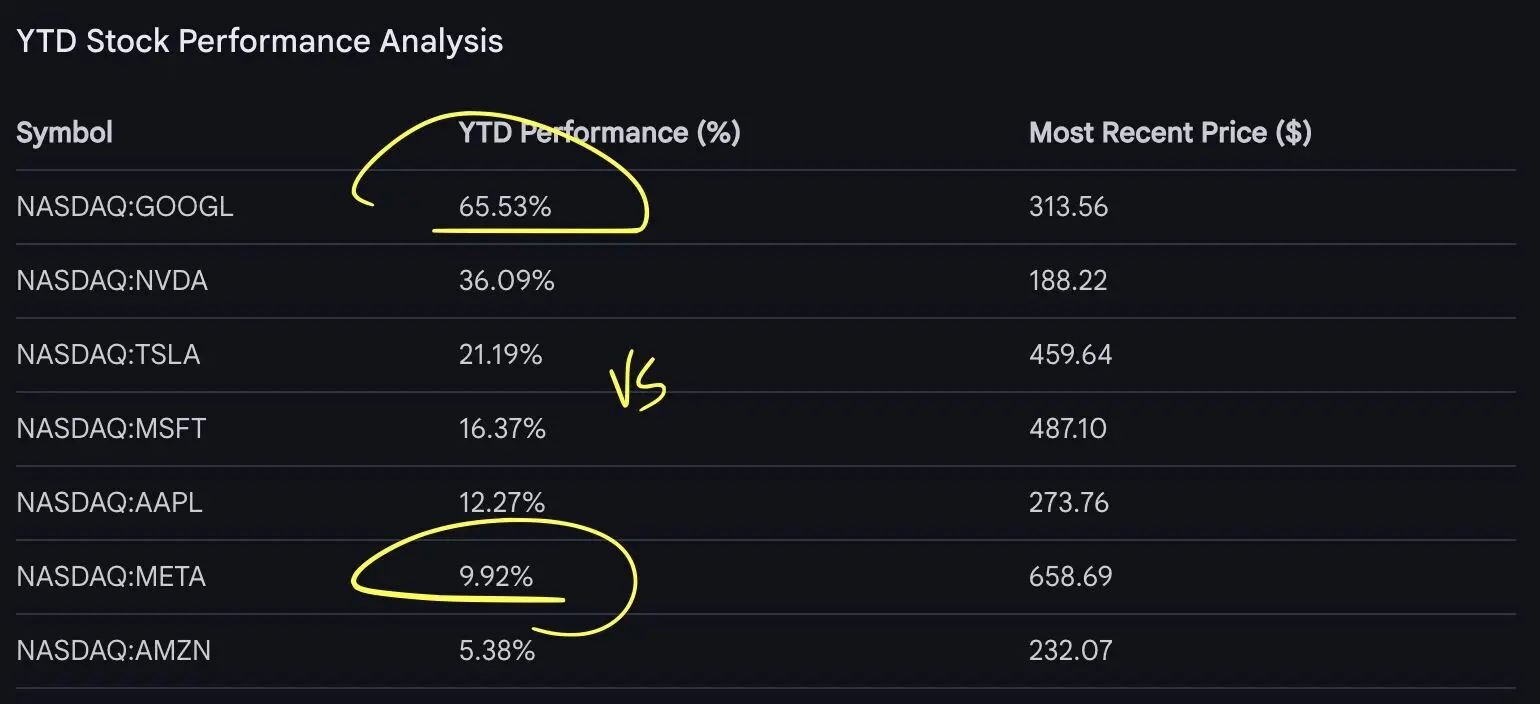
Google didn’t gain $350B in market value since their release of Gemini 3 Pro since Nov 18th by just building better models, they leveraged it in their 5 billion daily user network.
Meta just bet on the same lesson with their $2B acquisition of Manus AI in order to pull them out of being the second lowest performing Mag 7 Stock YTD.
If they just wanted another AI hype acquisition, they already have models and if they wanted hype, there were louder startups to buy.
Manus was interesting for a different reason. While everyone else was chasing attention, they were busy making agents actually work. Meta noticed.
Meta already owns user access at a global scale with over +4B daily active users on: WhatsApp. Instagram. Facebook. Messenger. They know where people are, what they want, and when they want it. What they didn’t have was a clean way to turn that intent into useful action.
Google already showed how this works. They didn’t win by talking about Gemini. They won by embedding “do this for me” everywhere people already work.
- Beautify this slide
- Summarize this doc
- Calculate this sheet
Manus is an interface bet. A way to drop outcome-driven AI directly into the places billions of people already spend their time.
And that changes the question. It’s no longer: “Does this product use AI?”
It’s: “What can I get done without leaving where I already am?”
That’s a powerful distribution shift in one of the largest networks in the world.
And once AI is embedded where work is happening, the next question isn’t about interfaces.
It becomes about who is actually accountable for the result.
The Screen Era Is Ending. The Voice Era Is Beginning.
2026 will be the death of screens. And the rise of voice. Screens aren’t “the future” ... They’re a workaround.
A coping mechanism we’ve carried for 40 years because computers couldn’t do the most human thing:
listen → understand → respond → act.
So we built this entire civilization on: menus, tabs, forms, dashboards, “click here to do the thing.” That era is ending.
The interface is finally becoming conversation. OpenAI is literally reorganizing teams to overhaul audio… in preparation for an audio-first personal device. Not “better voice mode.”
A new front door. And when the front door changes, everything behind it changes too. Look at the pattern:
- Google is testing Audio Overviews for Search.
- Tesla is turning the car into a conversational assistant.
- Meta is turning your face into a directional listening device.
- Startups are building rings because the new “mouse” is your voice.
This is why I keep saying: Apps are about to disappear. Not because the software goes away. Because the software moves into the background and becomes capability.
In a voice-first world:
- onboarding dies
- “where do I click?” dies
- dashboards become an internal tool (not the product)
- the winning UX is: Did it get the outcome? Star Trek wasn’t predicting gadgets.
It was predicting the UI. Say what you want. The system does it. If your product still requires users to learn your interface… You’re about to get unbundled by someone who lets users speak.
Because once there’s nothing left to learn, the only thing left to notice is whether the work actually happened.
Outcomes are Everything
China just shipped the most dangerous SaaS competitor of 2026. A billing model. For 20+ years, SaaS was the same deal: Pay upfront → buy seats → pray adoption happens → hire people to get the outcome.
Now a publicly listed company in China (Bairong, Inc.) just flipped the contract: They’re selling AI Workers under OaaS (Outcomes-as-a-Service): Not “features.” Not “logins.” Not “copilots.”
Results. With accountability.
Each agent comes with:
- A role + job description
- KPIs (yes, revenue targets)
- Performance-based billing
And here’s the part every SaaS CEO should lose sleep over: If performance drops, the bill drops. If performance improves, the vendor earns more.
That’s not software... That’s labor. Under contract. They’re already claiming outcome numbers like:
- Recruiting cycle cut from 28 days → 2 days
- Sales/service conversion up +217%
- Professional services where agents handle 90% of high-frequency workThis is what I’ve been hammering on:
The SaaS era doesn’t end because of “rates” or “competition.” ... It ends because the risk moves:
- Old world: customer carries the risk (“hope our tool works for you”)
- New world: vendor carries the risk (“pay me when it works”)
So going into 2026: ... Vendors who are not able to price against results will struggle. The "Seat" is dead, the "Outcome" is everything.
At Atonom, we believe in the same philosophy and are betting our future on it.
Zoom Out
Here’s what all of this adds up to.
The seat was never the product. It just disguised the fact that humans were carrying the risk. Learning the tool. Driving adoption. Owning the outcome when things did not work.
That risk is starting to move.
First to agents that can actually run work. Then to vendors willing to price against results. And eventually to systems that are judged less by how impressive they sound and more by whether anything reliably happened without supervision.
This is not about hype cycles or feature launches. It is about accountability.
When software starts owning outcomes, it stops being something you use and starts being something you depend on. Most companies are not built for that shift yet.
But the ones that are will not need to explain it. It will just be obvious from the work getting done.
