

This week saw several crazy disruptions in the old way of doing things, and the fundamental undermining of incumbent players and approaches.
I believe this week's biggest shift was when Google released "TurboQuant," a breaking new AI memory compression technology that will reduce the amount of memory required to run LLMs by 6x. Its being dubbed Google’s "DeepSeek Moment” having wiped out $95B from the legacy memory incumbents in 24 hours. Just think about the implications.
This week also saw the declaration of the "AI Coding Boom" when Andrej Karpathy, the former co-founder of OpenAI and head of AI at Tesla, says he hasn’t typed a line of code since December. This vibe coding threat has absolutely decimated the legacy software companies that are down 30%+ over the last 6 months (eg: Microsoft -26%, Oracle -54%, Adobe -32%, ServiceNow -42%, Workday -44%).
Also, new research just released from TechRadar and Tropic confirms a massive structural shift in spending. Enterprise software budgets are up 58% year-over-year, but the money is moving from legacy SaaS at 8% to AI-Native tools (OpenAI, Anthropic, Cursor) seeing grow of 94%.
Interestingly, instead of "AI related" layoffs, this week OpenAI announced is doubling its workforce to 8,000 ... and in doing so kicked off the "AI Hiring Boom." The shift highlights new class of high-value jobs (with a 50%+ higher comp according to PwC) for the people who can actually deploy AI inside the enterprise.
All of these changes together show how this new "Era of AI" is accelerating the change in operating, working and growing. Companies and people that embrace the these approaches have a huge leg up, those who don't are finding the gap widening daily.
Google just had its "DeepSeek moment," and it just cost the memory industry $95 Billion in 24 hours.
This week Google released research on "TurboQuant," a new AI memory compression technology. The new approach is staggering: it will reduce the amount of memory required to run LLMs by 6x.
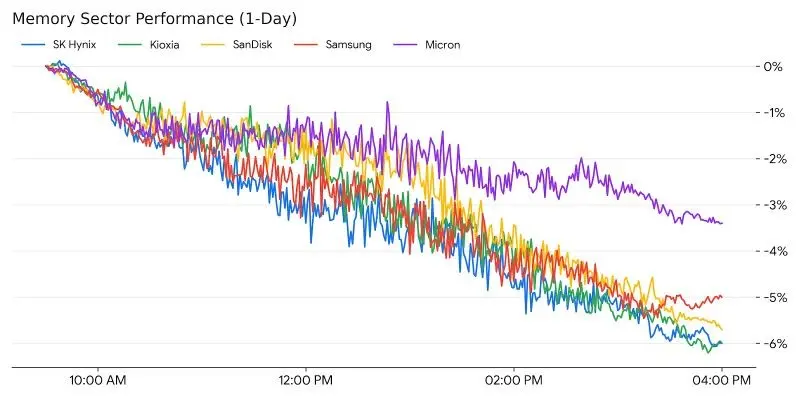
Matthew Prince, CEO of Cloudflare, called the research “Google’s DeepSeek.” He's right. Investors panicked, fearing this will crush the demand for AI memory chips.
Here is what yesterday's sell-off looked like:
- Samsung Semiconductor: down 5.0% ($40.8B lost)
- SK hynix: down 6.0% ($28.1B lost)
- Micron Technology: down 3.4% ($15.1B lost)
- SanDisk: down 5.7% ($6.0B lost)
- KIOXIA Group: down 6.0% ($4.8B lost)
Total value wiped out: $95 Billion. But the stock sell-off is actually the least interesting part of this story.
If tokens become 6x cheaper, the cost of running autonomous agents drops to near zero. You are no longer constrained by compute costs to run digital labor.
This accelerates the death of traditional, seat-based SaaS. When the underlying intelligence becomes this efficient, the companies that win will be the ones orchestrating the work and providing outcomes, not just selling software features.
AI is about to move into second gear. And the shift toward AI Cloud Employees is about to happen much faster than we realized.
$95B doesn’t get erased over a research paper unless the market believes a core assumption just broke. If the cost of intelligence is no longer a constraint, the next question isn’t about tools. It’s about how we build and consume software.
The Software Paradigm Shift and the AI Coding Boom
We are at the $1 bitcoin stage of an AI coding boom, and its destroying the legacy software industry. The best coders in the world are no longer coding. They are managing agents.
Andrej Karpathy (Former co-founder of OpenAI and head of AI at Tesla) says he hasn’t typed a line of code since December. Not because he stopped building. Because AI agents are now writing, testing, iterating, and even helping run parts of his physical environment.
Public investors have vetted this and are seeing the declines in the legacy software companies.
IGV, an EFT (Exchange-traded fund) that is one of the cleanest public baskets of software is down 30%+ over the last 6 months. Its biggest weights include: Microsoft, Palantir Technologies, Oracle, Salesforce, Palo Alto Networks, Intuit, AppLovin, CrowdStrike, Adobe, and ServiceNow.
This is not some weak corner of tech. This is the software establishment.
And several of the biggest names have already been hit hard over roughly the same six-month stretch:
- Microsoft -26%
- Oracle -54%
- Adobe -32%
- ServiceNow -42%
- Workday -44%
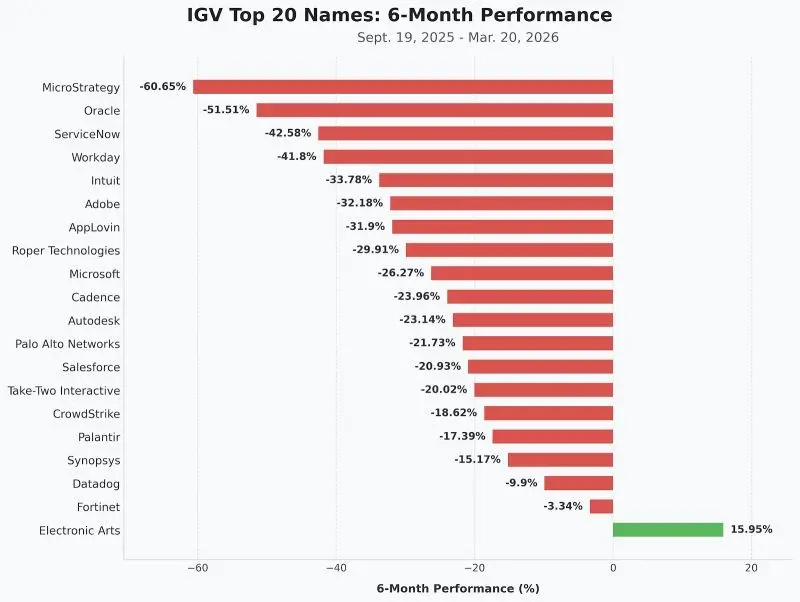
The market is not just repricing software stocks. It's a paradigm shift on how we build and consume software. The next giants won't be the apps with the most features. They will be the companies building the turnkey agents doing work and providing outcomes vs making more work for humans.
Most people still think this feels early, weird, and overhyped. That is just what February 9, 2011 felt like when bitcoin was worth $1.
As the software paradigm shift and the AI coding boom continue to destroy the legacy software industry, we are seeing seismic shifts in how companies price and fund technology.
The Great Budget Migration → AI-Native Budgets ... RIP Seats
The era of "AI as a feature" is over. We’ve entered the era of "AI as the line item".
New research from TechRadar and Tropic confirms a massive structural shift. Enterprise software budgets are up 58% year-over-year, but the money is moving to completely new winners.
We are experiencing the "Great Budget Migration." For 20 years, SaaS grew by selling "seats." You hired a person, you bought a license. That link is breaking.
- AI-Native tools (OpenAI, Anthropic, Cursor) saw spend grow 94% YoY.
- Primarily SaaS growth slowed to a crawl at 8%.
- SMBs actually cut legacy SaaS spend by -8% to fund AI.
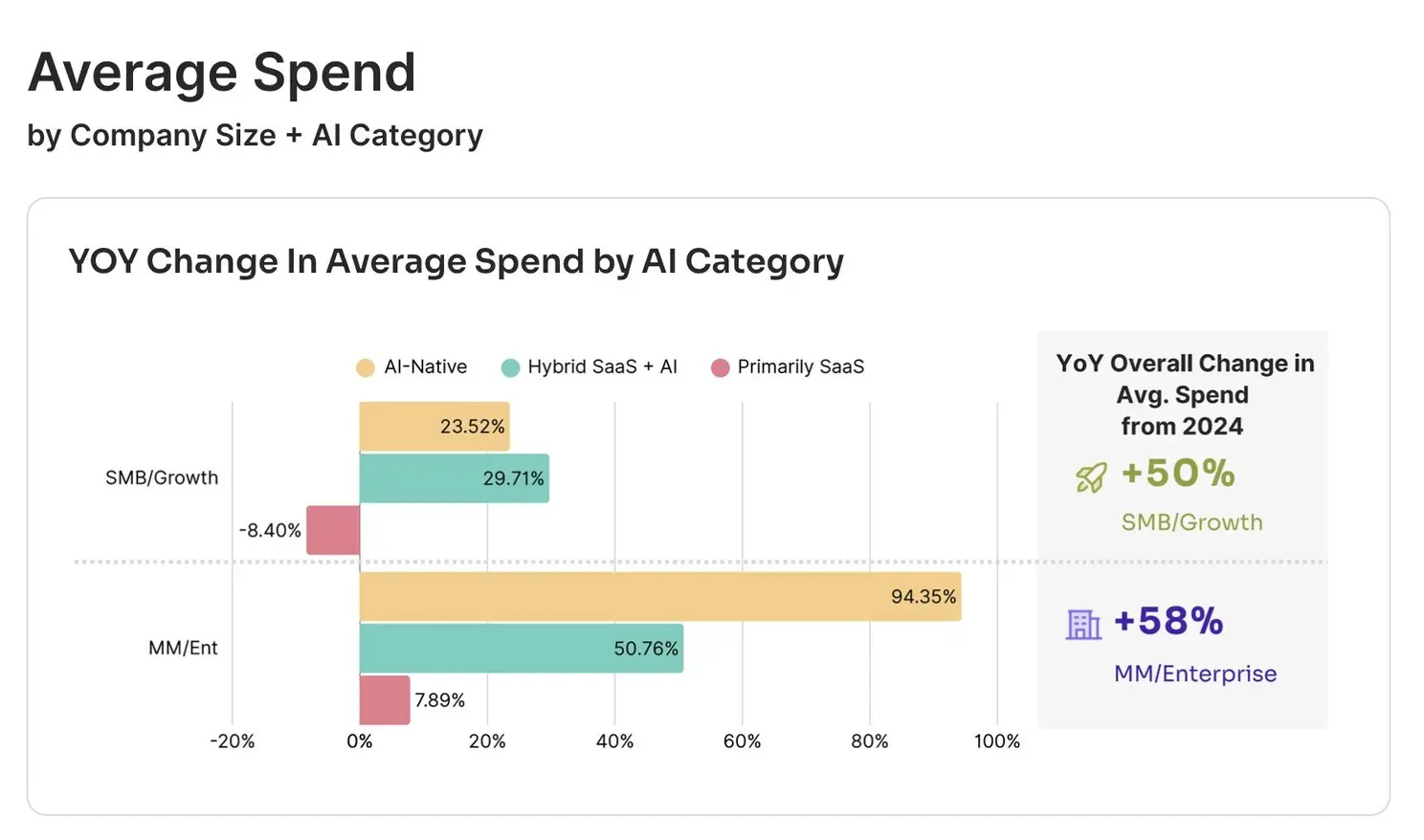
There is a fundamental "Value Crisis" for legacy software. Leaders aren't looking for more dashboards; they are looking to buy completed work (as seen in the absolute beatdown public SaaS companies have taken in the last 12 months).
1 - From Seats to Outcomes: When a tool like Cursor (up 4,300% in spend) allows one dev to do the work of three, the enterprise doesn't need more seats of legacy project management tools. They need API budget for the intelligence doing the heavy lifting.
2 - The "AI Tax" Resistance: Legacy vendors are adding 20–37% premiums for "AI features." But the data shows buyers are resisting. They’d rather pay for a "Cloud Employee" that does the work than a legacy tool that just "summarizes" it.
3 - Budget Re-platforming: This 58% jump isn't just growth, it's a reallocation. Companies are effectively moving labor budgets into their software budgets.
Software is no longer just a place where work happens. It is the thing doing the work.
When budgets move this fast, this isn’t a tooling decision anymore. You’re not buying software to support people. You’re replacing parts of the work those people used to do.
And once that starts happening, you rebuild teams around systems that do the work instead of people who manage it.
And thus the AI Hiring Boom Commences.
OpenAI is doubling its workforce to 8,000 ... The "AI Hiring Boom" is just starting.
For weeks, the story has been layoffs.
- Cuts.
- Reorgs.
- “AI efficiency.”
And yes, some of that is real. But a lot of it looked more like inefficiency layoffs, macro pressure, and struggling companies using AI as cover. Now the market is turning. Companies are rebuilding around AI capability.
And the new roles that are emerging tell the story:
- Forward-deployed engineers (FDE)
- AI agent architects
- Technical ambassadors
- Hybrid operators between research, software, and client delivery
PwC says workers with AI skills earn 56% more on average. Accenture and Microsoft are already formalizing this with a (FDE) forward-deployed engineering practice.
So yes, AI is eliminating some work. But it is also creating a new class of high-value jobs (with a 50%+ higher comp) for the people who can actually deploy it inside the enterprise.
This is not just a hot new tech cycle. It is the beginning of a whole new class of jobs, earning and wealth creation.
The Bottom Line: From Software to Outcomes
This week marked a definitive shift from the SaaS Era to the AI-Native Era. The old moats, like memory scarcity and per-seat licensing, are evaporating in real-time. Here is the high-level takeaway:
- The Hardware Shock: Google’s TurboQuant effectively "printed" $95B in virtual memory, breaking the scarcity model that legacy chipmakers relied on.
- The Software Collapse: As "vibe coding" goes mainstream, the "per-seat" model is dying. Legacy giants (MSFT, Oracle, Adobe) are down 30%+ as investors realize we no longer need licenses for people, we need APIs for labor.
- The Budget Migration: Enterprise spending is skyrocketing (+58%), but it’s fleeing old-school SaaS (+8% growth) for AI-native tools (+94% growth).
- The Rise of the AI Cloud Employee: The gap between winners and losers is widest here. Forward-thinking companies are moving past "AI as a feature" and toward platforms like us at Atonom. By deploying AI Cloud Employees for SDR, Support, and Recruiting roles, they get outcomes.
- The New Labor Opportunity: While legacy roles are being disrupted, OpenAI’s massive hiring spree proves that the AI Architect is the new high-value asset, commanding 50%+ higher salaries.
The Verdict: We have moved from software that supports work to software that does the work. The gap between those who embrace this and those who cling to legacy seats is now a canyon.
