
Every week I try to keep up with AI, and every week the story gets bigger.But this week felt different. The same pattern kept showing up everywhere I looked: in compute, in budgets, in how teams actually get work done, in creative tools, even in academia.
What’s happening is pretty simple. A new class of Compute Barons just took center stage. They control the instantaneous, programmable infrastructure that’s driving the fastest investment boom software has ever seen. And that surge in spending is blowing open the gap between companies that treat AI like a real workforce and those still running pilots on the side.
You can see the ripple effects everywhere. Big financial shifts. Legacy players making very specific bets. Generative creation becoming normal. And at the far end of it, real cracks forming in the systems we rely on to validate scientific truth.
The old world can’t keep up with the new speed. The next era won’t be about who has the “best model.” It’ll be about who owns the rails underneath and who’s willing to rebuild their organization around them. So let’s start with the part that sets everything else in motion: the rise of the new Compute Barons.
AI's New Barons
2025 is the year AI crowned a new set of Compute Barons. TIME called them “The Architects of AI.” That misses the point. These aren’t architects. They’re industrial barons, not unlike Gilded Age barons of the 1890s like Rockefeller, Carnegie, Morgan, Vanderbilt who built massive empires in oil, steel, railroads, and finance. Today is AI compute.
AI stopped being “tech.” It became the operating system for power, money, and work. A small group now controls the rails the global economy runs on.
- They moved markets with trillion-dollar infrastructure bets.
- They altered social and interpersonal dynamics.
- They carried U.S. GDP on their backs.
- They turned chips into geopolitical leverage.
- They reorganized labor before regulators even understood the model.
- They pushed into education, healthcare, and the emotional layer of society.
TIME captured the surface. The deeper story is the consolidation. We’re watching a new Carnegie/Rockefeller era form in real time. The resource isn’t steel or oil.
And this time the infrastructure is global, instantaneous, and programmable.
The Compute Barons are here. Their product is the future, and everyone else is downstream of it. The end of the article references Trump speaking directly to Jensen Huang (NVIDIA) with a laugh in September: “I don’t know what you’re doing here. I hope you’re right. ... I think we all hope he does."
And when a handful of players control the rails, the financial shift hits almost immediately. That’s exactly what we’re seeing right now.
The Fastest Reallocation in Software History
Enterprise AI just pulled off something no software category has ever done. And almost no one in IT, finance, or the boardroom is acting like it. $37B in Enterprise AI spend this year. Roughly 3x in twelve months. According to the Menlo Ventures study, no SaaS category in history has ever scaled anywhere near that fast.
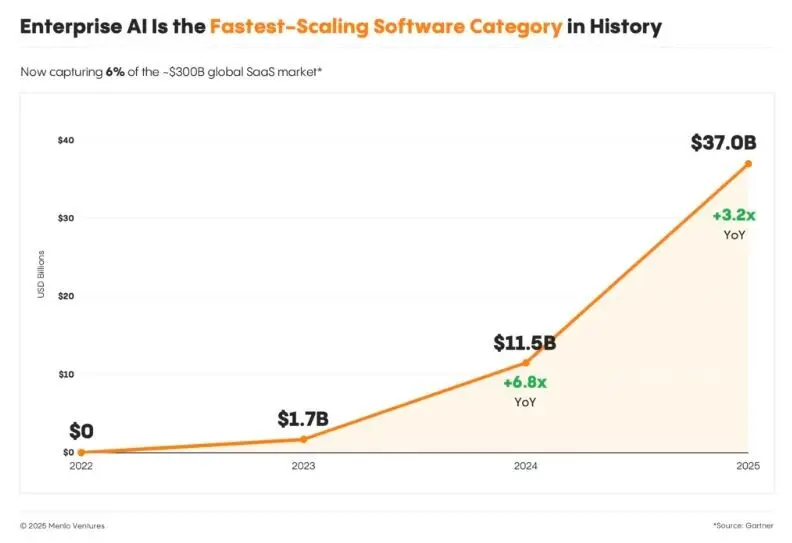
But the shape of the growth is the real story:
- Build-your-own is over.
- 76% of enterprise AI use cases are now bought, not built.
- The fantasy that every company will train its own models died quietly. Speed won.
- Startups own the value layer.
- AI-native startups now control 63% of the application layer.
- They ship workflows, not slideware.
- They don’t carry the integration debt that is crushing the Fortune 500.
- It’s a reallocation away from SaaS. Menlo is blunt. This isn’t a bubble.
- The dollars already moved. The workflows already reorganized.
- AI applications are becoming the new enterprise stack.
If you want to know where the next decade is going, stop watching the model leaderboard. Start watching the companies that can turn compute → workflows → outcomes. Outcomes as a Service (OaaS), that’s where the power is shifting.
And all that reallocation shows up in one place first: inside the enterprise. The gap between companies using AI as real labor and companies running pilots is opening fast.
The New AI Productivity Gap
OpenAI just published their "State of AI" study this week and people are screenshotting the “AI saves you 40–60 minutes a day.”
But, I don't think thats the interesting part of the report ...
The real story is the growing divide that is opening up between companies that hired AI as a workforce (Autonomous Enterprises) … and companies that positioned “AI” in a slide deck.
From OpenAI’s State of Enterprise AI 2025:
- 7M+ work seats 9× → AI is now headcount.
- Structured workflows 19× → 20% of usage is process, not chat.
- Reasoning use 320× → AI is deciding, not just typing.
- Frontier workers 6× more messages → AI on every task.
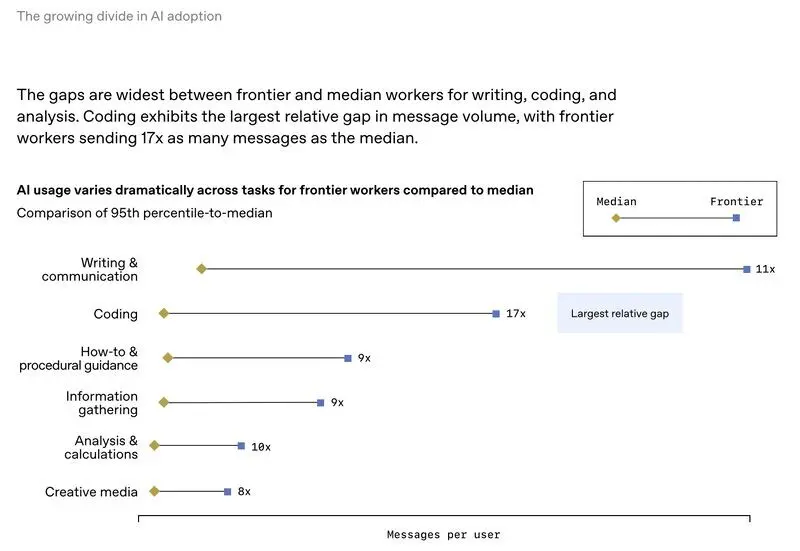
"The gaps are widest between frontier and median workers for writing, coding, and analysis."
Here’s what this actually looks like inside companies:
Typical company:
- They turned on one chatbot.
- They ran one training.
- Told people: “Play with it when you have time.”
- AI sits in a browser tab nobody really depends on.
Autonomous Enterprise:
- AI is plugged into daily work across sales, marketing, support, HR, finance.
- Repeated tasks run through AI workflows, not one-off prompts.
- Teams plan work assuming “Cloud Employees” carry a real share of the load.
Same tools. Same models. Completely different businesses in 24 months.
Here’s the scary part: If your “AI strategy” is a pilot, a press release, and a presentation … you’re basically helping your competitors train their AI team while yours sits on the bench.
Once you see how far the enterprise gap has opened, the next layer becomes impossible to ignore. If AI is the new workforce, who owns the infrastructure underneath it?
IBM is Following the Infrastructure Money
If you still think IBM is a boomer dividend stock, you’re behind on AI.
Everyone’s chasing NVIDIA, OpenAI, Anthropic. Meanwhile IBM just wrote an $11B all-cash check for Confluent and turned itself into one of the most interesting AI infra trades on the market.
Confluent isn’t a “nice to have” tool. It’s the real-time data backbone behind Kafka that powers banking transactions, clickstreams, and event data for modern AI systems. That’s not another “AI feature.” That’s an attempt to own the operating layer for enterprise AI.
And while most of the market still treats IBM like background noise, the numbers say something very different:
- 2015–2018: ugly years, multiple drawdowns, IBM looked like dead money
- 2019–2023: slow rebuild, mostly positive, double-digit gains in key years
- 2024: +39.27%
- 2025 YTD: +43.70%
That’s not “safe income stock” behavior. That’s a rerate. Compare IBM's performance to the other SaaS royalty like Salesforce, HubSpot, Adobe, ServiceNow.
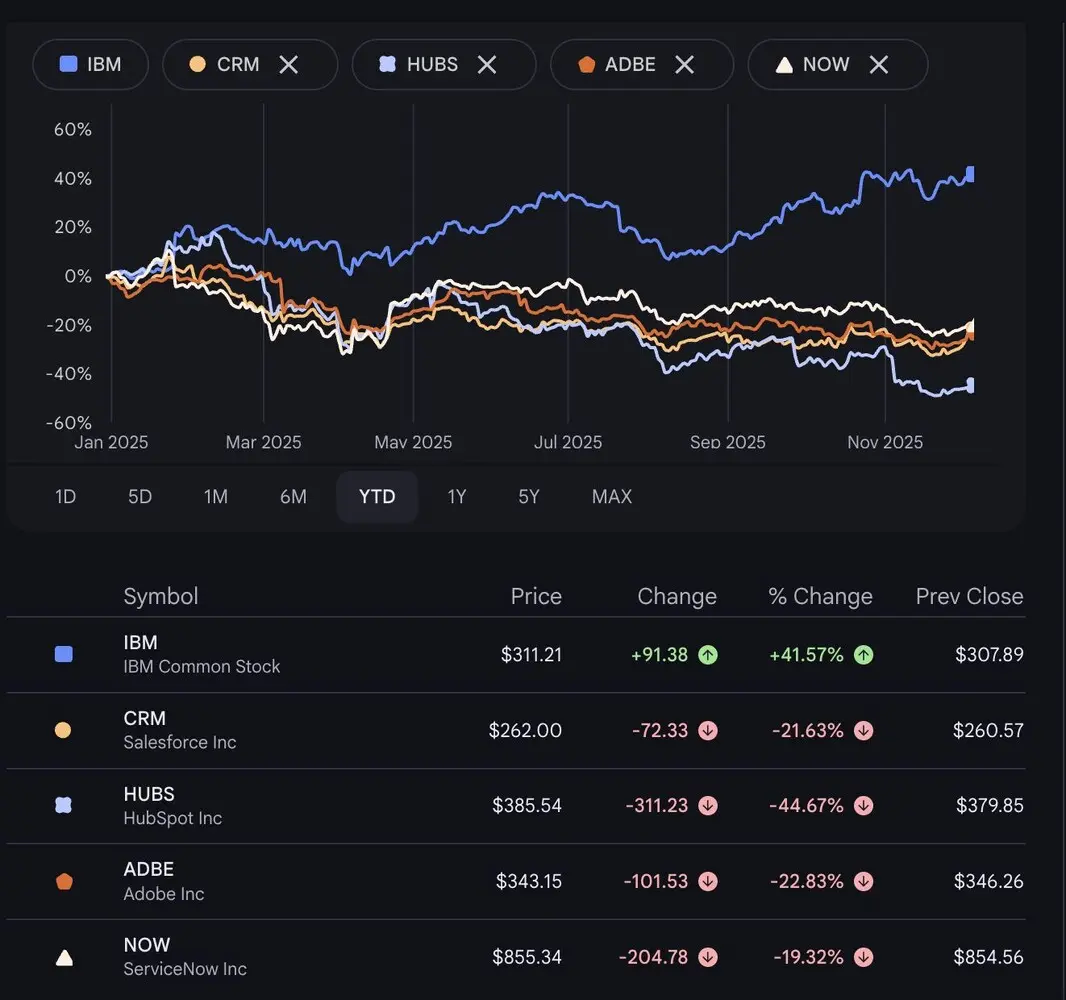
But here’s the uncomfortable part, if your AI watchlist is all shiny model names and zero “boring” infra names, you’re misreading where a lot of the value is accruing.
Everyone is chasing the shiny front-end of AI: chatbots, copilots, agents.
IBM is quietly trying to own the rails:
- From dashboards → to data streams
- From SaaS seats → to AI infrastructure
- From “log in and click around” → to “pipe in your data and let the agents work”
If AI agents and Cloud Employees are the new labor, IBM is betting it can own the plumbing they all run on. So the question isn’t: “Can IBM reinvent itself?” The real question is: Are we sleepwalking past one of the most important AI infrastructure plays in the market because the logo looks like 1985?
The commercial acceptance of AI is now undeniable. The clearest signal that this debate is over is from the most protective company in the world.
Disney Opened the AI Vault
The Walt Disney Company just did the one thing no one thought they’d ever do. They opened their IP vault to AI.
For decades, Disney has treated its characters as sacred assets. They sue first. They negotiate never. They protect that universe like Fort Knox.
So when Disney signs a 3-year deal with OpenAI, puts a billion dollars behind it, and lets Sora generate videos with Mickey, Moana, Iron Man, and Darth Vader : some people will call that a partnership. I see it as a surrender.
Not a surrender to OpenAI. A surrender to inevitability. AI isn’t a toy anymore. It’s how things get made now. It’s the engine behind the ideas and the way they reach the world.
When the most protective IP company on earth decides the future of storytelling runs through generative AI, the debate is over. Studios won’t be able to compete with this. They’ll either adapt or get left behind.
This is the moment Hollywood realized AI isn’t optional or the enemy anymore.
As commercial and creative value consolidates around compute, it becomes clear that AI is exposing the weak points in every system. But the deepest fault line may not be in the market or culture, but in the academic institution we rely on to establish foundational truth.
The Frightening Collapse of Peer Review
AI might have just broken the system we trusted to validate scientific progress.
Everyone’s obsessing over the kid, Kevin Zhu, the guy on LinkedIn bragging about publishing “100+ top conference papers in the past year,” “cited by OpenAI, Microsoft, Google, Stanford, MIT, Oxford and more.”
Now there’s a public back-and-forth between Zhu and Hany Farid, a Berkeley computer science professor, dissecting whether those papers are “real” or reviewable.
Wild story. Wrong focus.
The real story is this: the governor that kept scientific progress rigorous and sane, peer review, might have just collapsed under AI-level volume and hype.
For a century, peer review acted like a governor on an engine:
- Slow the process
- Validate the quality
- Check the research
It was designed to protect the foundation we use to build academic (and human) progress. That governor is breaking.
Submissions have exploded. Reviewers are drowning. Conferences are approving papers no human had time to actually evaluate.
- NeurIPS took in over 21,000 papers this year, up from under 10,000 in 2020.
- ICLR saw a 70%+ jump to nearly 20,000 submissions in just one year.
This isn’t a scandal. It’s a structural failure. When throughput spikes and filters collapse, slop doesn’t get caught. Bad or shallow research slips through, becomes “infrastructure,” and gets ingested into the next generation of models and papers. Error compounds.
That’s the real risk. And honestly, it is a pretty frightening.
Earlier this week I argued that AI isn’t destroying the university, it’s exposing how broken the system already was. But here’s the twist: in this case, AI isn’t just exposing weak safeguards in academia, it’s actively overwhelming them.
If peer review can’t keep up, what exactly are we trusting when we say “the research shows…” in an AI era?
Zoom Out
When you step back from all of this, the pattern is pretty hard to miss. AI is now operating at machine throughput, and most of the systems around it are still built for human throughput. That mismatch is showing up everywhere at once.
You can see it in the power shift toward the Compute Barons. You can see it in the money rushing into new infrastructure. You can see it in the gap opening inside companies. You can see it in the way creative work is changing. And you can definitely see it in the strain on the institutions we rely on to tell us what’s true.
That tension creates a handful of real problems: a power problem, a financial problem, and a trust problem. None of them get solved by another model release or some clever prompt tricks.
The next few years are going to come down to who treats this moment as an architectural rewrite instead of a feature upgrade. AI isn’t slowing down to match the old systems. And if you wait for the old systems to catch up, you’re going to find out they never will.
