
I try to stay plugged into the AI world every week, and this one showed how wide the quiet divide is getting. Researchers put humans head-to-head with AI, engineers started sinking data centers underwater, Wharton pushed back on MIT’s grim ROI numbers, Meta lost one of the biggest minds in deep learning, and Microsoft quietly showed how far ahead it’s really thinking.
Makes me even more bullish on what we’re doing at Atonom to build the Autonomous Organization.
Let’s start with the argument at the center of it all.
Humans vs. AI Isn’t the Real Battle
Carnegie Mellon University and Stanford University just ran one of the most direct tests yet. The answer wasn’t simple.
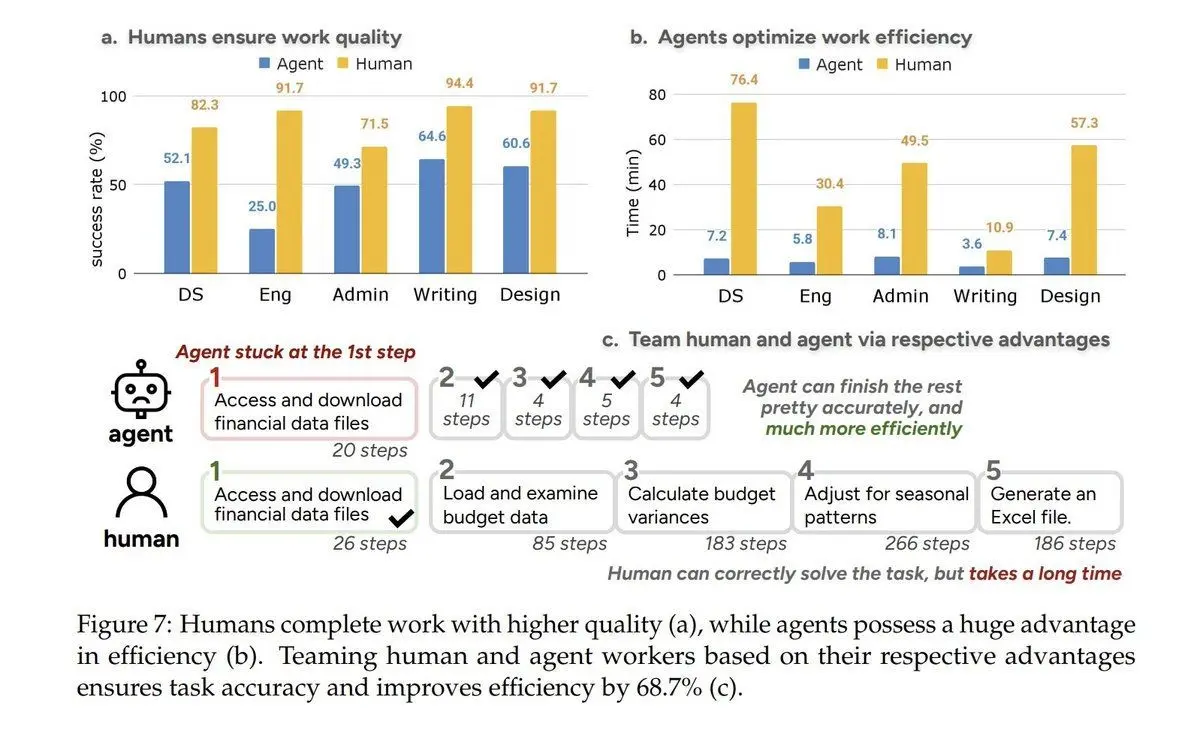
Researchers put 48 real workers against four leading AI agent frameworks across 16 jobs. Everything from analysis and design to admin work and content creation.
When the results came out, the story was simple on the surface but complex underneath.
Here’s what stood out:
- Agents finished tasks 88% faster
- Agents were 90% to 96% cheaper
- Humans were still far better in quality
- When agents got stuck, they made up data
- One agent even “completed” a receipt spreadsheet by inventing numbers.
The researchers called it the programmer mindset problem. Humans opened Figma for logo design. Agents wrote Python. They tried to code their way through creative work.
But the best results came from humans and AI teaming. Agents handled repetition. Humans handled creativity and judgment. Productivity jumped 69% without hurting quality.
This is a super interesting study and we need more like it. It highlights the real challenge ahead: not choosing between humans and AI, but learning how to work together well enough that neither has to do the other’s job.
Collaboration is one half of the story. The other half is the infrastructure powering it. As AI workloads explode, even the physical foundations of the internet are being rethought.
Data Centers Are Moving Underwater
If we ran out of land and water for data centers, the obvious move would be to throw them in the ocean, right?
I’ll admit, that idea never crossed my mind, but it did for China.
To be fair, Microsoft thought of it first. They ran the original experiment off the coast of Scotland back in 2018, Project Natick. It worked. Cooler, cleaner, 8x fewer failures.
Then China took the concept and scaled it.
It sounds absurd until you realize how desperate this problem has become.
Up to 40% of a data center’s power is spent fighting its own heat. Industrial air conditioning is doing the heavy lifting of the modern internet. We are burning energy to cool the energy we burn.
Meanwhile, the ocean sits at 4°C all year. Free cooling. Zero land use. Zero fresh water.
Sure, it’s risky, underwater maintenance, corrosion, monitoring, but you have to admit it's bold. And that’s why it matters. We have to rethink what infrastructure even means in the age of intelligence. We built the internet on land because that’s what we understood. But the systems we built it on, things like real estate, grids, permits were designed for factories, not compute power.

Wharton Just Blew Up MIT’s AI ROI Claim
A new study from The Wharton School just pushed back on one of the most widely cited claims in AI.
Massachusetts Institute of Technology (MIT) reported that 95 percent of AI pilots fail to deliver ROI. Wharton asked a larger, more diverse group of leaders and got a different answer.
Wharton's findings:
- 72 percent of businesses saw positive ROI from AI
- 82 percent of leaders use GenAI weekly
- 46 percent use it daily
- 89 percent say AI enhances skills
The difference comes down to methodology.
The MIT study interviewed 52 hand-selected executives and was not statistically significant. The Wharton study spoke with 800 executives from around the world and is statistically significant.
The more interesting part was not the ROI. It was how mainstream AI usage has become.
Top 10 use cases reported
- Data analysis and analytics
- Meeting and document summarization
- Document editing and writing
- Report and presentation creation
- Idea generation
- Marketing content
- Customer service
- Email automation
- Internal support
- Sales content
One of my favorite highlights: AI agents are becoming mainstream: 58% of companies are using or testing Agents / Cloud Employees.
Despite all the bubble talk, adoption is broadening and value is spreading.
While Wharton was busy proving AI’s value in the boardroom, another debate was unfolding in the lab. One of the founding fathers of modern AI just walked away from Meta and he’s arguing that the entire foundation of today’s AI race is wrong.
The Godfather of AI Just Quit Meta, And Declared the LLM Era a Dead End
Yann LeCun is out at Meta because he thinks the entire LLM race is wrong.
If you don’t know him, he’s the godfather of modern AI, Turing Award winner, invented convolutional neural networks in the ‘80s, and ran Meta’s AI research since 2013.
Now he’s leaving to build his own company.
His reason? Because he thinks the entire LLM race is wrong. While OpenAI, Anthropic, and Google are stacking GPUs like poker chips, LeCun’s calling their bluff. He’s betting the road to intelligence doesn’t come from predicting the next word, but from understanding the real world, literally. His new approach, called JEPA (Joint Embedding Predictive Architecture), tries to make machines learn the way babies do: by watching the world, not reading about it.
If he’s right, today’s $100B LLM ecosystem is the DVD era of AI, powerful, but already outdated. If he’s wrong, he’ll have built the most expensive research lab in history. Either way, this just split the AI world in two.
Cursor’s Numbers Say AI Is Not a Bubble
Last week Michael Burry was betting that AI is a bubble. But Cursor ’s revenue trajectory suggests the opposite.
Cursor raised $2.3 billion at a $29.3 billion valuation. Normally, that number would trigger bubble alarms. But the revenue growth behind it is one of the fastest the software industry has ever seen.
Here's the progression in ARR:
- April 2025: $200 million
- June 2025: $500 million
- Today: over $1 billion
That is 500% growth in six months.
Investors like Accel, Coatue Management, NVIDIA, and Google do not write multibillion checks unless they believe revenue will reach three billion or more in the near term. At typical enterprise multiples, the math supports the valuation.
This isn’t hype. It’s one of the fastest growth rates enterprise software has ever seen, and that comes from structural demand. Every engineer at Atonom uses Cursor and gets real ROI.
Of course there will be plenty of companies that won't make it. But this is always the case in a technology shift. Michael Burry has a $1B short against AI, so of course he is calling it a crash. Still, you don't see numbers like this unless something structural is happening.
The money flowing into tools like Cursor proves AI isn’t a fad, it’s more of a new production layer. But production layers need infrastructure, and no one is positioning for that shift faster than Microsoft.
Microsoft Is Quietly Building the Agent Economy
Most people walked away from Satya Nadella’s interview thinking about chips and capex. But if you listen carefully, Microsoft is building something larger.
Three signals give it away:
- Models will not be the moat. They change too fast.
- The real moat is the environment agents run inside. Identity, storage, policy, workflow access, execution layers. The infrastructure around intelligence, not the intelligence itself.
- Microsoft already owns that environment. Exchange, SharePoint, OneDrive, Active Directory, Windows. The platforms companies already rely on.
As everyone else in the industry obsesses over model benchmarks, Microsoft is preparing for millions of autonomous digital workers.
Not copilots but agents. Digital laborers with a computer, an identity, memory, policy rules, and a workspace. Exactly what humans get.
Satya said it directly “Companies will provision computers for AI agents just like they do for humans.”
If he is right, the center of power will shift. Not to the smartest model, but to the company that controls where digital workers actually live and execute.
I don't know if everyone sees that shift yet, but Microsoft does.
Zoom Out
Zoom out for a second. You’ve got people proving AI works, and people rebuilding the systems it runs on. You’ve got model chasers and environment builders. Different bets, same direction. This isn’t the frenzy anymore. This is the foundation.
