
The headlines this week are about stock prices and “code reds,” but the real shift isn’t in the news cycle. It’s in the operating system underneath the economy. Everywhere you look, the old model is giving out. You can see it in the classroom where AI now outperforms the assignments. You can see it in supply chains that reorganize the moment intelligent automation shows up. You see it in SaaS earnings where infrastructure players accelerate and traditional apps struggle to keep pace.
The change isn’t happening at the edges. It’s happening in the architecture of the work itself. Systems built for human throughput are being rebuilt around machine throughput, and the pressure is rising across every industry. If you want the clearest look at what happens when the friction finally disappears, you won’t find it in a lab or a data center. You’ll find it in a field in Phoenix.
The One-Person Farm Is the Future of Work
What happens when AI turns the hardest job in farming into a one-person task? In Phoenix, a single operator with an iPad now does the work twenty people used to do on their hands and knees. The farm brought in Carbon Robotics’ LaserWeeder, and the most brutal task in agriculture flipped overnight. It scans the soil, identifies weeds, and vaporizes them with a laser. No fatigue and no delays, just throughput.
Agriculture didn’t adopt this because it loves new tech. It adopted it because the old model failed. It was too slow, too costly, and too fragile. When the economics break, the work changes.
Here’s how it always plays out:
- Automate the pain point
- The system reorganizes
- Workers move up the stack
- The old model dies quietly
Farming hit this point because the pressure was physical and unavoidable. When a job becomes too slow, too costly, and too hard on the people doing it, the system has no choice but to change. That same pressure already exists inside every modern company, it’s just hiding behind email, approvals, and coordination layers instead of heat and hard labor.
If one operator can do the work of twenty in a field, what happens when every team gets the equivalent of a LaserWeeder for their workflows, their data, and their decisions? The story isn’t about farms. It’s about the end of the old work model. Once AI takes the hard part, you don’t optimize the system, you rebuild it.
Once you understand what happened on that farm, you can see the same pressure everywhere else, especially in the model race everyone thinks still matters.
The Real Code Red Isn’t the Model Race
OpenAI just declared “code red” as Google closes the gap. Everyone’s treating it like the model race is heating up again. But that’s the wrong takeaway.
The model race is ending and the operational race is beginning.
We’re past the point where a few extra benchmark points decide winners. The future is something more fundamental, which companies can actually deploy AI into the bloodstream of their business.
Google catching up doesn’t threaten OpenAI’s models. It threatens the illusion that models are the bottleneck. The real bottleneck is inside enterprises. Most firms still can’t run a single agent end to end. Workflows are brittle. Data is fragmented. Org charts are built for email, not autonomy.
And while the labs are shipping weekly, the Fortune 100 is still supporting their AI strategy with slide decks and pilots. I think that’s the real code red. To win, OpenAI can’t just ship models. They have to turn compute into workflows, workflows into agents, and agents into outcomes.
If the real constraint is operational, not model performance, the market is going to reward the companies solving the constraint. That’s exactly what we’re seeing in earnings.
The Market Is Betting on Infrastructure, Not Features
Did Salesforce just prove Wall Street is done paying for “AI features”? Salesforce just reported $1.4B in AI ARR. Solid growth. Real customers. Real usage.
But look at the scoreboard this year:
- Salesforce (CRM): Down 30% YTD
- Oracle: Up 30% YTD
- Alphabet (GOOGL): Up 60–70% YTD
Same AI cycle. Totally different outcomes.
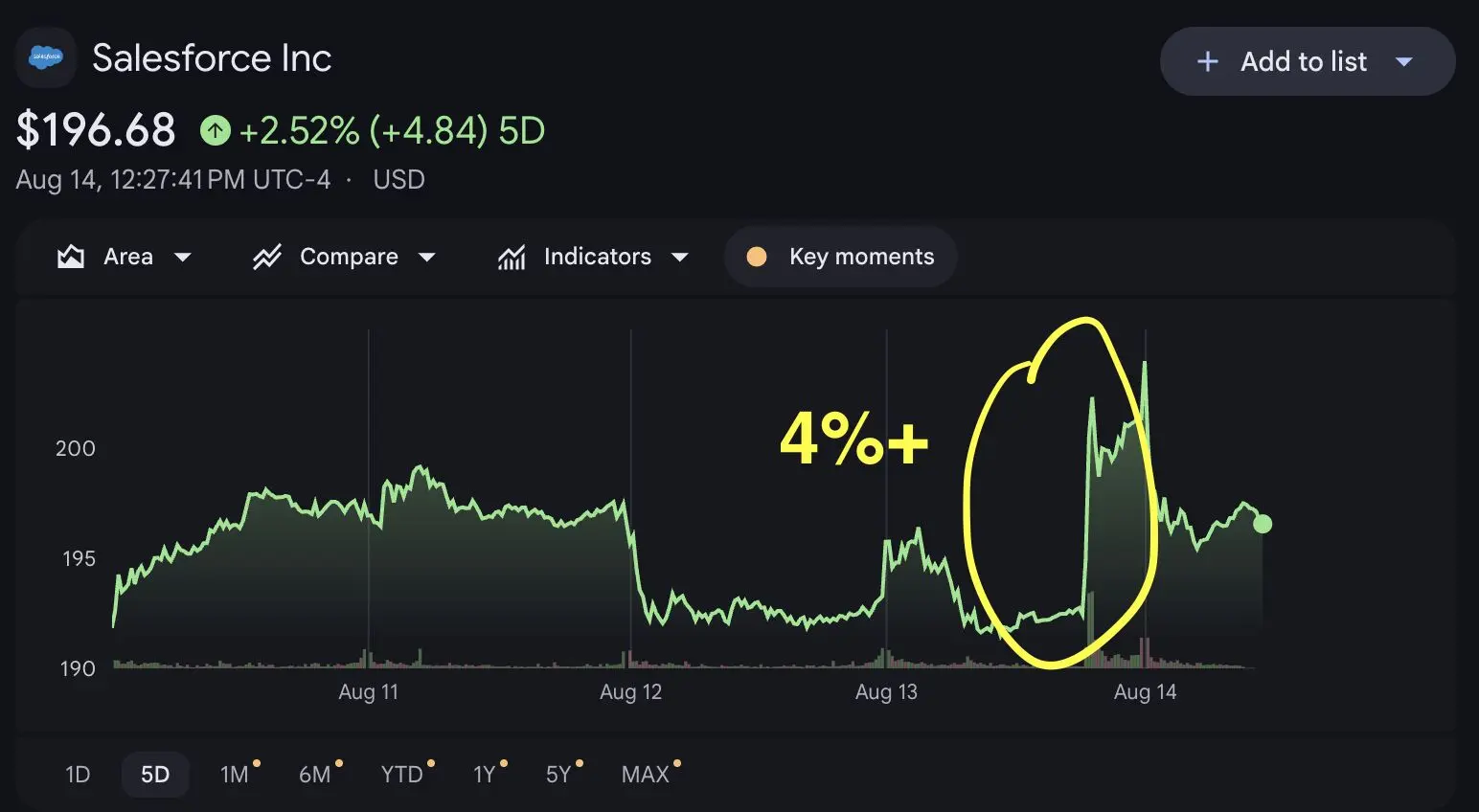
This is the tell: The market is starting to price AI infrastructure and operating systems, not SaaS with AI stickers. AI features are the new UI redesign. Infra is the new product.
1. Google rebuilt the stack
Google didn’t “add AI features.” They’re turning into AI infra:
- TPUs and massive data-center spend
- Gemini wired into Search, Workspace, Android, Cloud, Dev
They basically told investors: “We are the AI stack.” The stock chart says Wall Street believes them.
2. Oracle bought the mine
Oracle went from ’90s ERP to AI arms dealer:
- Tens of billions committed to GPUs and data centers
- Giant long-term cloud / AI commitments booked
That’s not “we have AI in our product.” ... That’s “we own part of the AI factory.” Result: stock up, multiple supported, narrative upgraded.
3. Salesforce upgraded the app
Salesforce’s move is different:
- Agentforce + Data 360 inside Sales & Service Cloud
- Acquisitions like Informatica to make AI easier on existing CRM data
- A legit $1.4B AI ARR engine growing triple digits
For customers, it’s perfect: “Don’t rip anything out. Turn on AI inside the CRM you already live in.” For investors, it still looks like: “CRM with better features.” And that’s why you can have:
- Strong AI numbers
- Higher guidance …and a stock still down ~30% YTD.
- Great business. Serious AI revenue.
But until it convinces the market it’s more than “CRM with AI,” it’s going to trade like … CRM with AI. So where do you put Salesforce today ... in the “AI infra” bucket or still in “SaaS with AI features”? Could we be on the verge of a AI breakout from them?
If Wall Street is rewarding the companies that own the AI infrastructure, then the next move is obvious. Even the firms that bet on alternate realities are now racing back to build the real one. Starting with Meta.
Meta Leaves the Metaverse
Meta is becoming less... meta. Mark Zuckerberg is quietly unwinding the metaverse bet to pay for the AI bet.
Remember, they literally rebranded Facebook to Meta because we were all supposed to live our personal and business lives in VR. Instead, they’re now planning to cut up to 30% of their metaverse group in 2026.
So now the money is moving:
- $70–72B in 2025 into AI data centers, chips, and infrastructure, with more than $600B committed to US infrastructure and jobs by 2028.
- Poached Apple’s top interface designer, Alan Dye, for hardware, software, and AI across Ray-Bans, glasses, and whatever comes next.
- The stock? Up 3–4% on the news. Wall Street is basically saying, “Thanks for turning the money pit into an AI factory.”
Same company. Completely different focus. Meta is now admitting that AI is the business, VR is the experiment. We are still in the first inning of the AI disruption, this is just another organizational shift to try to survive, and even thrive in the new AI era. 2026 will be littered with legacy SaaS carnage and AI winners ...
But Meta’s shift exposes a bigger problem. You can spend billions on AI infrastructure, but if the country you’re building in slows you down, you lose the race anyway.
The Cost of American Friction
Everyone keeps saying America is winning the AI race. But the signals tell a little different story ...
NBC News reported that a surprising number of U.S. startups are now building on free Chinese open-weight models. Not testing them, not tinkering, but building real products on them because the economics are impossible to ignore. At the same time, Google’s own CEO, Sundar Pichai is on national TV warning that America’s fragmented AI laws make it harder for U.S. companies to compete globally.
Two signals. Same direction.
Startups are choosing speed and affordability. China is providing both. U.S. regulation is adding friction. China is removing it. This isn’t about geopolitics. It’s about competitiveness. AI is becoming the operating system of every SaaS company. And right now the U.S. stack is expensive, difficult, and buried under conflicting rules. Meanwhile, Chinese models are cheap, open, customizable, and moving at a pace the Valley can’t ignore.
If the U.S. tech ecosystem wants to keep the lead, the answer isn’t fear. It’s friction ... Remove it. If we want to stay in first place, we have to make building faster, cheaper, and more flexible than anywhere else.
If friction is slowing down U.S. competitiveness, you don’t have to look far to see where it starts. The education system is running the same broken playbook.
AI Didn’t Break the University. It Exposed It.
AI isn’t destroying the university. It’s exposing it.
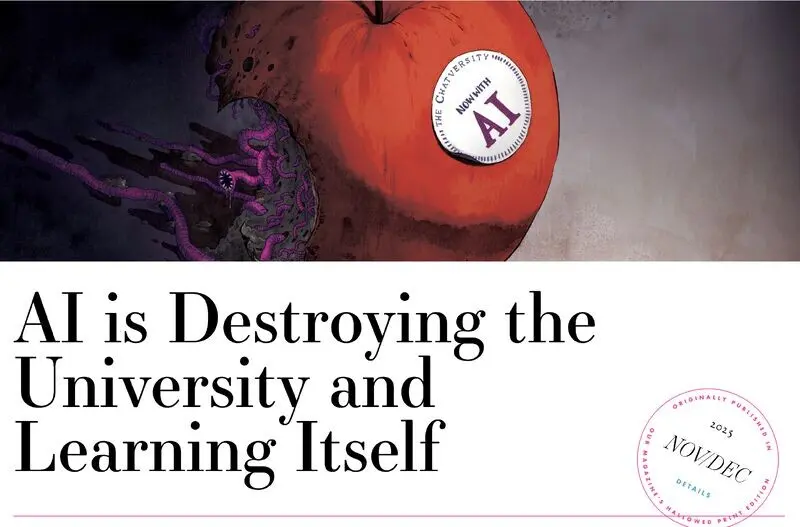
The Current Affairs piece on “AI destroying the university” is worth reading. Not because it proves AI is dangerous, but because it shows how hollow the current educational model already is.
- Students use AI to write papers
- Professors use AI to write slides and grade
- Admins cut budgets and buy shiny tools
- Vendors call it “innovation”
- Everyone pretends learning is happening
AI didn’t break that system. It just turned the lights on.
And students aren’t lazy. They’re rational. For years we’ve told them:
- Your GPA is your future
- Admissions, scholarships, internships all run on the same score
- One bad grade can cost you the “right” job or grad school
So of course they’ll use whatever tools they can. If the game is points, you play for points. When education is a badge, not a process, “cheating” stops looking like a moral failure and starts looking like strategy and risk management. Society and universities built that environment long before AI showed up.
- If a student can outsource the whole assignment to ChatGPT, that says more about the assignment than the student.
- If a professor can outsource lectures to a model, that says more about the class design than the professor.
- If leadership thinks a campus-wide AI license = “innovation,” that tells you where the priorities moved.
Blaming AI misses the point. We turned education into a badge-collection game and then got shocked when everyone started speed-running it, ... and especially now with AI. Keeping AI out of the classroom is the wrong fight. The real question is: What kind of learning AI can’t imitate in the first place?
- Apprenticeship on real, live problems and projects
- Writing where your own voice and stakes are visible
- Work that ships into the world, not just collecting badges
Judgment, experience and creativity, … not just output In that world, AI isn’t a shortcut. It’s a force multiplier. It handles the boilerplate so humans can spend more time thinking, building, creating, and arguing about things that actually matter.
Universities won’t stay relevant by rolling out campus-branded chatbots and calling themselves “AI empowered.” They’ll stay relevant by rebuilding around the one thing a model can’t own:
The formation of human reasoning and judgment.
AI isn’t destroying real education. It’s revealing how much of what we called “education” was just GPA farming.
Zoom Out
Look across all these stories and the pattern is the same. AI isn’t accelerating the old system. It’s exposing it.
- The one-person farm shows what happens when the work finally breaks.
- The model race shows that compute isn’t the constraint anymore.
- Wall Street shows that features don’t matter, infrastructure does.
- Meta shows that even the giants are being pulled back to reality.
- And the U.S. friction problem shows how fast we can lose our lead.
- The university shows how shallow our institutions have become.
Different domains, same signal. When AI removes the hard part, the system has to be rebuilt. The next era won’t reward labor. It will reward judgment.
