
Every week, I track what’s happening across AI, the stories that signal where work, value, and technology are heading. A few shifts stood out this week: the economy is splitting in two, compute is leaving Earth’s atmosphere, and BCG just mapped the GTM playbook for the Autonomous Era. And somewhere between those extremes, Michael Burry is betting it all comes crashing down.
Let’s start on the ground, with the data that shows just how fast the economy itself is splitting.
Two Economies Are Forming
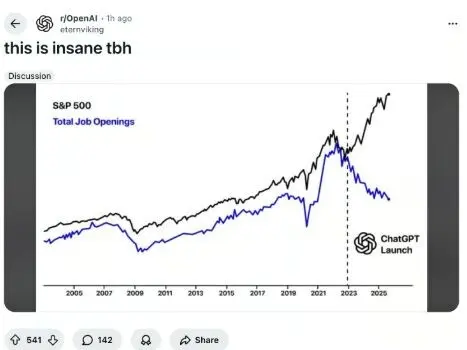
This chart went viral on Reddit last week. It shows the S&P 500 rocketing up while total job openings tank right after OpenAI's ChatGPT launched. At first glance, it looks like AI killed jobs and made investors rich. But that’s not quite the story.
Here’s the breakdown:
- Job openings actually started falling in early 2022, right when the Fed hiked rates eleven times.
- Big tech over-hired during COVID and then corrected.
- Meanwhile, AI stocks (NVIDIA, Microsoft, Meta, etc.) carried 75% of the S&P’s gains.
So, yeah, the chart looks like AI is eating the economy. But the truth is monetary policy crushed hiring and AI probably saved the markets.
Still, the split is real, and maybe even historic as there are clearly two economies forming:
- One built on compute and code
- One built on... everything else.
And if that gap keeps stretching, winning and working will start to mean two very different things. As markets divide here on Earth, the infrastructure powering them is literally leaving the planet.
The Solar Compute Economy
Google just announced Project Suncatcher, AI data centers in space. I actually laughed when I read it. The cloud was a metaphor. Now it’s literal. Here’s what’s actually happening:
AI has hit the limits of Earth. Data centers already consume more power than some countries. We can’t keep scaling compute inside the same physical and economic constraints that built the last decade of cloud.
So Google is moving the cloud off-planet. When I first read it, it caught me off guard. But the logic is both brutal and brilliant:
- The Sun produces 100 trillion times more energy than humanity consumes.
- In orbit, solar panels are 8x more productive and never see night.
- Optical links move data between satellites at 1.6 terabits per second.
If launch costs drop below $200/kg, as SpaceX is already projecting, then the economics beat terrestrial data centers on both cost and sustainability.
Think about what that means:
- AI training that never stops.
- No grid constraints.
- No data throttling.
- A compute fabric that literally lives above the planet.
By 2027, Google and Planet will test the first two prototypes. By 2030, if it works, the world’s largest cloud companies won’t be competing for land or power anymore, they’ll be competing for orbit.
The GTM Playbook of the Autonomous Era
Boston Consulting Group (BCG) just dropped a vision of 2035 that every sales leader needs to hear. BCG Managing Partner Phillip Andersen paints a future where agentic AI redefines the entire go-to-market motion:
Your best rep in 2035? AI. But they'll still report to a human. AI Cloud Employees will handle prospecting, outreach, negotiation, and even personalized support at scale. No more skipping the long tail. No more “we don’t have bandwidth.”
Every customer becomes reachable. But the real unlock isn’t automation... It’s augmentation.
“The seller of the future isn’t the artist painting the deal from scratch. They’re the orchestrator leading a team of digital workers.”
Key takeaways:
- Sales will scale like code, but trust still requires human leadership.
- Entry-level reps won’t vanish, they’ll train with AI, learn faster, and grow faster.
- Sellers become managers of digital teammates, not just deal-closers.
- Customer delight is the true goal, and AI makes it affordable at every tier.
BCG’s takeaway? Don’t wait. Start now: Invest in clean data, train reps to lead AI, and pilot agentic workflows early.
The AI Bubble Bet
Michael Burry thinks AI is a bubble. Is he right, or just early?
He built his name calling the 2008 crash before anyone else saw it. Now he’s betting against NVIDIA and Palantir Technologies, two companies that have come to represent the AI boom. His fund just disclosed over $1B in put options on both.
The Case He's Right: NVIDIA’s revenue may have doubled, but its market cap has increased tenfold. AI shows up in nearly every investor pitch, often as a feature, not a foundation.
The Case He's Wrong: AI is no longer a concept. It’s become infrastructure. It’s embedded in hardware, in software, and in the way work gets done. NVIDIA’s growth isn’t just narrative, it’s mathematical.
This moment doesn’t feel like Pets.com. It feels more like 2005, when the hype faded and the real builders took over. Bubbles don’t end the story. They strip out the noise.
The world’s splitting... economies, infrastructure, and strategy. Some companies are floating data centers in orbit. Others are still fighting for headcount. Call it what you want: a boom or a bubble, either way, the next economy is already here.
