
Every week I watch smart people chase the wrong things. Here is a pattern I keep seeing. Someone tells a great story, everyone believes it, and then reality shows up and ruins everything. The hire that changes nothing. The AI platform that has to buy what it already claimed to have. The marketer who thought sales was easy until day three.
This week every post follows the same arc. A confident narrative meets an uncomfortable truth. Sometimes it is funny. Sometimes it is a $4 billion punchline. Either way, the lesson is the same: what people say and what is actually happening are rarely the same thing.
Your Next Great Hire Won't Save You
Have you ever convinced yourself that your next hire was going to save you?
"Let's just hire someone experienced" "Let's bring in a proven leader" "Let's find someone who's done it before"
I've definitely been guilty of it. Then they show up and nothing changes.
The funny thing is, I don't even think it's usually their fault. I just don't think great companies are built by hiring experienced operators. They're built by creating systems where normal people can become great.
The best companies I've been part of had the beginnings of a machine. People walked into that environment and succeeded because the system helped them succeed. Then the great ones grew into something special.
So if the answer is not the perfect hire, what is it? Turns out it might be a system that includes AI. But probably not in the way you think.
AI Is Not Killing Jobs. It Is Creating Them.
AI-enabled companies are hiring MORE people, not less.
According to PwC's latest AI Jobs Barometer:
• Companies most exposed to AI grew headcount 52%
• Less AI-exposed companies grew headcount 36%
Interesting so the companies getting the most value from AI are expanding, not shrinking...I think most executives start with the question: "What jobs can AI eliminate?". That's a fair question but it's only half the question. The follow up should be: "What should those people be doing instead?"
Sounds like the best companies don't take productivity gains and stop there. They take the capacity AI creates and redeploy it into growth, customers, products, and new opportunities.
Here is a link to the release.
OK so AI is not replacing people, it is expanding teams. But if that is true, why does half the country still not trust it?
We All Say AI Is Dangerous. We All Use It Anyway.
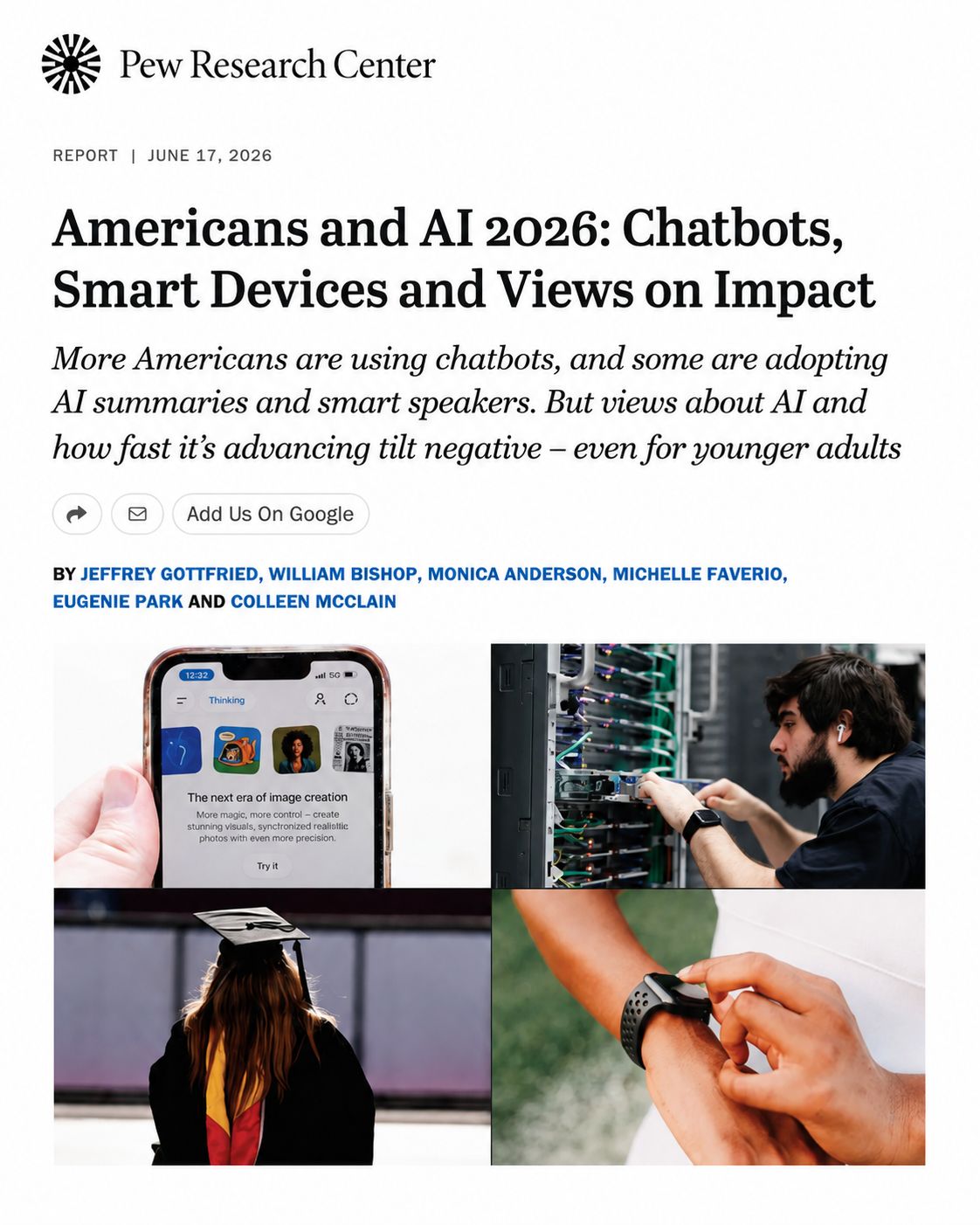
We're hypocrites. We say we don't trust AI, then use it anyway. New research from Pew Research Center found that almost half of Americans use AI tools now. And one out of every four people uses them every day.
At the same time:
- Most think AI is moving too fast
- Most think it'll make their data less secure
- More people think it'll hurt society than help it
We're basically treating AI like junk food. Everybody talks about how bad it is but nobody stops consuming it. It's super strange. Normally if people don't trust a technology, they avoid it.
Not AI.
- We complain about it on LinkedIn
- We warn our friends about it
- We tell everyone it's dangerous
- Then open it before our next meeting
Utility beats fear and the reality is AI has become to useful to ignore. People can say whatever they want in surveys but our behavior has already made the decision. The AI headlines are usually wrong.
So we do not trust it but we use it anyway. Now imagine being a billion dollar company selling AI you do not even have.
Salesforce Spent $4B Admitting Their AI Was Fake
Salesforce bought Intercom for $3.68B, proving Agentforce was a complete joke. Think about what just happened. Salesforce just spent billions to buy the exact capability they've spent the last two years telling everyone they already had.
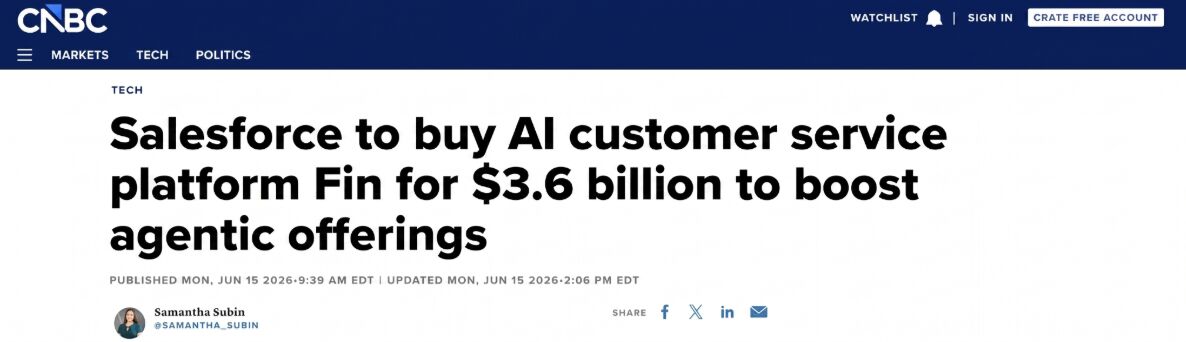
First it was Qualified for sales. Proof that if you slap enough AI buzzwords on a chatbot, someone will buy it. Now it's Intercom for support. Another chatbot company that couldn't get public, so it sold itself to the incumbent it was supposed to disrupt.
At some point you have to stop calling it a platform and start calling it a shopping spree. This is what happens when the demo works better than the product my friends.
It's like nobody is buying outcomes, they are buying stories. And Salesforce just told the biggest story in enterprise software:
"We built AI agents."
Then spent more than $4 billion buying a chatbot for sales and the chatbot for support they supposedly already had.
Buying stories instead of outcomes. People do this in every corner of business. Want proof? Hand a marketer a quota and watch what happens.
What Happens When a Marketer Gets a Quota
Most marketers secretly think sales is easy. (Not publicly, of course.)
But spend enough time around a marketing team and you'll hear some version of the same thing.
- Did sales follow up?
- Have they asked for the business yet?
- Why is this deal still open?
- How hard can it be to close a deal when the prospect is interested?
So let's run an experiment. Let's hand a marketer a quota and see what happens.
- DAY 1 "Easy. I'll just book some meetings." Learns that prospects don't wake up hoping for a discovery call. Sends a few emails. Gets ignored by everyone.
- DAY 2 Asks why SDRs don't personalize more. Spends three hours researching one account. Writes the perfect email. Receives no reply. Starts wondering if buyers actually read anything.
- DAY 3 Joins a discovery call. The prospect says they're interested. Leaves feeling great. Learns afterward that "interested" is sales code for absolutely nothing.
- DAY 7 The prospect goes dark. The marketer follows up. Then again. Then again. Then again.
- Discovers that most of sales is professionally bothering people who told you they were interested.
- DAY 10 Reads a LinkedIn post about social selling. Walks into the office and announces: We should just use LinkedIn more." Learns the top rep has already sent thousands of messages, built relationships for years, and still gets ghosted daily. There is no secret script.
- DAY 14 The prospect finally responds. "We love this. Just need budget approval." The marketer moves the deal to Commit. Legal gets involved. Procurement gets involved. Security gets involved. The deal moves to next year. The marketer finally understands enterprise sales.
- DAY 15 The CEO asks: "How is sales going?" The marketer replies: "We've got lots of interest." The sales team starts laughing.
Two weeks earlier, sales looked easy. Two weeks later, they had a newfound respect for every rep carrying a quota. Funny how every job looks simple until you're responsible for the outcome.
Every job looks simple until you are responsible for the outcome. Turns out that includes managing AI.
The Fastest Growing Job in Tech Is Not What You Expected
The fastest growing job in AI is... the AI Babysitter.
I came across an article where a developer said AI agents are basically toddlers.
- They need constant supervision
- They ask endless follow-up questions
- They require detailed instructions
- And if you leave them unattended for too long, they make a giant mess.
What's funny is that we were told AI would replace workers. Instead, people are spending their days managing them.
I asked Claude what to do about this. It apologized, gave me a 9-step framework, and asked if I wanted a template. Buddy, I don't need a framework, I need daycare.
Maybe the future of work isn't humans vs. AI. Maybe it's one human trying to keep 20 Cloud Employees from doing something stupid.
Great companies are not built by experienced operators. They are built by systems where normal people become great. And when AI creates capacity, the winners do not pocket the savings. They redeploy it into growth. And if the demo works better than the product, you do not have a product.
Also, every job looks simple until you are responsible for the outcome. And utility beats fear every single time.