

Wow. Okay here we go. It seems like the playbook most executives are running right now was written for a world that really no longer exists. Org charts, they feel more like status symbols these days. Headcount as proof of leadership? Nah, not really. And AI prototypes that wow everyone in the boardroom only to fall apart in the real world? There's a lot of that going around.
This week I've been thinking about what happens when reality catches up. Why some companies seem to be pulling away while others are stuck spinning their wheels. And why the winners usually aren't smarter, they're just moving faster.
Let's get into it.
The End of Headcount Flexing
Some leaders are addicted to headcount. That's about to become a big problem.
It's corporate vanity.
- "How many people are under you?"
- "What's your org size?"
- "How much budget do you control?"
We rewarded leaders for building bigger teams. But nobody cares anymore about how many people report to you. The market only cares about output.
The age of headcount flexing is over. Your sense of self and identity cannot come from the number of people who report to you.
You can't measure leadership by the size of their organization, you have to measure it by the value you create with the fewest resources possible.
The executives who've actually built with AI stop asking "why can't it just do this?" They start asking better questions. That's the only real cure for operational delusion.
Every CEO Thinks AI Is Easy Until They Try to Build It
Every CEO should spend one week building with AI before making an AI strategy decision. It would eliminate a lot of stupid delusions.
I was talking to a CEO the other day who told me: 'The distance from a convincing prototype to a scalable production platform is way bigger than I realized.'
That's the most honest thing I've heard about AI all year.
Like every CEO, he initially thought:
- Why can't AI just do this?
- Why don't we just build it ourselves?
- How hard can it be?
Then he opened Claude and started building. That's when reality punched him in the face.
- The demo works
- The integration doesn't
- The six-month project begins.
Nothing kills AI delusion faster than reality. After that, he said that the conversations changed. There was less hype, less panic, and better decisions.
I actually think the CEOs who have built with AI are often the most optimistic about its future. They're also the least naive about what it takes to get there.
When leaders stop focusing on headcount, they actually have to understand the technology they are trying to manage. When they refuse to get their hands dirty on the ground floor of execution, they fall face first into an expensive trap.
Just Because You Can Use AI Doesn't Mean You Should
Just because AI can do something doesn't mean it should.
ESPN has thousands of hours of NBA footage and decades of archived content.
And somehow they decided the best way to honor Tony Parker was to create an AI-generated version of him.

This is what happens when executives become obsessed with using AI instead of improving the business.
Not every process needs AI and not every human touchpoint should be replaced.
You have to be disciplined enough to know where NOT to use AI and right now, most organizations are automating things nobody asked them to automate.
True automation is not about building AI images to look cooler. It is about deploying AI to solve immediate, high-volume functional friction where absolute speed dictates the bottom line.
The Fastest Company Always Wins
It's crazy, everyone wants more leads but nobody is obsessed with responding to them faster.
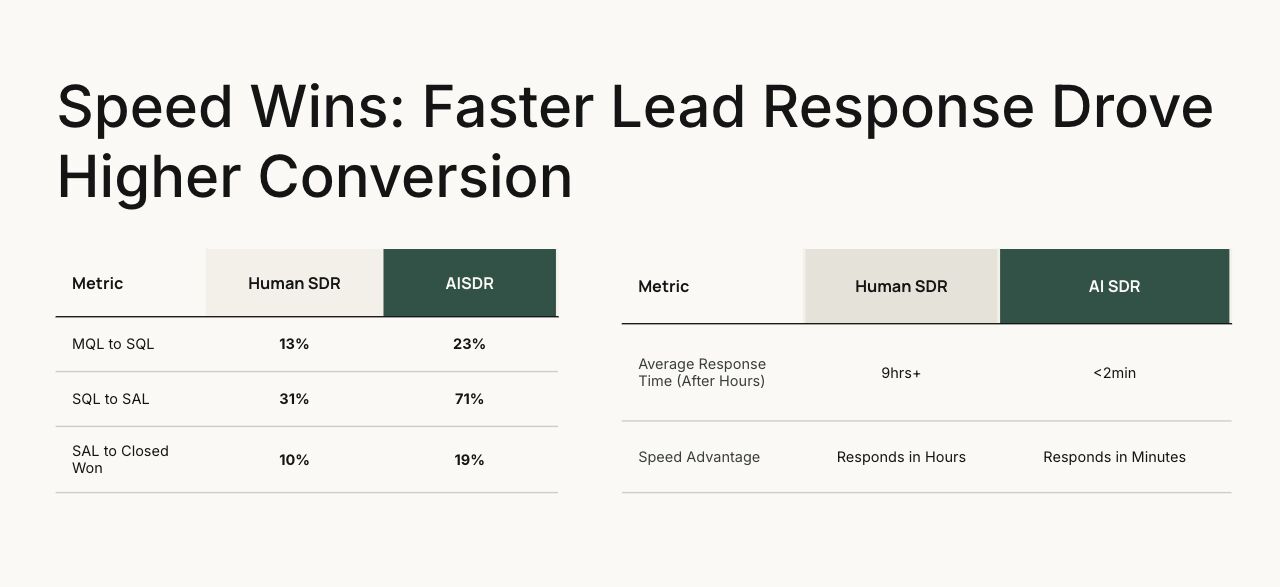
In a recent comparison between AI SDRs and Human SDRs, the biggest difference wasn't messaging, personalization, or qualification.
It was speed.
- AI SDR average response time: 2 minutes
- Human SDR average response time: 9 hours
What was the result? MQL-to-Meeting conversion increased 76%, meeting to conversion more than doubled, and close rates nearly doubled.
Think about that for a second.
- The prospect didn't suddenly become a better fit
- The offer didn't change
- The product didn't improve
We just showed up while the buyer was still paying attention. It's kind of crazy when you think about it. Most revenue teams spend months debating messaging, lead scoring, and campaign strategy while leads are literally sitting in a queue waiting for someone to respond.
The fastest company often wins, not because they're smarter, but because they showed up first.
Speed gets you in the room. What happens next is still a human problem.
Ghosting Isn't a Business Strategy
Everybody loves to complain about annoying sales reps. Fine.
- Some of them suck
- Some don't listen
- Some won't take a hint
I get it. But can we talk about the epidemic of grown adults who can't send a two-sentence email? You take a meeting, you seem interested, then you vanish. No update. Nothing.
Give me a break.
If you're not interested, say you're not interested. If the budget got cut, say the budget got cut. If you picked a competitor, say you picked a competitor.
Nobody cares. Sales reps aren't chasing you because they enjoy it. They're chasing you because you never gave them an answer.
You don't need a long explanation or to justify your decision. Just send a one-sentence email and let everyone get on with their lives.
The separation between companies winning the execution race and those drowning in their own noise comes down to a single choice. You are either using technology to escape your operational duties, or you are using it to scale your strategic impact. Winners are choosing value density over organization size, production capability over prototype hype, and instant execution over legacy manual queues.
Look at the data from this week. You cannot build a modern organization if your team takes nine hours to process a lead, your buyers are too scared to send a simple rejection email, and your leadership team is busy building tone-deaf digital deepfakes instead of fixing real functional friction. At Atonom, we see this line in the sand every single day. The era of comfortable corporate management is over.
The line is already drawn. On one side: organizations measuring themselves by layers, licenses, and internal metrics nobody outside cares about. On the other: operators who show up in two minutes, skip the vanity, and let output do the talking.
You don't need a bigger team. You need a cleaner system and the discipline to know where AI actually belongs.
Stop hiding behind the machine. Own the outcome.