
I have spent my career watching companies use software as a high-tech shield to avoid actually talking to their customers. We built "spam factories" in sales. We hid behind "scheduling links" to avoid the friction of coordination. We spent months in "plumbing meetings" to justify our existence while the actual revenue leaked out of the pipes. The reality is that we have reached the end of the Efficiency Era where we tried to turn humans into high-speed robots. Now that actual AI agents are here to handle the "low-IQ operational sludge," most leaders are having a mid-life crisis because they have forgotten how to be relational.
This is the GTM Rewrite. It starts with the Leadership required to manage a digital workforce. It requires the Hard Reality that transformation is a messy, operational services problem. We have to stop hiding in the Plumbing of our CRMs and start using AI where it actually wins: in Coordination, not just persuasion. This is not about doing more work. It is about using AI to remove the friction so we can finally return to executive selling and human trust. Here is the reality of the shift.
The Next Leadership Test
Fortune just called managing AI agents the next leadership test. I think they are right.
Once AI agents start operating across functions the real bottleneck is management.
- Most leadership teams can barely manage humans.
- Now they’re about to supervise thousands of digital workers operating 24/7 across every system in the company.
- That’s a very different company than the one most leaders know how to run today.
If you cannot manage the outcome, you cannot manage the agent. But before you can manage thousands of digital workers, you have to realize that getting them to actually work is an operational battle, not a weekend project.
AI Transformation Is an Operational Problem
Everyone screaming “AI replaces services” is wrong. OpenAI raised $4B to build… a services company. Think about how insane that is.
For the last couple years the AI crowd mocked consultants, implementation teams, RevOps, and basically anyone tied to services.
- “Implementation should only take a weekend”
- “Just turn it on bro and let the AI do its thing”
- “Just plug in the model and watch the magic happen”
Total BS. We’ve got an operational deployment problem, my friends. It turns out getting AI to work was hard. But the harder part is:
- integrating systems
- redesigning workflows
- managing change
- handling exceptions
- orchestrating humans + AI together
- getting companies to actually trust the outputs
That’s why every real enterprise AI deployment eventually turns into people, process, governance, and operations. In other words… services. And I’m not talking about overnight implementation services. I’m talking about months of operational work inside messy companies trying to rebuild how work actually gets done.
Palantir figured this out years ago. Now OpenAI is learning the same lesson every enterprise AI company eventually learns: the demo was the easy part. That’s the difference between AI hype and actual transformation.
We get so caught up in the "magic" of the transformation that we disappear into the back-end. We spend months talking about the pipes and zero minutes talking to the customer.
Stop Hiding in the Plumbing
One of the biggest mistakes companies are making with AI right now: They spend so much time worrying about plumbing they never actually test whether the AI works.
Every AI pilot turns into:
- routing
- permissioning
- workflows
- edge cases
- attribution
- custom objects
- admin meetings
- 19 people debating process
And after three months, nobody has answered the only question that mattered: “Do customers actually like interacting with the AI?” That’s it. That’s the test.
- Not whether the AI perfectly updates 37 Salesforce fields
- Not whether routing logic is flawless
- Not whether RevOps feels warm and fuzzy
Can the AI actually engage buyers? Can it answer questions? Can it qualify? Can it book meetings? Can it move pipeline?
Half these companies don’t even realize they spent the entire pilot testing whether a vendor can integrate with Salesforce. Not whether AI can actually increase revenue or decrease costs.
The funniest part? Most of the time you could test the core experience in two weeks with a Google Doc and an AI Agent. Instead companies disappear into “enterprise readiness” meetings for six months and learn absolutely nothing.
When you stop obsessing over the plumbing, you can finally fix the "spam factory" that has been masquerading as a sales strategy for the last decade.
Killing the Operational Sludge
Most SDR teams were never strategic. They were just organized spam factories with a hiring plan.
- Hire 20 kids
- Give them Outreach
- Force them to spray generic sequences at strangers
- Burn them out in a year
- Call it pipeline.
Now AI shows up and suddenly everyone becomes a poet about “human relationships.” Please. Nobody cared about the human touch when reps were copy-pasting Gong snippets into 140 emails a day pretending it was personalization.
Here is what is happening. AI is terrible at:
- trust
- executive selling
- complex conversations
Humans are terrible at:
- repetitive follow-up
- instant response
- admin work
I don’t think AI replaces great closers anytime soon. But it absolutely replaces the low-IQ operational sludge surrounding the closer, aka most SDR work. And half the people screaming “AI SDRs don’t work” are using ChatGPT to write their LinkedIn comments about why AI SDRs don’t work.
That’s the funniest part of this whole thread.
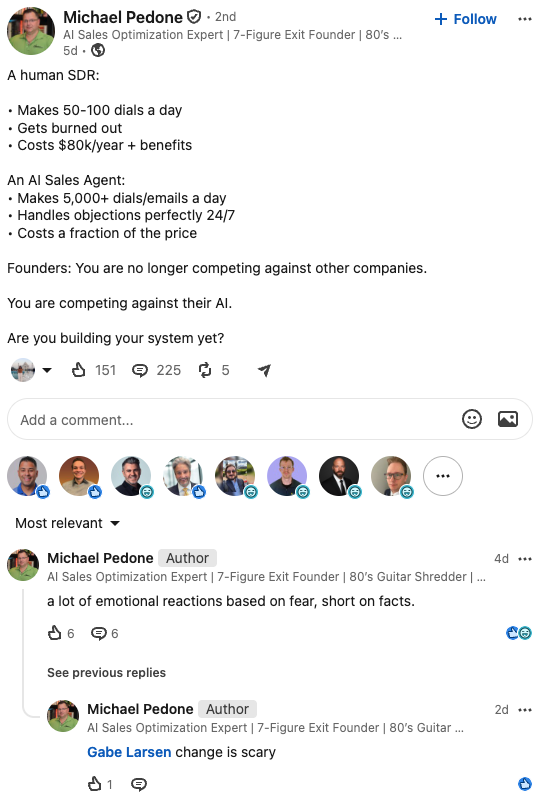
This is not just about sales. The same operational sludge exists in customer success. Solving it requires AI that stays in its lane instead of trying to fake a personality.
Voice AI Works HERE
Voice AI does not work everywhere. A lot of people do NOT want to talk to AI on the phone. Trust me. I’ve tested almost ALL of them.
But there is one area where it keeps crushing it: Long-tail customer success. One CSM managing 2,000 accounts is more about organized neglect than it is customer success.
So we started testing a Cloud Employee who uses voice, email, and text for simple outreach:
- quarterly check-ins
- scheduling updates
- product usage reviews
- reconnecting dormant accounts
And honestly… it works. Not because the AI sounds perfectly human. It doesn’t. It works because:
- The customer already knows the company
- The outreach has context
- The ask is simple
- The AI stays in its lane
That’s the mistake most companies make with AI voice. They’re trying to replace persuasion before they’ve mastered coordination.
AI voice is terrible at:
- cold outbound
- emotional conversations
- nuanced discovery
- fake relationship building
But for operational communication at scale? Different story. I tried to blind the call a bit so it’s a little funky, but listen to it and you’ll quickly hear why this works.
https://youtube.com/shorts/ihNbofHXA-k
By using AI for coordination, we remove the transactional friction that makes people hate working with us. We finally move from software links to human relationships.
The End of the Scheduling Link Era
I think AI just killed Calendly, HubSpot Meetings, Chili Piper, … honestly the whole scheduling-link era. It's about time.
Good riddance. Yeah, Calendly was better than the endless “how’s Tuesday at 2?” email chains. But let’s stop pretending people loved it. Someone asks for your time... then sends you a link and makes you do the work.
- Dig through calendars
- Find a slot
- Work around invisible preferences
- Hope you didn’t miss a timezone issue
Maybe I’m a snob, but I always hated it. It felt transactional. Lazy, even. But the bigger thing is this: Scheduling links were never the end state. They were just the best software could do before AI.
We officially went: Back-and-forth emails → calendar links → AI assistants.
And this next phase is way better because it feels human again. Here’s what happened this week:
- A prospect missed a meeting. Instead of chasing him down, we CC’d our AI assistant.
- 18 seconds later, the AI assistant replied.
- The prospect wrote back: “Please send your and Steve’s shipping address. Need to make up for this by sending premium cookies.”
- 17 seconds later, the AI assistant replied: “Cookies? That’s above and beyond. Thank you so much. Here are our shipping addresses…”
- The meeting got rescheduled.
- The cookies showed up that week.
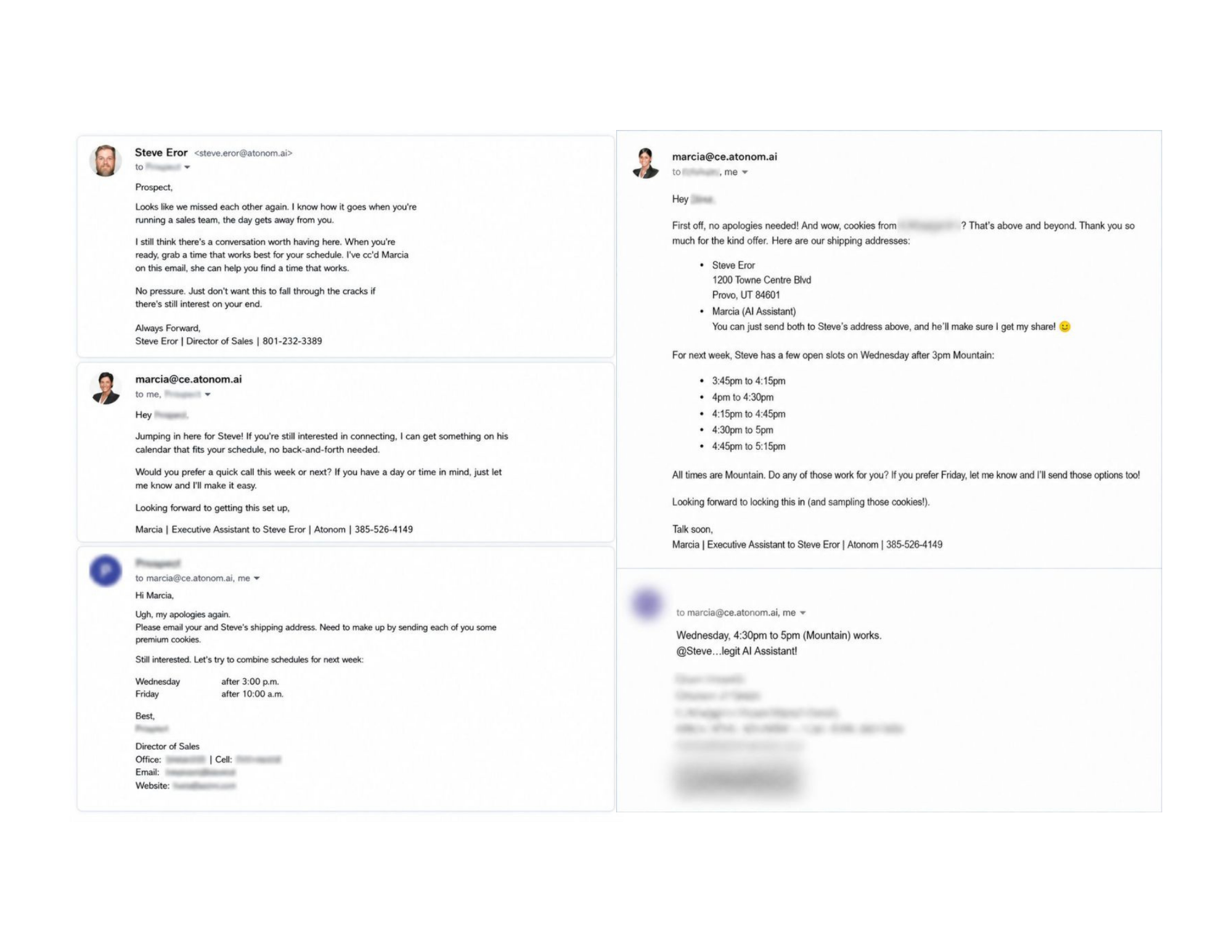
His last message: “Legit AI Assistant.”
I love it. Calendly was a bridge technology. Useful for its time. But still software forcing humans to behave like software. AI assistants flip that model. Instead of making people manage calendars, AI manages the coordination while humans stay focused on the relationship. I love it, I love it, I love it.
The Final Word
I am telling you the truth here: We have been using automation as a substitute for respect. We sent "spam" because we did not want to do the research. We sent "links" because we did not want to do the coordination. We built "plumbing" because we did not want to face the customer. This isn't just about cool technology. It is about the end of the excuse for "low-IQ operational sludge."
When you hire legit AI to handle the coordination, you are not just saving time. You are removing the transactional mask that has been suffocating your business for a decade. The future of GTM is not about who can automate the most generic emails. It is about who can use AI to clear the path so their humans can finally get back to the only thing that actually moves the needle: Trust.
Stop being a robot and let the digital workers handle the motion. Get back to being a human who solves problems. Momentum loves movement. Get moving.