
This week reminded me how often we solve the wrong problem.
Instead of fixing the foundation, we optimize around it. We use AI to improve grades instead of learning. We rewrite privacy policies instead of asking for permission. We buy more software instead of building a better product. We automate more work instead of fixing the process.
The symptom changes. The mistake doesn't.
Let's get into it.
A Students Become F Students When AI Stays Home
We are about to make the biggest hiring mistakes of our careers. A Brown University professor changed a final exam from take-home to in-person. The class average fell from a 96 to a 48.6.
How is that possible? One word: AI.
Turns out a lot of A students become F students when the AI stays home. We have confused using intelligence with having intelligence. Those are not the same thing.
We have no idea how to hire anymore.
- Degrees. AI helped earn it.
- GPAs. AI helped keep it.
- Resumes. AI definitely wrote it.
Maybe every interview should end the same way that final exam did. No AI. Now show me what you can actually do.
When you can no longer trust a resume, you have to look at how companies handle data trust too. Because right now, tech giants are learning that lesson the hard way.
HubSpot Changed Its Mind
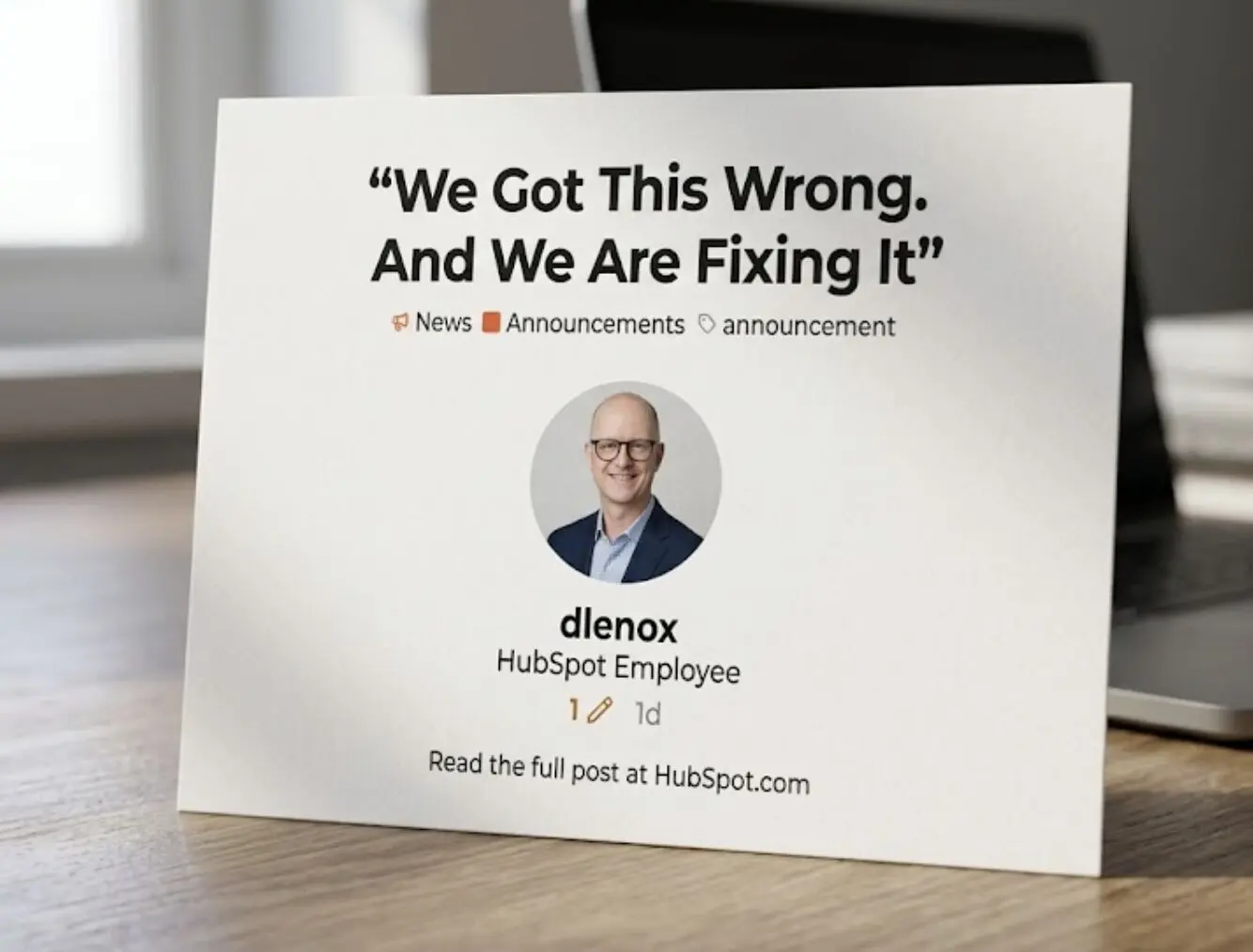
A few days ago I called out HubSpot after they told customers their data would be shared unless they opted out.
The post sparked a huge discussion. I expected HubSpot to defend the decision. Instead, they reversed course. Then co-founder Dharmesh Shah joined the conversation personally.
Good. More companies should do this.
But then I read the explanation:
"We should have communicated it better."
Guys... that is not why people were upset.
Nobody was sitting there thinking they needed another paragraph from legal. They were thinking, "Why wasn't I asked first?"
And that is exactly why every AI company should be paying attention. Every AI company wants the same thing:
- More data
- Better models
- Smarter enrichment
There is nothing wrong with that. Just ask first. It is not that hard.
Credit to HubSpot and Dharmesh Shah for listening and reversing course. Now let's make sure the rest of the SaaS industry learns this lesson before they have to write the same apology.
HubSpot fixed their trust issue, but other software companies are facing a different identity crisis. Instead of building trust, they are just building bloated feature lists.
Zoom's Strategy Sucks
Zoom's strategy is simple: Become the software equivalent of a Cheesecake Factory menu.
Am I wrong?
- First it was video meetings. Loved it.
- Then phone. Okay... I guess.
- Then contact center. Getting a little ambitious.
- Then docs. Wait, what?
- Then email. C'mon, bro.
- Now buyer intelligence. Apparently that required buying Common Room. You guys good over there?
What is next? Zoom HR, Zoom Payroll, and Zoom ERP?
At what point do you admit you are just building a mediocre version of everyone else's product? Pick a lane, my man.
Somewhere along the way, SaaS companies stopped trying to be the best. Now they are trying to be all of it. I bought Zoom because I needed video meetings. Not because I was hoping they would eventually compete with half my tech stack.
Bloated software tries to do everything, which leads to companies panic-buying features. We see this exact trap playing out in B2B sales operations every single day.
B2B Sales Is Drowning in Pretend Productivity
I went on John Barrows' Make It Happen Monday podcast to talk about the biggest sales trap of 2026.
Right now, B2B sales is drowning in pretend productivity.
We got sloppy during the SaaS golden age. Now that growth is hard again, companies are panic-buying AI. They slap a research bot onto a broken sales process and expect a miracle.
The hard truth is that saving a rep two hours a day is completely useless if they do not have the sales fundamentals to actually close a deal. If you want to stop burning cash and actually move the number, map the process first.
Automate the transactional while protecting the relational. Let your reps own the strategy, the trust-building, and the negotiations. Look past the hype and find the real ROI. Listen here.
If you fix the process, you stop worrying about how the work gets done. Because at the end of the day, consumers care about outcomes, not origin stories.
The Obsession With AI Authenticity
The people screaming that AI is not authentic do not seem to care that almost everything else they buy is manufactured.
- Nobody buys canned soup expecting Grandma to be in the back stirring the pot.
- Nobody stands in the Apple Store asking if the iPhone was handcrafted.
- Nobody gets upset that an elevator does not have an operator.
We stopped caring how things were made a long time ago. We care if they work. But the second AI writes an email, designs a logo, answers a customer, or drafts a presentation, people suddenly become art critics.
"It is not authentic."
Really?
If an AI customer service agent solves your problem in two minutes instead of making you wait on hold for 45, do you actually care? We have confused process with outcome. The obsession with AI authenticity feels like it is more about discomfort than reality.
- Factories replaced craftsmen.
- ATMs replaced bank tellers.
- Self-checkout replaced cashiers.
- GPS replaced paper maps.
In the end, people choose what works. They always have. AI will be no different. Five years from now, nobody will ask whether AI created it. They will ask one question: Did it work?
We can debate the nuances of AI all day long, but trying to explain this shifting reality to the next generation will remind you how ridiculous the corporate world sounds.
YouTuber or AI Employee?
Does anybody else's kids have absolutely no idea what they do for work?
I tried explaining my job to my 10-year-old.
Me: "I help companies hire AI employees."
Him: "So... you make people hire robots?"
Me: "No. They're not robots and I don't make them do anything."
Him: "Then why are they called AI employees?"
Fair point.
Me: "Well... they answer phones, reply to emails, schedule meetings, do research..."
Him: "So... they're robots."
Me: "No."
Him: "Then why do you make all those videos?"
Me: "So companies understand how AI employees can help their business."
He stared at me for about five seconds.
Him: "So you're basically a YouTuber?"
Me: "...No."
Another pause.
Him: "Oh... so you work at ChatGPT?"
At that point I gave up. If I cannot explain my own job to a 10-year-old, who eats ketchup with a spoon, maybe I do not actually know what I do either.
The Reality Check
This week's stories all point to the same problem. We're getting really good at optimizing around broken foundations.
Students use AI to earn better grades instead of learning the material. Software companies add more features instead of building a better product. Sales teams buy more AI instead of fixing the process. Companies rewrite announcements instead of earning trust.
The technology isn't the problem. The shortcuts are. The companies that win won't be the ones with the biggest AI budget or the longest feature list. They'll be the ones willing to fix what's underneath before reaching for another tool.
AI can amplify a great system. It can't save a broken one.